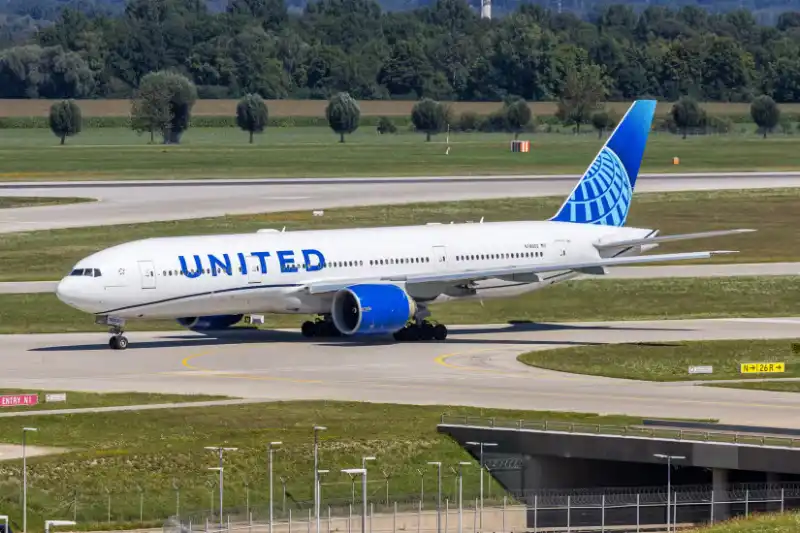
United Airlines has taken a significant step in the race to modernize in-flight connectivity, completing the first Starlink retrofit on a Boeing 777-200ER. The milestone places the Chicago-based carrier ahead of several major competitors in bringing next-generation satellite internet to long-haul international passengers, a market where reliable onboard connectivity has increasingly become a deciding factor for travelers.
The aircraft at the center of this development, registration N37018, recently completed its prototype Starlink installation at Rio de Janeiro–Galeão International Airport (GIG). According to United Airlines CEO Scott Kirby, the aircraft will now enter a period of certification and validation testing before the technology is approved for commercial service. While the jet is not yet scheduled for passenger operations, its successful modification marks the beginning of a much larger transformation across United’s international fleet.
For an airline operating one of the world’s largest long-haul networks, the introduction of Starlink on widebody aircraft represents more than a technology upgrade. It is a strategic investment designed to improve passenger experience, strengthen competitive positioning, and support United’s broader fleet modernization plans.
After years of industry promises surrounding faster onboard internet, United appears poised to become one of the first major global carriers to deploy Starlink extensively on long-range international routes.
Why The Boeing 777-200ER Was Chosen For The First Starlink Installation
United’s decision to begin with the Boeing 777-200ER fleet was not accidental. The airline selected 22 aircraft from this subfleet as the first group of long-haul jets to receive Starlink technology, creating a controlled environment for testing and operational experience before expanding the program.
These aircraft are powered by the highly capable General Electric GE90 engines, which are also used on United’s Boeing 777-300ER fleet. The commonality between the two aircraft variants simplifies future integration efforts and allows technical knowledge gained during the initial installations to be transferred efficiently.
The airline’s older Boeing 777-200 aircraft equipped with Pratt & Whitney PW4000 engines are not expected to receive Starlink upgrades. With retirement plans already underway for these aging jets, investing in extensive modifications would provide limited long-term value. Instead, United is focusing resources on aircraft that will remain core components of its international network for years to come.
This approach reflects a broader trend across the aviation industry, where airlines prioritize technology investments on aircraft with the longest remaining service lives.
Starlink’s Potential To Transform Long-Haul Passenger Experience
For travelers on international flights lasting ten, twelve, or even fifteen hours, internet connectivity is no longer viewed as a luxury. Business travelers expect uninterrupted access to email, collaboration platforms, and cloud services, while leisure passengers increasingly demand streaming-quality internet throughout their journey.
Starlink’s low-Earth-orbit satellite network offers several advantages over traditional geostationary satellite systems. Because the satellites orbit much closer to Earth, latency is significantly reduced, resulting in faster response times and a more seamless browsing experience.
Passengers can expect improvements in:
- Video conferencing performance
- Streaming capabilities
- Real-time messaging
- Cloud-based work applications
- General browsing speeds
The technology has already generated positive feedback on domestic routes where United has begun introducing Starlink-equipped aircraft. However, the real test lies in long-haul international operations, where passengers spend extended periods connected and place far greater demands on onboard networks.
Scott Kirby has emphasized that international routes represent the most exciting phase of the rollout, highlighting customer demand for enhanced connectivity on United’s longest flights.
United Gains An Early Advantage In The Airline Wi-Fi Competition
The global airline industry is rapidly moving toward a new era of high-speed onboard internet, but United currently appears to be moving faster than many of its largest rivals.
American Airlines has announced plans to begin Starlink installations on more than 500 Airbus narrowbody aircraft. However, that initiative is expected to begin during the first quarter of 2027, and the carrier has not yet revealed a comprehensive widebody deployment strategy.
Delta Air Lines has chosen a different path, partnering with Amazon to develop connectivity solutions integrated with its digital ecosystem. While ambitious, Delta’s rollout is not expected to begin until 2028, leaving a substantial window for competitors to establish leadership.
JetBlue is also pursuing next-generation satellite connectivity through Amazon-backed low-Earth-orbit technology. The airline already enjoys a strong reputation for complimentary onboard Wi-Fi, and its upcoming network enhancements could further strengthen that position.
Despite these developments, United’s active retrofit program on long-haul aircraft gives it a notable advantage in the near term, particularly among international travelers seeking consistent connectivity across global routes.
Alaska And Hawaiian Airlines Remain Strong Competitors
Although United is making headlines with its first widebody retrofit, Alaska Airlines and Hawaiian Airlines have already achieved substantial progress with Starlink deployment.
Their Airbus A321neo and Airbus A330 fleets have largely completed Starlink installations, providing valuable operational experience with the technology. Following the merger of the two carriers, Alaska is working to expand Starlink across the combined fleet and has publicly targeted fleetwide deployment by 2027.
The smaller scale of Alaska’s operation has allowed for a faster rollout compared to the immense challenge facing United. Nevertheless, United’s larger international footprint means successful implementation could ultimately have a greater impact on global airline connectivity standards.
The contrast highlights two different approaches: rapid deployment across a smaller fleet versus large-scale integration across one of the world’s most complex airline networks.
The Massive Scale Of United’s Starlink Ambitions
United Airlines operates the largest commercial aircraft fleet in the world, with more than 1,100 aircraft in service. Implementing Starlink across such a vast operation represents one of the most ambitious connectivity projects ever attempted by an airline.
Reports indicate the carrier aims to reach a pace of approximately two aircraft retrofits per week once the installation program reaches full operational maturity. Achieving that target would dramatically accelerate deployment and allow hundreds of aircraft to be upgraded over a relatively short period.
The long-term focus extends beyond the initial 777-200ER group. Boeing 777-300ER aircraft are expected to be among the next candidates for installation, followed eventually by United’s extensive Boeing 787 Dreamliner fleet.
Questions remain regarding the airline’s future Dreamliner deliveries. United currently has a substantial order backlog, and it remains unclear whether new aircraft will arrive from Boeing with Starlink systems already installed or require post-delivery modifications.
Regardless of the installation pathway, United’s ultimate objective is clear: provide Starlink connectivity across its entire fleet. If successful, the airline could establish one of the most comprehensive high-speed in-flight internet networks in commercial aviation, setting a new benchmark for long-haul passenger connectivity and strengthening its position in an increasingly competitive global market.