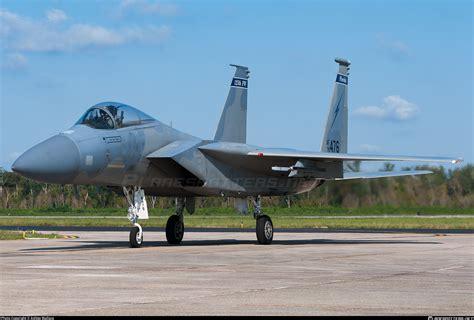
On March 26, 2025, the U.S. Air Force marked the end of an extraordinary era by officially retiring the F-15C Eagle, a fighter jet that had served as the backbone of American air superiority for more than four decades. This pivotal decision, announced at Kadena Air Base, reflects a calculated step toward modernizing airpower capabilities while bidding farewell to one of the most iconic warplanes in aviation history.
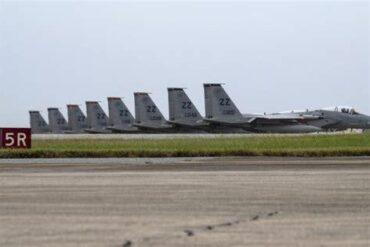
The F-15C’s retirement culminates a process initiated in late 2022 when concerns over escalating maintenance challenges, structural fatigue, and advancing air defense threats became too pressing to ignore. By April 2025, the last permanently stationed F-15C/D Eagles had departed Kadena, closing a significant chapter in the defense of the Indo-Pacific region.
The Strategic Impact of the F-15C’s Withdrawal
Kadena Air Base, located in Okinawa, has long served as the nerve center for U.S. air superiority in East Asia. Since the early 1980s, the F-15C Eagle patrolled the skies as a vigilant guardian, replacing the venerable F-4 Phantom II and asserting American presence across the East China Sea and beyond. The retirement of the F-15C not only symbolizes a technical transition but also raises concerns about potential gaps in regional air dominance.
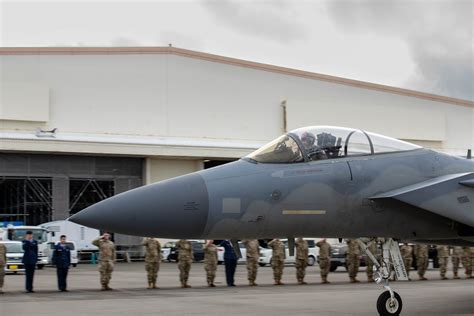
Brigadier General David Eaglin, commander of the 18th Wing, underscored that this transition is not about substituting the F-15C with a single platform but about maintaining overall combat capability through a diverse mix of rotating aircraft. These include the F-22A Raptor, F-16CM Fighting Falcon, F-15E Strike Eagle, and the F-35A Lightning II, each bringing advanced capabilities that collectively ensure operational readiness.
The F-15C’s Design: A Masterclass in Air Superiority
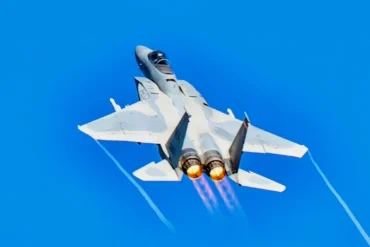
The F-15C Eagle, developed in the 1970s by McDonnell Douglas, was engineered explicitly for air superiority—a direct response to the Soviet MiG-25 Foxbat threat. Boasting a high thrust-to-weight ratio, large wing area, and low wing loading, the F-15C excelled in maneuverability and speed. Its robust twin Pratt & Whitney F100-PW-220/100 afterburning turbofan engines generated up to 23,770 pounds of thrust each, enabling blistering speeds of Mach 2.5 at altitude.
Its avionics suite, including the formidable APG-63(V)3 AESA radar, allowed the Eagle to track and engage multiple targets at long ranges, while its arsenal—featuring the M61A1 20mm Gatling gun, AIM-9 Sidewinder, and AIM-120 AMRAAM missiles—ensured unmatched lethality.
Operational Legacy: Dominating the Skies
The F-15C’s operational history is a testament to its effectiveness. Entering service in 1979, it quickly became synonymous with U.S. air dominance. During Operation Desert Storm in 1991, the Eagle secured more than 30 confirmed kills against Iraqi aircraft, including MiG-29 Fulcrums and Mirage F1s, all without a single loss in air-to-air combat.
The aircraft also played key roles in subsequent conflicts, from patrolling no-fly zones over Bosnia and Kosovo to providing air cover during missions in the Persian Gulf and the campaign against ISIS. Its record of over 100 air-to-air victories with zero dogfight losses is unmatched, underscoring its reputation as one of the most successful fighter jets ever built.
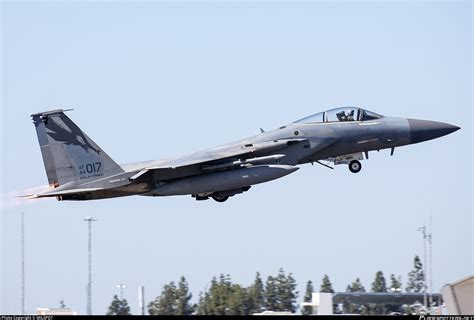
Kadena Air Base: A Cornerstone of Indo-Pacific Defense
Founded in 1945, Kadena Air Base has evolved into the largest and most strategically vital U.S. Air Force installation in the Indo-Pacific. From launching B-29 Superfortress missions during the Korean War to housing F-105 Thunderchiefs in the Vietnam era, Kadena’s legacy is deeply intertwined with U.S. military history.
Today, Kadena hosts the 18th Wing, the largest combat wing in the U.S. Air Force, supporting a variety of missions from aerial refueling and surveillance to combat search and rescue. Despite the departure of the F-15C, Kadena remains critical to U.S. force projection, particularly given its proximity—less than 800 kilometers—to flashpoints like Taiwan and the South China Sea.
Transitioning to the Future: The F-15EX Eagle II
While the F-15C’s retirement signifies the end of an era, it also ushers in the next chapter of air superiority. The F-15EX Eagle II, developed by Boeing, retains the aerodynamic brilliance of its predecessor while integrating cutting-edge technology. Featuring fly-by-wire controls, the APG-82(V)1 AESA radar, and the EPAWSS self-protection suite, the EX variant is designed to thrive in modern combat environments.
Notably, the F-15EX can carry up to 22 air-to-air missiles, integrate hypersonic weapons like the AGM-183 ARRW, and boasts a projected service life of 20,000 flight hours. Though it lacks stealth characteristics, its unmatched payload capacity and advanced sensor suite position it as a formidable transitional asset while the U.S. advances its Next Generation Air Dominance (NGAD) program.
Balancing Legacy and Innovation
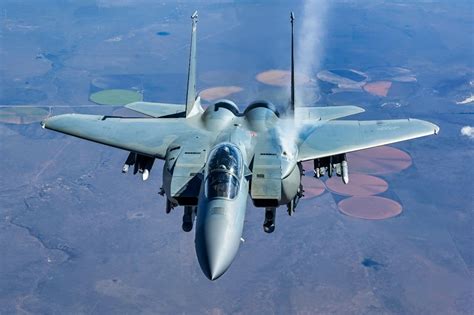
The F-15C Eagle’s retirement reflects a necessary evolution in air combat strategy. As near-peer adversaries like China and Russia develop advanced aircraft and missile systems, reliance on aging fourth-generation fighters becomes increasingly untenable. The U.S. Air Force’s pivot toward rotational deployments of fifth-generation fighters and the integration of platforms like the F-15EX aim to ensure sustained air dominance.
Yet, the F-15C’s legacy will endure—not only in the annals of air combat history but also in the continued evolution of air superiority doctrine. Its unmatched record, engineering excellence, and battlefield successes serve as enduring benchmarks for future generations of warfighters and aircraft designers alike.