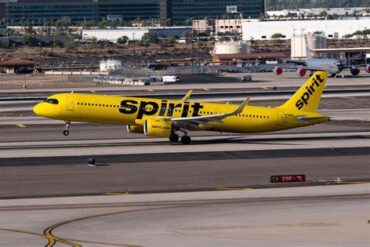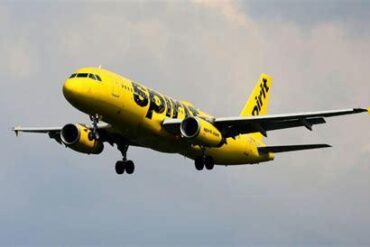
The fate of Spirit Airlines has taken a dramatic turn, with a proposed federal rescue package potentially handing the United States government control of up to 90% of the struggling airline. What began as a liquidity crisis has now escalated into one of the most unusual interventions in modern aviation history—one that could redefine how governments engage with failing carriers in a post-pandemic, high-cost environment.
A High-Stakes Bailout to Prevent Collapse
The proposed $500 million federal rescue deal emerges as a last-ditch effort to prevent Spirit Airlines from sliding into full liquidation. Sources familiar with the negotiations suggest the package is designed not only to stabilize short-term operations but to fundamentally restructure ownership. If finalized, the deal could convert government support into equity, effectively placing the airline under majority federal control once it exits bankruptcy.
This move reflects mounting concern within Washington, particularly as Donald Trump publicly acknowledged the airline’s precarious position. In a recent statement, he emphasized the importance of preserving jobs, pointing to the airline’s workforce of approximately 14,000 employees. The message was clear: allowing Spirit to fail could trigger ripple effects far beyond aviation.
Bankruptcy, Fuel Costs, and a Perfect Storm
Spirit’s financial troubles did not emerge overnight. The airline filed for bankruptcy twice—first in 2024 and again in August 2025—highlighting persistent structural weaknesses. While leadership initially projected a summer recovery, those plans were derailed by surging fuel prices tied to geopolitical tensions in the Middle East.
The airline’s ultra-low-cost model, once its greatest strength, has become increasingly fragile in a high-cost environment. Unlike legacy carriers with diversified revenue streams, Spirit relies heavily on maintaining razor-thin margins. When fuel costs spike, profitability evaporates quickly.
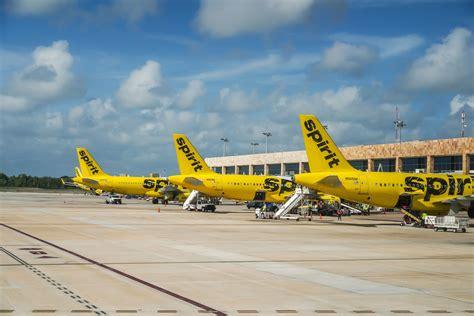
Operationally, the airline has already taken aggressive measures. Fleet reductions, grounded aircraft, and workforce adjustments have become routine. Entire rows of Airbus A320-family jets now sit idle, awaiting engine repairs or reassignment.

Inside the Operational Strain
Behind the headlines lies a workforce navigating uncertainty. The Association of Flight Attendants has attempted to reassure employees, pushing back against what it describes as exaggerated media narratives. Union representatives have encouraged staff to continue operations as normal, even as internal restructuring unfolds.
Yet the visible signs of strain are hard to ignore. Aircraft storage at secondary facilities, reduced flight frequencies, and temporary leaves for flight attendants all point to an airline operating at its limits. Industry analysts argue that Spirit has already exhausted most cost-cutting options.
Mike Boyd of Boyd Group International summarized the dilemma bluntly: airlines cannot simply shrink their way to survival. At some point, scale becomes essential—not optional.
Why Spirit Airlines Matters More Than It Seems
Beyond its own balance sheet, Spirit plays a critical role in the broader aviation ecosystem. Alongside carriers like Frontier Airlines, Breeze Airways, and Avelo Airlines, it forms the backbone of the ultra-low-cost carrier (ULCC) segment.
These airlines exert downward pressure on ticket prices across the industry. Even the so-called “Big Three”—American Airlines, Delta Air Lines, and United Airlines—have been forced to adapt, introducing basic economy fares and stripped-down pricing tiers to remain competitive.
If Spirit were to disappear, that pressure would vanish almost overnight.
The Consumer Impact of a Potential Shutdown
Economists warn that the loss of Spirit Airlines would lead to a measurable increase in domestic airfare. Without ULCC competition, legacy carriers would face less incentive to maintain aggressive pricing strategies.
Jan Brueckner, an aviation economist formerly at the University of California, has emphasized that Spirit’s influence extends far beyond its own passengers. The airline acts as a market regulator, forcing competitors to remain price-sensitive. Remove that force, and the equilibrium shifts—almost always upward.
For travelers, that translates into fewer budget options, reduced route competition, and ultimately higher ticket prices across multiple segments.
Government Ownership: A Rare Aviation Intervention
While government bailouts are not unprecedented, outright ownership of a commercial airline in the United States is exceedingly rare. The proposed deal signals a willingness to step beyond traditional support mechanisms, such as loans or temporary subsidies.
If completed, the transaction would effectively nationalize Spirit Airlines—at least in the short to medium term. The federal government would gain a controlling stake, with the option to divest later once financial stability is restored.
This approach mirrors strategies used in other industries during crises but remains largely untested in modern U.S. aviation. The implications could extend beyond Spirit, potentially setting a precedent for future interventions.
What Comes Next for Spirit Airlines
The immediate priority is survival. Securing liquidity, stabilizing operations, and emerging from bankruptcy are the first milestones. Beyond that, the challenge becomes rebuilding a sustainable business model in an environment where costs remain volatile and competition is relentless.
For now, flights continue, passengers board as usual, and the airline presses forward under intense scrutiny. But behind the scenes, negotiations are shaping what could become one of the most consequential restructurings in aviation history.
Whether Spirit Airlines reemerges as a leaner private carrier or a temporarily nationalized entity, one fact remains unavoidable: its survival carries implications not just for employees or investors, but for the entire structure of airfare pricing in the United States.