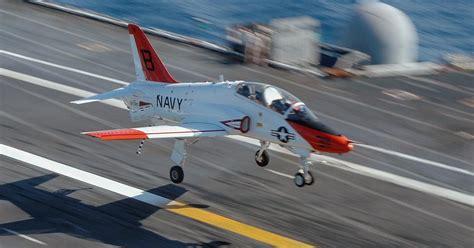
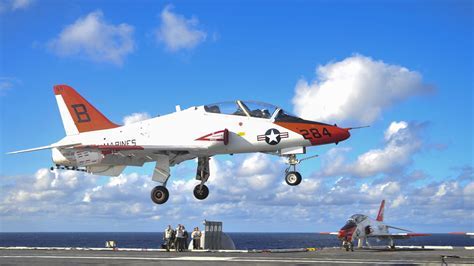
For more than three decades, the T-45 Goshawk has served as the backbone of the U.S. Navy’s jet training fleet, forging the skills of thousands of naval aviators who would go on to operate everything from the F/A-18 Super Hornet to the F-35C Lightning II. However, the era of the Goshawk is coming to a close. The Navy has confirmed that it plans to select a replacement aircraft by 2027, marking a historic shift in how future pilots will train for the demanding world of naval aviation.
The T-45, a navalized derivative of the British Aerospace Hawk, first entered service in 1991. Despite extensive upgrades over the years, its 1970s design roots and aging airframes are increasingly unsustainable for modern pilot training needs. The aircraft’s reliance on legacy systems, limited digital avionics, and maintenance-heavy components make it increasingly costly to operate. Furthermore, the shift toward simulation-based carrier training has reduced the necessity for aircraft capable of performing actual carrier landings, paving the way for a wider field of replacement candidates.
The End of an Era for the Goshawk
The T-45’s impact on naval aviation is undeniable. Designed to replicate the performance envelope of front-line fighters, the Goshawk allowed student aviators to practice advanced maneuvers, instrument flight, and carrier approaches before ever stepping into an operational squadron. The aircraft also introduced digital flight control systems and hands-on-throttle-and-stick (HOTAS) controls to generations of trainees, bridging the gap between analog training platforms and modern digital cockpits.
Yet, as naval aviation transitions into the age of fifth-generation fighters and networked warfare, the Goshawk’s once cutting-edge systems have become outdated. The Navy’s Trainer Aircraft Replacement (TAR) program seeks not only to replace an aging fleet but to redefine what a 21st-century jet trainer should deliver: efficiency, digital integration, and advanced simulation compatibility.
New Training Philosophy: Less Deck Time, More Digital Time
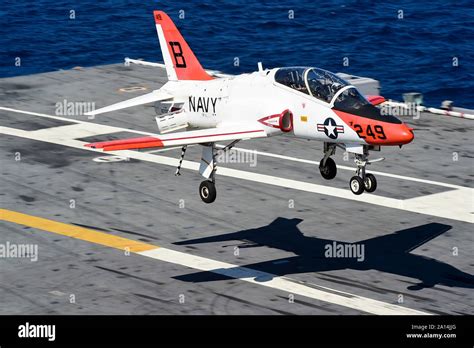
In previous generations, carrier qualification was a rite of passage for every Navy pilot. However, the cost, risk, and logistical challenges of deck landing qualifications have led to a fundamental change. The Navy now relies heavily on high-fidelity simulators and assisted landing technologies such as the Precision Landing Mode (PLM) used in the F/A-18E/F and F-35C programs. This shift means that the next trainer aircraft no longer needs to be carrier-capable—a major design simplification that opens the door to several international and commercial candidates.
Instead of deck performance, emphasis is now on mission systems, data links, and networked training capabilities that emulate modern combat environments. Advanced simulators paired with real aircraft will allow instructors to run synchronized scenarios across multiple platforms, effectively creating a live-virtual-constructive (LVC) training ecosystem.
Boeing’s T-7A Red Hawk: The Familiar Favorite
The Boeing-Saab T-7A Red Hawk enters the competition as the most established contender. Already selected by the U.S. Air Force as its next-generation trainer, the Red Hawk benefits from years of development and partial production infrastructure already in place. It’s powered by a GE F404 engine, delivering up to 17,000 pounds of thrust with afterburner, and capable of reaching Mach 0.975.
While the T-7A has faced program delays and technical issues, its maturity and interoperability with the Air Force could make it an appealing choice for the Navy. Boeing also touts the aircraft’s modular open architecture, which allows rapid software and systems upgrades—critical for keeping pace with evolving fighter technologies.
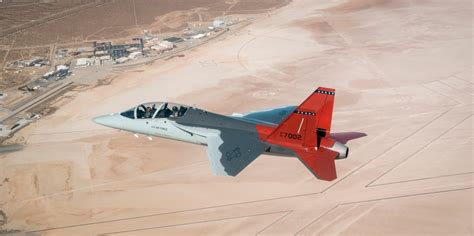
The Red Hawk’s digital design process—employing advanced 3D modeling and virtual prototyping—reduced development time by nearly 75% compared to traditional programs. Its glass cockpit, embedded training systems, and robust performance envelope position it as a strong candidate for Navy adoption, especially if logistical commonality with the Air Force’s fleet is prioritized.
Lockheed Martin and KAI’s TF-50N: A Proven, High-Performance Option
Lockheed Martin, in partnership with Korea Aerospace Industries (KAI), is offering the TF-50N, a navalized derivative of the FA-50 Fighting Eagle light combat aircraft. Unlike the Red Hawk, the TF-50N is already combat-proven and operational in several air forces worldwide, including those of South Korea, the Philippines, and Poland.
The TF-50N shares the same GE F404 engine as the T-7A but boasts a higher top speed of Mach 1.5, giving it genuine supersonic capability. This could appeal to Navy planners who wish to expose trainees to supersonic flight regimes before transitioning to front-line fighters.
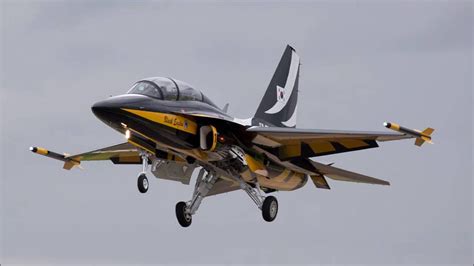
The aircraft also benefits from existing maintenance infrastructure and global supply chains, making it a lower-risk, off-the-shelf solution. Lockheed Martin emphasizes its embedded training capability, which allows pilots to simulate radar operations, weapon engagements, and network-centric missions without external pods or systems.
Textron and Leonardo’s M-346N: A Twin-Engine Workhorse
The Textron/Leonardo M-346N, derived from the proven M-346 Master, is another top contender. Its twin Honeywell F124-GA-200 engines deliver 6,280 pounds of thrust each, offering redundancy and safety advantages that the Navy values for overwater operations. With a maximum cruise speed of 679 mph, the M-346N is subsonic but boasts superior handling characteristics and exceptional fuel efficiency.
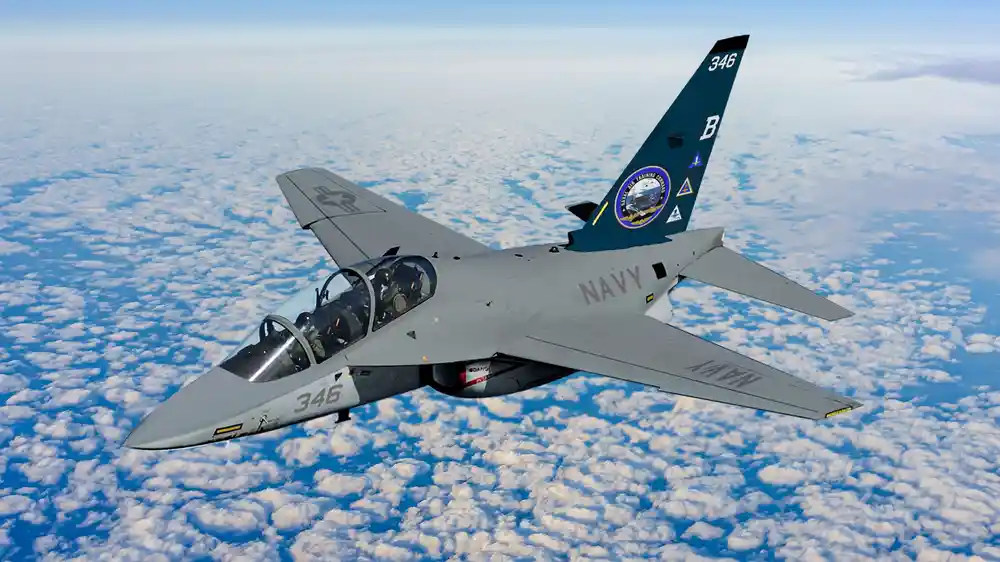
With over 150,000 flight training hours logged globally, the M-346 platform has already proven its reliability in service with Italy, Singapore, and Israel. Textron also brings extensive U.S. industrial presence through brands such as Beechcraft, Bell, and Cessna—an advantage that could strengthen its bid from a domestic production standpoint. Furthermore, the M-346N’s open-architecture avionics allow for seamless integration with future U.S. Navy digital training systems.
The Wild Card: Stavatti’s SM-31 Stiletto
Among the more unconventional entries is the Stavatti SM-31 Stiletto, a proposed single-engine jet trainer featuring thrust-vectoring capabilities and futuristic aerodynamics. However, Stavatti has never built an operational aircraft, casting doubt on the feasibility of its ambitious timeline. The company claims the Stiletto will be ready by 2034, but without a proven track record or prototype, it remains an outsider in this high-stakes race.
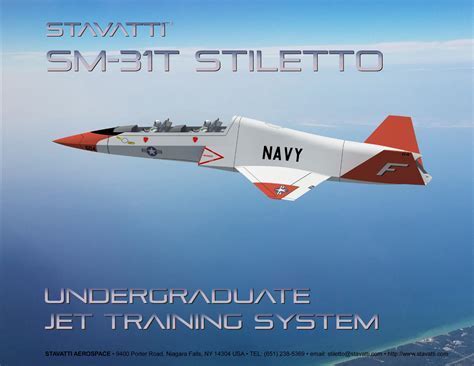
Despite skepticism, the concept hints at the Navy’s broader openness to innovation. If successful, a clean-sheet design like the SM-31 could introduce unprecedented agility and maneuverability into the training syllabus, especially for pilots preparing for next-generation stealth fighters.
SNC’s Freedom Trainer: A Cost-Effective, Carrier-Capable Contender
In contrast to many competitors, Sierra Nevada Corporation (SNC) has presented a completely clean-sheet aircraft, the Freedom Trainer, explicitly tailored to the Navy’s requirements. Uniquely among the candidates, it retains carrier landing practice capabilities, addressing the Navy’s traditional training culture while still aligning with modern cost-saving measures.
Powered by twin Williams FJ44-4M turbofan engines, the Freedom Trainer promises to reduce engine-related lifecycle costs by up to 40% compared to the T-45. SNC claims the jet’s performance envelope mirrors that of fourth and fifth-generation fighters, allowing pilots to train realistically across a wide range of mission profiles—from low-level navigation to simulated strike operations.
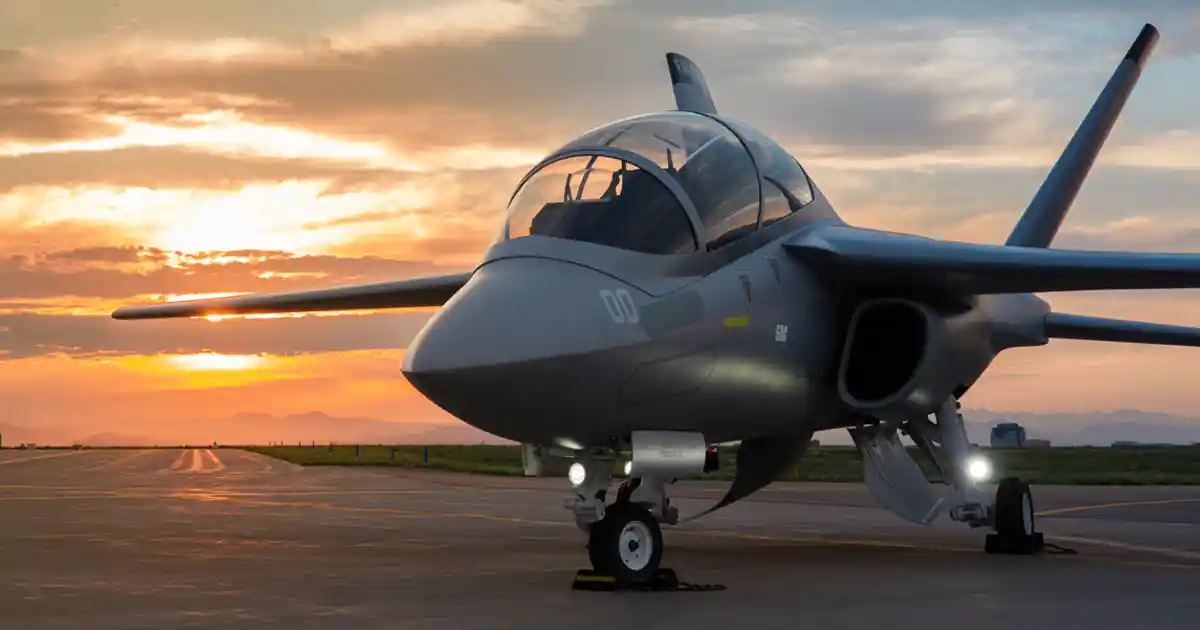
The Freedom Trainer’s emphasis on maintenance simplicity, low operational costs, and adaptability could make it the dark horse of the competition. Its modular design also allows for rapid reconfiguration between training roles and light attack missions, aligning with the Navy’s growing preference for multi-mission flexibility.
Evaluating the Contenders: What the Navy Will Prioritize
The Navy’s decision will likely hinge on several critical criteria:
- Training Effectiveness: Integration with next-generation simulators and mission systems.
- Lifecycle Cost: Long-term maintenance and operational sustainability.
- Industrial Readiness: Domestic production capability and supply chain resilience.
- Digital Interoperability: Compatibility with joint training networks across the U.S. services.
Given these parameters, the T-7A Red Hawk and TF-50N currently appear to have the strongest positions—one for its joint-service appeal, the other for its combat-proven pedigree. However, SNC’s Freedom Trainer’s cost advantage and carrier-capable design might make it an unexpected winner if the Navy prioritizes affordability and naval adaptability.
A New Chapter for Naval Aviation Training
As the T-45 Goshawk prepares to sunset, the Navy’s next trainer will symbolize not just a generational aircraft change but a complete rethinking of how pilots are prepared for 21st-century warfare. The shift away from deck qualifications toward integrated digital simulation reflects a profound transformation in naval doctrine—one focused on agility, technology, and cost-efficiency.
Whether the future Navy aviator trains in a Red Hawk, a Freedom Trainer, or a yet-unseen aircraft, one thing is clear: the Goshawk’s legacy will endure. It has bridged eras, from analog gauges to augmented reality cockpits, and paved the way for the sophisticated, networked pilot training environments of tomorrow. The upcoming competition is not merely about selecting a new aircraft—it’s about defining the future identity of naval flight training in an era where the line between real and virtual skies grows ever thinner.