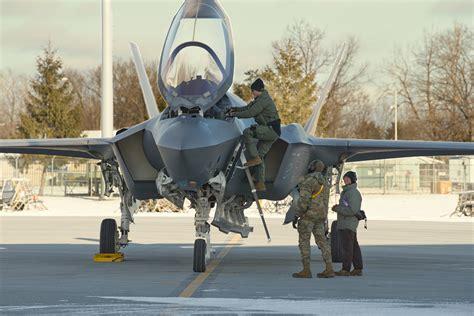
The United States has redeployed six F-35A Lightning II stealth fighters from the Vermont Air National Guard toward the Middle East, signaling a calibrated yet unmistakable reinforcement of American airpower in the U.S. Central Command (CENTCOM) theater. The movement, conducted on February 9 and 11, 2026, comes at a moment of heightened tension with Iran, as indirect diplomatic negotiations over Tehran’s nuclear and missile programs continue in parallel with a visible military buildup.
The six aircraft, assigned to the 158th Fighter Wing based at Burlington Air National Guard Base, departed the continental United States under the callsigns Tabor 41 through Tabor 46. Their transatlantic crossing required coordinated aerial refueling support, underscoring the logistical choreography behind even a relatively small fighter deployment. After crossing the Atlantic, the jets landed at RAF Lakenheath in the United Kingdom before continuing eastward toward the Middle East.
Three KC-135 Stratotanker aircraft from Bangor Air National Guard Base, operating under the callsigns Gold 81, Gold 82, and Gold 83, provided midair refueling support during the February 9 flight. The tankers subsequently landed at RAF Mildenhall, near Lakenheath. On February 11, as the F-35As departed the UK and flew over the Mediterranean, three KC-135s again accompanied them, extending their operational reach. The Vermont aircraft carried “VT” tail markings identifying their home unit, though at least one jet had markings partially obscured, a detail that hints at operational discretion.
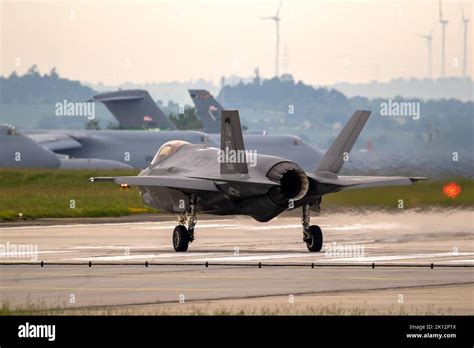
Expanding the CENTCOM Airpower Footprint
The redeployment of these F-35As is not occurring in isolation. It forms part of a broader U.S. military reinforcement in the Middle East that includes multiple fighter squadrons and expanded missile defense coverage. Three squadrons of F-15E Strike Eagles, one squadron of F-16 Fighting Falcons, and one squadron of A-10 Thunderbolt II aircraft have been positioned in the region. Twelve F-15Es from RAF Lakenheath have deployed forward, and an F-15E squadron from Mountain Home Air Force Base has already maintained a presence for approximately ten months.
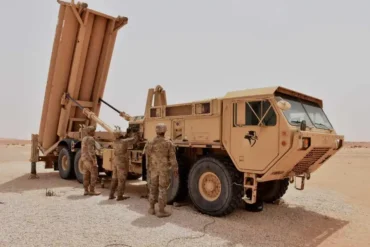
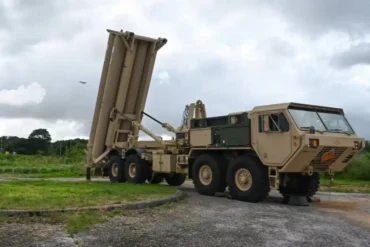
Strategic airlift has supported this buildup at scale. Between 80 and more than 100 C-17 Globemaster III and C-5 Galaxy flights have transported equipment and personnel into theater. Patriot and THAAD missile defense systems have been reinforced, adding layered protection against potential ballistic missile threats. HH-60W Jolly Green II combat search and rescue helicopters have also deployed, enhancing recovery and personnel protection capabilities in a high-risk environment.
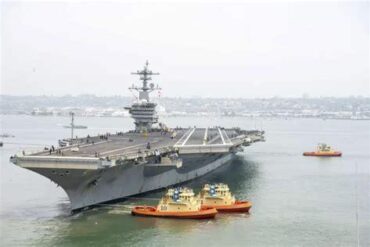
At sea, USS Abraham Lincoln has operated within the CENTCOM area since late January 2026, following a transit from San Diego through Guam and the South China Sea. A second carrier strike group has been instructed to prepare for possible deployment, with USS George H.W. Bush identified as the most likely candidate. The cumulative effect is unmistakable: air, sea, and missile defense assets are being aligned to provide deterrence, flexibility, and rapid response.
The Vermont F-35A Mission Profile
The 158th Fighter Wing is not new to operational deployments. Earlier in 2026, the unit participated in Operation Absolute Resolve, a U.S. mission targeting former Venezuelan president Nicolás Maduro. An image dated January 3, 2026, showed an F-35A taxiing after military actions in Venezuela, demonstrating that the unit has recently operated in a live combat environment.
Six additional F-35As from the same Vermont wing had already deployed to Morón Air Base in Spain the previous month, staging through Puerto Rico and the Portuguese Azores. That European positioning provided strategic flexibility, allowing rapid reinforcement of either the Mediterranean or Middle Eastern theaters.
The Vermont unit is identified as specializing in suppression of enemy air defenses (SEAD), a mission set that aligns precisely with the F-35A’s design strengths. SEAD involves locating, jamming, and destroying hostile radar and surface-to-air missile systems. In modern warfare, neutralizing enemy air defenses is often the prerequisite for any sustained air campaign. The F-35A’s sensor fusion, stealth profile, and internal weapons carriage make it particularly suited to penetrating contested airspace.
Lessons from Operation Midnight Hammer
The F-35A’s role in the Middle East was vividly demonstrated during Operation Midnight Hammer in June 2025. That strike campaign targeted Iranian nuclear facilities at Fordow, Natanz, and Isfahan. The operation involved 4,000 personnel and 125 aircraft, including seven B-2 Spirit stealth bombers that delivered GBU-57 Massive Ordnance Penetrator bombs against hardened underground sites.
More than 24 Tomahawk cruise missiles were launched from a U.S. submarine against Isfahan. Accounts referenced either 12 or 14 GBU-57 bombs used against Fordow and Natanz, illustrating the scale of the strike. In that campaign, Air Force F-35As did not carry the heavy penetration munitions themselves. Instead, they suppressed Iranian air defenses and escorted the B-2 bombers, ensuring that the strategic bombers could approach and strike their targets with reduced risk.
Subsequent U.S. assessments stated that the strikes degraded Iran’s nuclear program by one to two years. In February 2026, Iranian officials claimed that some bombs had not detonated and remained at the facilities, complicating inspection access. Regardless of competing narratives, the operation demonstrated how fifth-generation fighters integrate with stealth bombers and naval assets in a coordinated, multi-domain strike.
The F-35A Lightning II: Capabilities and Cost
The F-35A is the conventional takeoff and landing variant of the F-35 Lightning II family and is operated by the U.S. Air Force and Air National Guard. It first flew in December 2006 and entered U.S. Air Force service in August 2016. As of 2026, more than 1,300 F-35 aircraft of all variants have been delivered globally. The United States plans to procure 2,456 F-35s through 2044, underscoring the platform’s central role in future force structure.
The aircraft’s average flyaway cost as of July 2024 stood at approximately $82.5 million, excluding the engine. The Pratt & Whitney F135 engine was cited at $20.4 million as of August 2025. Powered by that single F135 engine, the F-35A can reach speeds of Mach 1.6.
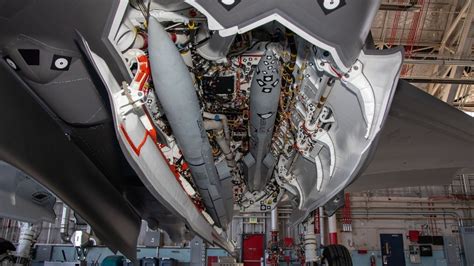
Internally, the aircraft carries a 25 mm GAU-22/A cannon with 182 rounds and can load AIM-120 air-to-air missiles and precision-guided munitions within two internal weapons bays. It is also certified to carry the B61 Mod 12 nuclear bomb, reflecting its dual-capable role in strategic deterrence.
Its technological core lies in sensor fusion. The Northrop Grumman AN/APG-81 active electronically scanned array radar, the AN/ASQ-239 electronic warfare system, the AN/AAQ-37 Distributed Aperture System, and the AN/AAQ-40 Electro-Optical Targeting System combine to provide pilots with an integrated, 360-degree view of the battlespace. The aircraft’s diverterless supersonic inlets, canted vertical stabilizers, and radar-absorbent materials reduce its radar cross-section, allowing it to operate in contested environments with a lower probability of detection.
Compared with legacy fourth-generation fighters such as the F-16, the F-35A carries more than double the internal fuel, extending its combat radius. Software upgrades have progressed through multiple blocks, with Block 3F establishing baseline combat capability and Block 4 enhancements underway to expand weapons integration and sensor performance.
Diplomacy Under the Shadow of Force
The military buildup unfolds alongside diplomatic engagement. On February 6, U.S. and Iranian representatives held indirect talks in Muscat, Oman, mediated by Omani Foreign Minister Badr bin Hamad Al Busaidi. Washington has demanded limits on uranium enrichment below 60 percent purity, surrender of roughly 400 kilograms of enriched uranium, restrictions on ballistic missile development, and cessation of support for regional proxy groups.
Iran has maintained that its missile program is non-negotiable and that it retains the right to uranium enrichment. Iranian President Masoud Pezeshkian declared on February 11 that Iran would not yield to what he characterized as excessive demands. U.S. leadership has indicated that failure of negotiations could result in further military action.
In this context, the deployment of additional F-35A stealth fighters functions as both reinforcement and signal. It reinforces operational capacity within CENTCOM and signals that the United States retains credible strike and suppression capabilities should diplomacy falter. The aircraft’s prior operational use in both Latin America and Middle Eastern strike support roles illustrates that these are not symbolic assets; they are combat-proven platforms integrated into a broader, multi-domain force posture.
The arrival of Israeli Air Force F-35I Adir fighters—three additional jets delivered to Nevatim Air Base on January 18, 2026, bringing the fleet to 48—adds another layer to the regional equation. Fifth-generation aircraft are now embedded across allied air forces in the theater, reshaping the operational balance.
As indirect talks continue in Muscat and military assets reposition across airfields and carrier decks, the F-35A’s forward movement embodies the dual-track approach defining this moment: diplomacy pursued under the watchful presence of stealth.