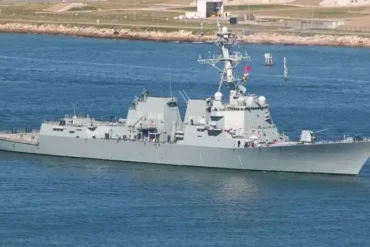
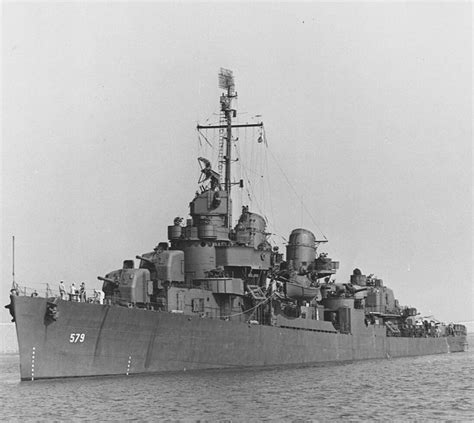
The USS William D. Porter (DD-579) was a Fletcher-class destroyer commissioned by the U.S. Navy in July 1943. Designed for speed, firepower, and escort duties, the warship was built to protect larger vessels from enemy aircraft, submarines, and surface threats. Yet, despite its capabilities, the destroyer became infamous for an extraordinary sequence of mishaps that followed it from the Atlantic Ocean to the Pacific theater during World War II. Its reputation for misfortune began almost immediately after it left port and continued until a Japanese aircraft sank it in June 1945.
Unlike many American warships remembered for their combat achievements, the William D. Porter became known for accidents, procedural failures, and incidents that threatened other ships. The most notorious episode occurred during a voyage escorting President Franklin D. Roosevelt aboard the battleship USS Iowa. A training exercise unexpectedly turned into a potentially catastrophic emergency when a torpedo was launched toward the presidential ship.
The destroyer’s story was not simply a collection of bizarre accidents. It also illustrates the importance of discipline, communication, and technical procedures aboard warships operating under wartime pressure. Although its reputation for bad luck grew with every incident, many of its troubles resulted from human error rather than chance alone.
The USS William D. Porter’s First Mishaps at Sea
The William D. Porter began its operational career inauspiciously. After its shakedown cruise, the destroyer departed Norfolk, Virginia, on November 12, 1943. Almost immediately, its crew made a mistake while raising the anchor. As the ship moved away, the anchor dragged across the deck of another destroyer, damaging railings and destroying lifeboats. It was an embarrassing beginning for a warship expected to operate alongside some of the U.S. Navy’s most important vessels.
The following day brought another mishap. A depth charge accidentally rolled overboard and detonated underwater because its safety mechanism had not been properly set. Depth charges were powerful anti-submarine weapons, and an accidental explosion could endanger nearby ships and personnel. Although the incident did not sink the destroyer, it reinforced the impression that something was going wrong aboard the vessel.
Conditions at sea soon added to the difficulties. A powerful wave swept a sailor overboard, killing him, while seawater flooded one of the ship’s boilers. The resulting mechanical problems forced the destroyer to reduce speed and arrange repairs. Reporting the situation to the USS Iowa required the Porter to break radio silence, a serious breach of procedure during a sensitive wartime mission.
These early incidents were particularly damaging because the destroyer was participating in an escort mission involving the president of the United States. Operational security and reliable coordination were essential, leaving little tolerance for avoidable mistakes.
The Torpedo Incident That Nearly Struck USS Iowa
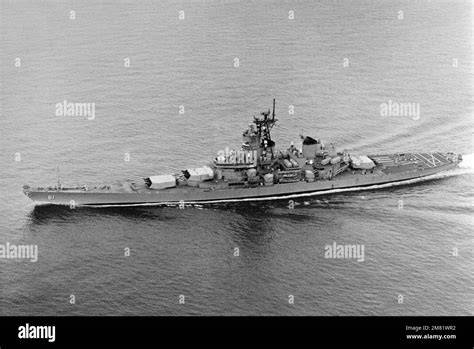
The William D. Porter’s most infamous episode occurred during its November 1943 escort mission with the USS Iowa (BB-61). President Roosevelt was traveling aboard the battleship as part of a voyage connected with Allied wartime diplomacy. The Iowa was among the most powerful American warships afloat, and protecting it was a responsibility that demanded exceptional care.
During a training exercise, the Porter practiced torpedo procedures with the Iowa nearby. The exercise was supposed to be controlled, with the torpedo’s primer charge removed to prevent an actual launch. However, a torpedo was fired toward the Iowa because the necessary safety step had been overlooked.
The destroyer’s commander, Lieutenant Commander Wilfred Walter, immediately recognized the danger. The crew attempted to warn the battleship using signal lamps, but the message did not reach its intended recipient quickly enough. The Porter then broke radio silence to transmit an urgent warning that a live torpedo was approaching.
The Iowa took evasive action and avoided the weapon. The incident could have resulted in the loss of a major battleship and potentially endangered the president. Instead, the torpedo passed without striking its target, turning a training error into one of the most extraordinary near-disasters in U.S. naval history.
The Navy ordered the Porter to Bermuda, where investigators examined what had happened. The inquiry identified Chief Torpedoman Lawton Dawson’s failure to remove the primer as the immediate cause of the accidental launch. Dawson received a sentence of 14 years of hard labor, although President Roosevelt waived the punishment. The destroyer’s reputation, however, was already firmly established.
Pacific Operations Brought More Trouble
Despite its troubled Atlantic experience, the William D. Porter remained in service. It reached Dutch Harbor, Alaska, on December 29, 1943, and subsequently joined operations in the Pacific. Its responsibilities included patrols, bombardment, and protecting American forces from enemy attacks.
Even in the Pacific, the destroyer struggled to escape its reputation. During a New Year’s Day celebration in 1944, an intoxicated sailor fired one of the ship’s five-inch guns. The 55-pound shell traveled toward the backyard of a local base commander, where a holiday gathering was taking place. Fortunately, nobody was injured, but the incident provided another example of how a preventable mistake could create a potentially dangerous situation.
For the following months, the Porter carried out patrols around the Kuril Islands and later participated in operations associated with the Battle of Leyte Gulf, one of the largest naval engagements of World War II. These missions required American warships to defend against Japanese aircraft, support advancing forces, and maintain control of critical maritime routes.
By 1945, the destroyer was operating around Okinawa, where American forces faced fierce Japanese resistance. The Porter served as an air-defense picket ship, helping protect the invasion fleet from aircraft approaching the landing areas. Its crew shot down six enemy aircraft and fired on targets ashore, demonstrating that the vessel could perform effectively despite its earlier history.
How a Japanese Aircraft Finally Sank the Destroyer
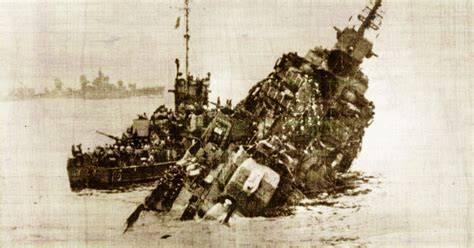
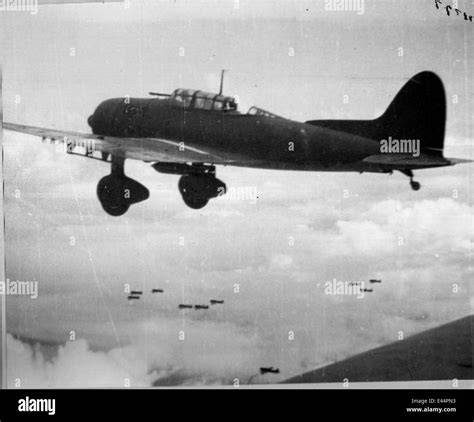
The William D. Porter’s final ordeal came on June 10, 1945, during the Battle of Okinawa. A Japanese Aichi D3A1 dive bomber attacked the destroyer as Japanese forces continued trying to disrupt American naval operations.
The Porter maneuvered to evade the aircraft, and the bomber missed its intended target before striking the water nearby. However, the aircraft’s momentum carried it beneath the destroyer’s keel, where it exploded. The underwater blast inflicted devastating damage and lifted the warship out of the water.
The crew fought to save the vessel, attempting to control the damage and keep it afloat. Their efforts continued for hours, but the destruction proved too extensive. The order to abandon ship was eventually given, bringing the destroyer’s operational career to an end.
Remarkably, the entire crew survived the sinking. Although the ship disappeared beneath the sea, its sailors escaped, avoiding the kind of mass casualties that accompanied the loss of many other warships during the Pacific campaign.
Was the USS William D. Porter Really the Unluckiest Ship of World War II?
The USS William D. Porter earned its place in naval folklore through a combination of unusual accidents, serious procedural failures, and an extraordinary final encounter with a Japanese aircraft. From its anchor damaging another destroyer to the torpedo that nearly struck the USS Iowa, its history contained enough incidents to make its reputation understandable.
Nevertheless, describing the Porter as the unluckiest ship of World War II requires some perspective. Many American and Allied warships suffered catastrophic losses, and the Porter itself remained operational for much of its short career. Its combat service included meaningful contributions to the Pacific campaign, particularly during the fighting around Okinawa.
What distinguished the destroyer was not simply that unfortunate events occurred, but that several of its most memorable incidents stemmed from mistakes that could have been prevented. The accidental torpedo launch, in particular, demonstrated how a single overlooked safety procedure could threaten an entire naval mission.
The USS William D. Porter was ultimately lost to enemy action, rather than to one of its own earlier mishaps. Its story survives as both an unusual chapter in American naval history and a reminder that modern warships depend on rigorous training, clear communication, and disciplined crews. Its reputation for misfortune may be legendary, but the sailors who served aboard it also demonstrated courage under fire—and all escaped when their ship finally sank.