The Pentagon’s plan to equip every V-22 Osprey with an upgraded proprotor gearbox by 2027 is moving ahead, but the production numbers raise a difficult question: is there enough time to replace the gearboxes across the entire fleet? The new components are intended to address one of the aircraft’s most persistent and consequential mechanical problems, particularly failures associated with the steel used in the gearbox gears. Yet the arithmetic surrounding the modernization effort suggests that completing every replacement within the stated timeframe could be considerably more complicated than the headline target implies.
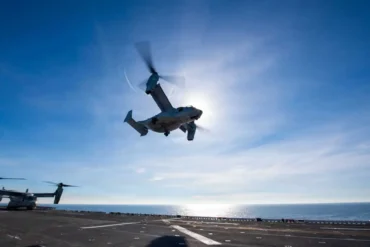
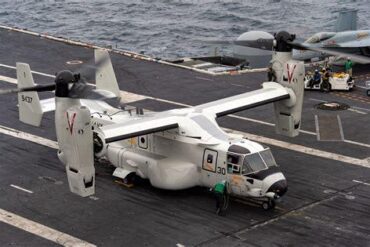
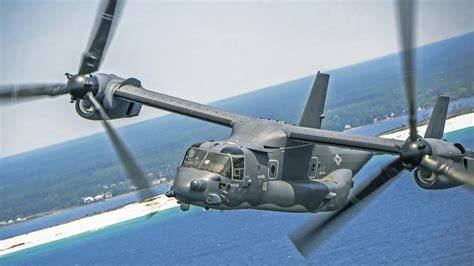
The V-22 is unlike almost any other aircraft operated by the US military. It can take off and land vertically like a helicopter, then rotate its engine nacelles and fly horizontally with the speed and range characteristics of a turboprop aircraft. That unusual combination has made the Osprey an important asset for the Marine Corps, Navy, and Air Force. At the center of this capability is a remarkably complicated drive system that must reliably transmit thousands of horsepower to two enormous proprotors while allowing the aircraft to transition between different flight modes.
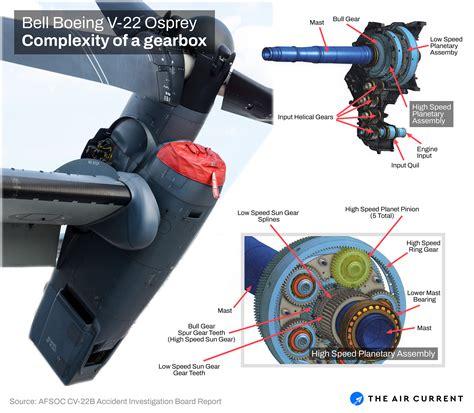
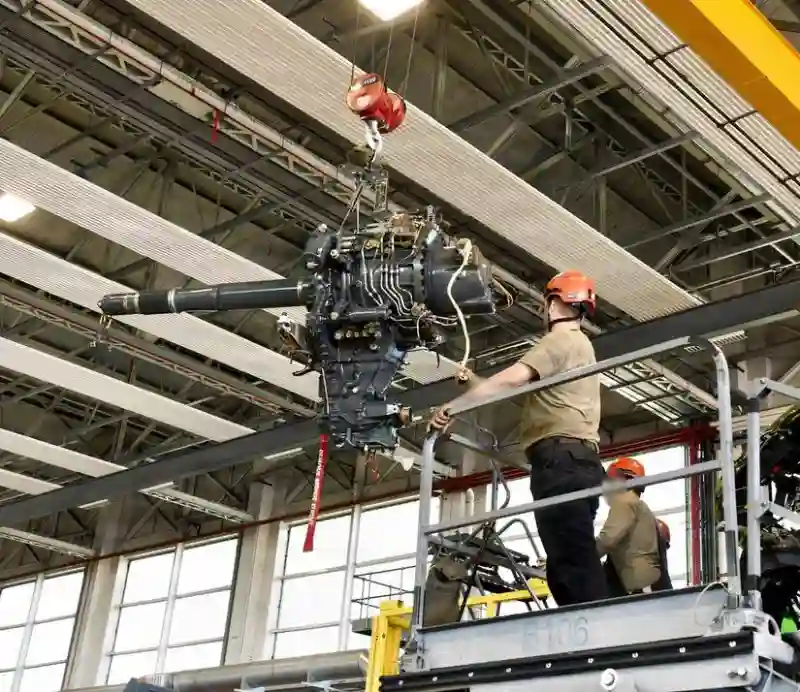
The gearbox is therefore far more than another replaceable aircraft component. Each proprotor gearbox weighs approximately 2,600 pounds, while the V-22’s complete drive system weighs roughly 3,780 pounds, including the tilt-axis and mid-wing gearboxes and interconnecting shafting. The main gearbox accounts for about 70% of that drive-system weight. It takes the high rotational speed generated by the Rolls-Royce AE 1107C engines and converts it into the lower-speed, high-torque output needed to turn the proprotors.
Why the V-22 Osprey Gearbox Matters So Much
The engineering challenge becomes clearer when examining what happens inside the gearbox. Power from each AE 1107C engine has to pass through multiple gear assemblies before reaching the proprotor. The high-speed and low-speed planetary assemblies contain numerous gears and pinions, with the high-speed assembly using five pinion gears and the low-speed assembly using six. The arrangement provides a degree of redundancy, allowing the system to continue operating under certain damaged conditions.
That redundancy, however, does not eliminate the underlying metallurgy problem. The Osprey has experienced repeated gearbox-related failures since entering service. The aircraft achieved initial operating capability in 2007, and during the following years, the gearbox became a recurring focus of engineering investigations, maintenance activity, and operational restrictions. The problem has been especially serious because a failure in such a central component can affect not only the aircraft’s availability but also flight safety.
The V-22 fleet currently consists of hundreds of aircraft distributed among several services. Estimates in the supplied material place the fleet at roughly 403 to 420 aircraft, while another figure used in the modernization calculation puts the current inventory at 469. The Marine Corps operates the largest portion, with hundreds of MV-22Bs, while the Navy operates CMV-22Bs and the Air Force’s Special Operations Command operates CV-22s.
That fleet structure matters because the gearbox replacement program is not dealing with a small number of specialized aircraft. Every V-22 has two proprotor gearboxes, meaning a fleet of 469 aircraft would require 938 gearboxes if both units on every aircraft were replaced. This is where the Pentagon’s ambitious timeline encounters an important mathematical problem.
V-22 Gearbox Production Rate Raises Questions
Brigadier General David C. Walsh, who manages the V-22 program through Naval Air Systems Command, confirmed that new gearboxes are being manufactured at a rate of 12 per month and distributed among the three services. On the surface, 12 units every month sounds substantial. Over a full year, however, that production rate equals only 144 gearboxes.
At 144 gearboxes annually, producing 938 replacement units would take approximately 6.5 years if production remained constant and every gearbox went directly toward replacing existing components. That simple calculation does not account for gearboxes already produced, aircraft that have already received upgraded components, spare requirements, installation capacity, inspection time, transportation, testing, or other demands on the production line.
This does not necessarily mean that the Pentagon’s 2027 objective is impossible. The program began introducing the new gearboxes into repair facilities in January 2026, so production and installations were already underway before the end-state target. Some aircraft may also receive only one replacement during a particular maintenance event, while others could already have upgraded hardware installed. The military may have additional production capacity, procurement arrangements, or scheduling mechanisms not reflected in the simple 12-per-month figure.
Nevertheless, the arithmetic exposes why the 938-unit requirement deserves attention. If the goal is literally to replace both proprotor gearboxes on every aircraft in a 469-aircraft fleet, a production rate of 12 units per month creates a substantial gap between theoretical demand and annual output.
The Metallurgy Problem Behind the Osprey Upgrade
The reason for the expensive and complicated overhaul goes back to the steel used in the V-22 gearbox. Most of the problematic gears were manufactured from X-53 steel produced through a double-melt process. Over time, investigators identified material inclusions within the alloy as a significant source of concern.
An inclusion is essentially an unwanted foreign material or impurity trapped within the metal. Under repeated loads, such a flaw can become a starting point for cracking. In a component subjected to enormous forces and continuous rotational stress, even a very small imperfection can eventually become a serious structural problem.
A Navy review identified 22 instances of gear failures since 2006 associated with cracking caused by inclusions. Investigators also found that failed gears could generate metal chips, creating additional operational problems inside the transmission system. The issue therefore was not simply that one gear might crack. A damaged gear could potentially produce secondary effects throughout a highly interconnected mechanical system.
The problem received renewed attention following the fatal V-22 crash near Yakushima Island, Japan, on November 29, 2023. Eight Airmen died when the CV-22 went down during the accident. The subsequent investigation determined that the proprotor gearbox had suffered a catastrophic failure and considered an inclusion in the steel as a possible contributor.
The Yakushima Crash Changed the Gearbox Debate
The Yakushima accident became a major turning point for the Osprey fleet. Following the crash, approximately 400 V-22 aircraft underwent a three-month safety stand-down, illustrating how a gearbox concern could affect the operational availability of the entire fleet.
The aircraft’s gearbox history also includes another major issue involving hard clutch engagements. These events occur when the clutch slips and then re-engages, producing severe torque fluctuations. Such sudden changes can create substantial stresses throughout the drive system and complicate aircraft control.
The Government Accountability Office subsequently found that serious accident rates for the Air Force and Marine Corps V-22 fleets increased during fiscal years 2023 and 2024 compared with their average rates during the preceding eight years. Depending on the service, the increase ranged from 36% to 88%. Those figures do not mean that every accident was caused by gearbox problems, but they underline the broader readiness and safety pressures surrounding the aircraft.
Readiness has also been affected. When a gearbox malfunction occurs or a potentially affected aircraft requires inspection, the aircraft can be removed from service until technicians complete inspections, repairs, and certification. Naval Air Systems Command reported low average readiness and availability for portions of the V-22 fleet during the 2020-2024 period, with reported levels around 50% for the Navy and AFSOC and 60% in another portion of the fleet.
Triple-Melt Steel Is the Core of the Fix
The new gearbox addresses the metallurgy problem by using X-53 triple-melt steel rather than the earlier double-melt material. The additional processing step is intended to reduce the number and size of unwanted inclusions within the finished alloy.
That change could have an important effect on gearbox reliability. Admiral John E. Dougherty IV, Commander of Naval Air Systems Command, said the transition from double-melt to triple-melt gears is expected to reduce the probability of the relevant failure by an order of magnitude. He described the change as moving the associated risk from serious to medium.
Colonel Robert Hurst, head of the V-22 Joint Program Office, similarly stated that the new alloy is expected to reduce inclusions by approximately 90%. These figures explain why the military considers the replacement program necessary rather than treating the gearbox problem as an ordinary maintenance issue.
Why 12 Gearboxes a Month Is the Critical Number
The central issue is ultimately one of scale. A production rate of 12 gearboxes per month equals 144 per year. A fleet of 469 aircraft requires 938 units if both proprotor gearboxes are replaced. Even before accounting for installation and logistics, those numbers do not naturally align with a complete fleet conversion in a short period.
There is also an important distinction between manufacturing a gearbox and installing one. New hardware must reach maintenance facilities, aircraft must enter appropriate maintenance windows, technicians must remove existing components, replacement gearboxes must be installed and inspected, and the aircraft must undergo the required checks before returning to operational service. The practical throughput of the modernization program can therefore be lower than the theoretical production rate.
Conversely, the simple calculation should not be interpreted as proof that the 2027 objective will fail. Production may have started before the January 2026 repair-bay deliveries, and the stated fleet size may include aircraft with different modernization requirements. Some aircraft may also be retired, placed in long-term maintenance, or otherwise handled differently during the program.
The more defensible conclusion is that the 12-per-month figure alone does not demonstrate that every V-22 can receive two new gearboxes by 2027. Additional information about inventory, installation rates, production increases, completed retrofits, and service-specific schedules is necessary to reconcile the stated objective with the apparent hardware requirement.
The V-22 Gearbox Upgrade Has More Than a Safety Dimension
For the military, the modernization is about more than preventing another gearbox failure. The V-22 has become a central part of Marine Corps assault support, Navy carrier logistics, and Air Force special operations. Its ability to combine vertical operations with relatively high-speed conventional flight gives commanders an aircraft that cannot easily be replaced by a conventional helicopter.
That makes availability particularly important. An aircraft designed to provide unique operational flexibility loses much of its value when maintenance problems keep large numbers of the fleet grounded. Improving gearbox reliability could therefore affect not only safety statistics but also mission availability, maintenance workloads, spare-parts demand, and the number of aircraft available for training and deployments.
The new triple-melt gearbox represents a substantial engineering response to a problem that has followed the Osprey for much of its operational life. The metallurgy appears designed to attack one of the fundamental causes rather than merely treating symptoms after failures occur.
The remaining question is whether the modernization schedule can match the size of the fleet. 938 gearboxes for 469 aircraft is a formidable requirement, while 12 gearboxes per month represents 144 units per year. Those figures make the Pentagon’s 2027 objective difficult to reconcile without additional production, already-completed installations, or a different definition of what constitutes fleet-wide completion.
For the V-22, the gearbox upgrade is therefore both an engineering fix and a logistical test. Triple-melt steel could substantially reduce the inclusion-related failure risk, but the benefit will ultimately depend on how quickly the upgraded hardware can reach aircraft across the fleet. The technology may be moving in the right direction; the calendar and the production numbers will determine how quickly the Osprey can realize its full benefit.