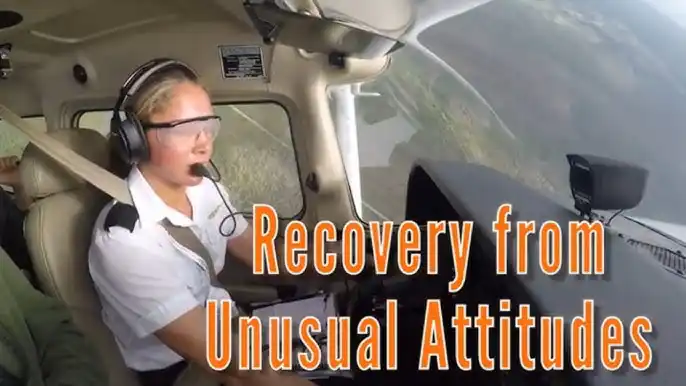
Unusual attitude recovery is a critical skill in instrument flight training and real-world aviation safety. When an aircraft departs from controlled flight parameters due to spatial disorientation, turbulence, or system failure, recognizing and recovering from the unusual attitude swiftly and correctly can be the difference between safe continuation of flight and catastrophic loss of control. Yet, as pilots dive into literature and training resources, they quickly discover that not all sources agree on the correct recovery sequence.
This inconsistency has prompted a healthy debate across aviation communities, especially when comparing procedures outlined by Sporty’s IFR training resources and the FAA’s Airplane Flying Handbook (AFH). Each source presents a different order of control inputs, leading to confusion about what the ‘correct’ sequence truly is.

Diverging Doctrines: Sporty’s vs FAA AFH
Sporty’s IFR manual, a staple in instrument training, outlines the recovery order for a climbing right turn as Power → Pitch → Roll. This suggests a focus on energy management before attitude correction. Conversely, the FAA’s AFH, considered the official regulatory guide, specifies a different sequence: Pitch → Roll → Power, prioritizing the aircraft’s attitude and aerodynamic safety before adjusting energy.
Why does this divergence exist? The answer lies in context. Sporty’s approach seems grounded in scenarios where airspeed is critically low, implying that restoring power immediately is essential to prevent a stall. The AFH’s guidance, meanwhile, reflects a generalized and perhaps more cautious sequence, especially for nose-high unusual attitudes, where reducing angle of attack and avoiding a stall is paramount.
Understanding the Aerodynamic Logic
To navigate these discrepancies, we must dive into the aerodynamics behind each attitude scenario:
In a nose-high unusual attitude, particularly during a climbing turn, the aircraft risks an accelerated stall. The wings are often loaded beyond their safe angle of attack, making immediate pitch correction essential. Reducing pitch lessens the angle of attack, helping to avert a stall. Rolling wings level unloads asymmetric lift distribution. Only then should power be adjusted to recover energy lost during the maneuver.
Thus, the AFH’s recommended Pitch → Roll → Power prioritizes aerodynamic stability over energy restoration.
In contrast, nose-low attitudes, where airspeed is increasing rapidly, present the danger of overspeeding or exceeding structural limits. Here, rolling the wings level before pulling up is critical. Pulling back too soon while banked can place tremendous stress on the airframe and induce a spiral. This logic supports a modified order: Roll → Pitch → Power, or even delaying power application until pitch and roll have stabilized.
The Reality of Simultaneity in Recovery Inputs
Although handbooks prescribe sequences, many instructors emphasize that in practice, control inputs are applied nearly simultaneously, especially in real-world flying. The distinctions exist to prevent errors, such as inducing secondary stalls or exceeding load factors. The nuance comes down to intentional prioritization, not robotic step-by-step action.
For example, in a nose-high situation:
- We reduce pitch aggressively but in a controlled manner.
- Roll to wings level follows almost concurrently to reduce asymmetric loading.
- Power application is delayed until the aircraft’s attitude is stabilized to avoid over-pitching.
Such synchronized actions still adhere to the AFH’s order but reflect the fluidity required in actual recovery.
Mnemonic Aids: Memory Tools with Mixed Interpretations
Pilots have developed various mnemonics to internalize unusual attitude recovery sequences. Two of the most common include:
- PUSH → ROLL → THRUST → STABILIZE
- UPRT: Recognize → Pitch → Roll → Thrust
These aids serve a useful purpose in high-stress scenarios. The idea is to keep actions orderly and intentional. However, it’s crucial to remember that even these tools reflect a simplification of complex aerodynamic realities. They are not universal formulas and must be adapted to specific attitude scenarios.

Training Perspectives from the Aviation Community
In a Reddit thread discussing the differences between Sporty’s and AFH guidance, experienced pilots and instructors chimed in with useful insights:
- u/pilotinprogresss noted that in practical training, many of the actions are taught to occur simultaneously, particularly for nose-high attitudes.
- bhalter80 emphasized that in nose-low recoveries, rolling wings level must come first, as it is essential for avoiding structural overstress before pitching.
- bingeflying highlighted the PUSH → ROLL → THRUST mnemonic as a fast cognitive anchor, especially helpful in upset prevention scenarios.
- kaisarissa drew a line between unusual attitude recovery and full upset recovery training (UPRT), the latter involving more aggressive responses typically used in high-altitude upset scenarios.
The consensus among instructors, particularly for checkride and FAA-based procedures, is that Pitch → Roll → Power remains the tested and taught sequence for nose-high unusual attitudes.
Upset Recovery vs. Unusual Attitude Recovery: The Line of Distinction
Though sometimes conflated, there is a notable difference between unusual attitude recovery and upset recovery. The former, generally encountered in IMC or under spatial disorientation, involves less aggressive maneuvers and is designed for smooth, safe recovery. Unusual attitudes might result from a momentary lapse or distraction.
Upset recovery, by contrast, often stems from external forces like wake turbulence, windshear, or aerodynamic anomalies. These situations may push the aircraft into extreme bank angles, inverted flight, or dangerously high/low speeds. As such, UPRT emphasizes:
- Quick recognition
- Aggressive yet coordinated pitch correction
- Wing unloading via roll control
- Controlled energy management with thrust and speed brakes
Hence, while unusual attitude recovery may benefit from gentle coordinated input, upset recovery may demand abrupt, forceful control use depending on the situation.
The Practical Application in Flight Training
Flight instructors and designated pilot examiners often train and evaluate unusual attitude recovery with simulated instrument failures or hooded flight. The recovery procedure must demonstrate a pilot’s ability to identify aircraft attitude solely through instruments and apply the correct sequence promptly.
Instructors commonly introduce these recoveries during private pilot instrument training, with the goal of building:
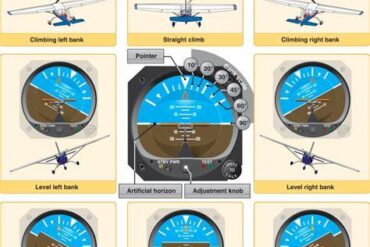
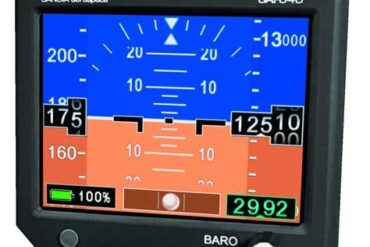
- Confidence in interpreting attitude indicators
- Decisiveness in control application
- A safety-first mindset
Most syllabi recommend the AFH-based sequence because it provides a balanced focus on aerodynamic integrity and safety. However, many instructors also emphasize the “big picture”—what matters is recovering without inducing further instability.
Conclusion: A Context-Driven Approach to Safety
The correct sequence of unusual attitude recovery is not a fixed formula but rather a context-sensitive framework that depends on the aircraft’s specific attitude, energy state, and environmental conditions. While the FAA AFH prescribes Pitch → Roll → Power for nose-high recoveries—and that sequence is widely accepted for checkrides and formal instruction—it’s vital to adapt inputs dynamically during actual flight.
Sporty’s emphasis on applying power first reflects concern over low energy states, especially in climb scenarios. However, if pitch and roll corrections are delayed in favor of power, the aircraft risks entering a stall.
Ultimately, pilots must understand why each control input matters. Instructors should continue teaching the FAA-sanctioned sequence, but also train students to read and respond to the aircraft’s actual condition, recognizing that safe recovery often means simultaneous, prioritized input—not mechanical obedience to a checklist.
Every recovery maneuver is a judgment call grounded in aerodynamic understanding. Whether in the sim, the classroom, or 10,000 feet above ground in IMC, knowing how to respond to an unusual attitude quickly and correctly is a lifesaving skill, and one that should be continually refined through practice, scenario-based training, and critical thinking.