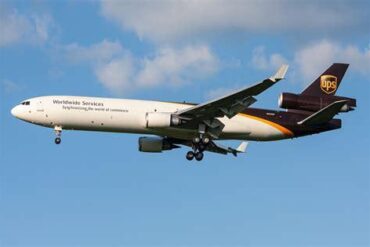
UPS Airlines sits at the center of modern global commerce, quietly moving the physical backbone of the digital economy every night while most of the world sleeps. Parcels ordered with a click, industrial components feeding just-in-time factories, medical supplies that cannot wait—these flows depend on an air network engineered for reliability at extreme scale. Unlike passenger airlines that chase frequency and flexibility, UPS designs its fleet around concentration, consolidation, and certainty. That philosophy leads naturally to a single, towering answer when asking which aircraft UPS is the world’s largest operator of.
The aircraft is not subtle, nor is the strategy behind it. In an age when four-engine jets have largely vanished from passenger service, UPS has doubled down on one of the most iconic and capable freighters ever built. This decision reveals more than a fleet statistic. It exposes how UPS thinks about routes, time sensitivity, infrastructure limits, and the future shape of global trade.
By examining the aircraft itself, how UPS uses it, and why no other airline operates more of them, the logic behind this dominance becomes unmistakably clear.
The Aircraft That Wears the Crown: Boeing 747-8F
UPS Airlines is the largest operator in the world of the Boeing 747-8, specifically the Boeing 747-8F freighter variant. No passenger airline, no cargo competitor, and no hybrid operator comes close to matching UPS in active 747-8 aircraft. This includes carriers traditionally associated with jumbo jets, such as Lufthansa, Cargolux, and Korean Air. Even when combining operators of both the freighter and the passenger 747-8I, UPS still leads.
This distinction matters because the 747-8F is not a legacy aircraft kept alive out of habit. It is the final and most advanced evolution of the “Queen of the Skies,” designed explicitly to serve high-density, long-haul cargo missions in a post-747-400 world. While most airlines exited the four-engine era to cut fuel burn and simplify operations, UPS embraced the 747-8F as a strategic anchor for its most demanding routes.
The decision reflects confidence in sustained global cargo demand where scale beats frequency. Instead of moving smaller loads more often, UPS prefers to move vast volumes in fewer, perfectly timed departures, especially across oceans where speed and reliability carry a premium.
Why the Boeing 747-8F Still Matters in a Twin-Engine World
The Boeing 747-8F occupies a category of its own. No other production freighter combines its payload capacity, internal volume, and range into a single platform. The aircraft can carry roughly 140 metric tons of cargo while flying intercontinental distances approaching 4,200 nautical miles without payload restrictions. For UPS, this translates into the ability to consolidate what would otherwise require multiple flights into one precisely scheduled movement.
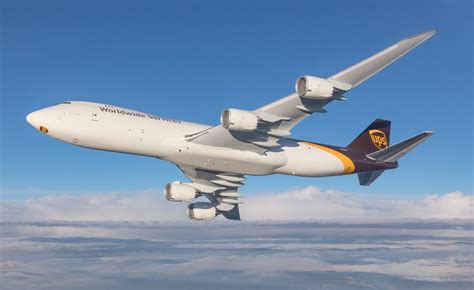
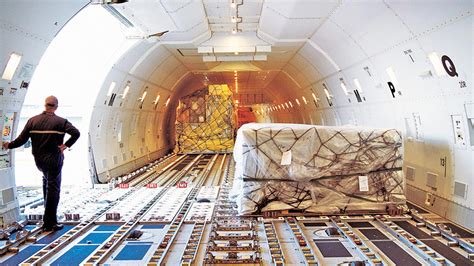
Beyond raw numbers, the design offers operational advantages that remain unmatched. The iconic nose door allows for straight-in loading of outsized cargo, including industrial machinery, aerospace components, and irregular freight that cannot be broken down into standard containers. This flexibility is essential for a global logistics provider serving industries far beyond consumer e-commerce.
Equally important is how capacity interacts with airport constraints. Many of the world’s most critical cargo gateways are slot-restricted, curfew-limited, or infrastructure-constrained. In these environments, one very large aircraft can be more efficient than several smaller ones, reducing congestion while maximizing throughput per slot. The 747-8F thrives precisely where access is scarce but demand is relentless.
UPS’s 747-8F Fleet Size and Structural Advantage
UPS operates 30 Boeing 747-8F aircraft, all active, making it the single largest concentration of the type in global service. This is not an opportunistic fleet assembled through conversions or secondary acquisitions. It is a purpose-built, carefully phased subfleet designed for long-term deployment.
The aircraft share a narrow age range, with the oldest just over a decade old and the youngest delivered within the past few years. This uniformity is operational gold. Maintenance planning becomes predictable, spare-parts inventories are optimized, and crew training benefits from deep specialization rather than constant adaptation.
Cargo airlines think in decades, not in marketing cycles. UPS expects these aircraft to remain productive well into the late 2030s and early 2040s, a timeline that reflects both the structural longevity of the 747-8F and the enduring relevance of ultra-high-capacity freighters. In an industry where aircraft are tools rather than symbols, longevity equals confidence.
How UPS Deploys the 747-8F Across Its Global Network
The Boeing 747-8F is not sprinkled randomly across the UPS route map. It is deployed with surgical precision on lanes where density, distance, and time sensitivity intersect. The heart of this deployment lies across the Pacific Ocean, connecting major Asian manufacturing centers with North American sorting hubs.
These routes support enormous volumes of electronics, automotive components, industrial equipment, and high-value express freight. The 747-8F allows UPS to move these flows overnight, aligning perfectly with factory output cycles and next-day delivery promises downstream.
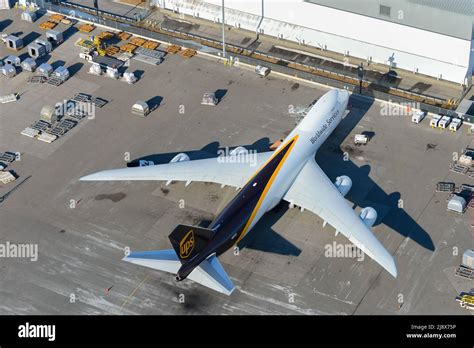
Europe–North America and Asia–Europe routes also see regular 747-8F service, particularly between major hubs rather than secondary cities. This hub-to-hub philosophy is central to UPS’s model. Large aircraft move freight between continental gateways, where it is redistributed using smaller freighters optimized for regional and domestic legs.
Within the United States, the aircraft appears far less frequently. Domestic use is typically limited to repositioning, maintenance logistics, or peak-season surges. The 747-8F is, by design, an international heavyweight, reserved for missions where its scale delivers clear economic and operational advantages.
Why UPS Chose Scale Over Frequency
Many airlines have shifted toward smaller widebody freighters, citing lower fuel burn and greater scheduling flexibility. UPS acknowledges those advantages—but chooses scale anyway. The reason lies in network economics, not individual flight efficiency.
On dense, predictable lanes, moving more cargo per departure reduces complexity across the entire system. Fewer flights mean fewer crews, fewer slots, fewer chances for disruption, and more predictable arrival waves at sorting hubs. When multiplied across hundreds of nightly movements, these efficiencies compound dramatically.
The 747-8F also aligns with UPS’s philosophy of infrastructure leverage. The company invests heavily in massive automated hubs capable of processing huge volumes in short time windows. Feeding these hubs with large, synchronized arrivals maximizes return on that investment. Smaller aircraft, arriving more frequently, would dilute those gains.
Operational Reliability and Long-Term Economics
Cargo operations reward reliability more than novelty. The Boeing 747-8F benefits from a mature global support ecosystem, robust structural margins, and engines designed for sustained high-utilization cycles. UPS values this predictability, especially when aircraft routinely fly long overnight sectors with little tolerance for delay.
Fuel efficiency is often cited as a weakness of four-engine aircraft, but this metric changes when viewed per ton of cargo rather than per flight. When fully utilized, the 747-8F can be remarkably competitive on a cost-per-kilogram basis, especially on long-haul routes where its capacity advantage shines.
This is why UPS continues to invest in the type even as no direct successor exists. There is currently no production aircraft that fully replaces the 747-8F’s combination of volume, payload, and loading flexibility. Until such an aircraft emerges, the 747-8F remains strategically irreplaceable.
How Long the 747-8F Will Remain at UPS
UPS’s planning horizon for the Boeing 747-8F extends well beyond the typical passenger airline lifecycle. With many aircraft still early in their service lives, operations into the 2040s are not only plausible but expected. Structural durability, modern avionics, and consistent high-demand routes all support this outlook.
The deciding factor will not be age, but economics. As long as global trade continues to favor consolidated, time-critical intercontinental flows—especially across the Pacific—the 747-8F will remain relevant. Given current trends in manufacturing concentration and e-commerce growth, those conditions appear durable.
The 747-8F in the Context of UPS’s Broader Fleet Strategy
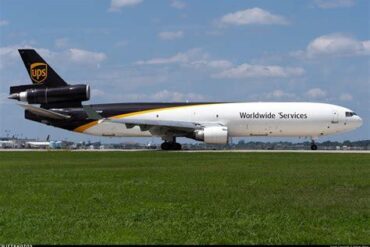
UPS does not rely on a single aircraft type. Its strength lies in a layered fleet, with each aircraft serving a defined role. Below the 747-8F sit Boeing 767-300Fs, prized for their flexibility on regional and medium-haul routes. Older types such as the MD-11 and Airbus A300 are being methodically retired as part of a long-planned modernization cycle.
What stands out is that UPS has not replaced its largest aircraft with something smaller. Instead, it has preserved the top end of its capacity spectrum while renewing the middle. This evolutionary approach minimizes risk while maintaining unmatched lifting power where it matters most.
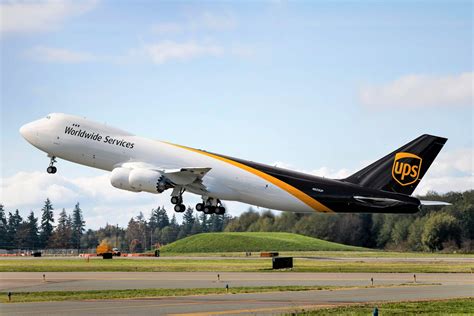
The result is a fleet capable of absorbing shocks, scaling during peak seasons, and supporting global commerce with remarkable consistency.
Why No Other Airline Matches UPS’s 747-8F Commitment
Other carriers operate the Boeing 747-8F, but none at UPS’s scale. This gap reflects differences in business models rather than capability. UPS controls its cargo end-to-end, from pickup to final delivery, allowing it to fully exploit ultra-large aircraft. Airlines that sell space to third parties often prefer flexibility over concentration.
UPS also benefits from network certainty. Its demand is not speculative; it is contractually anchored to global shippers who value reliability above all else. This stability justifies long-term investment in specialized aircraft that might be risky for more volatile operators.
In essence, UPS’s dominance as the largest operator of the Boeing 747-8F is a consequence of alignment. The aircraft fits the network, the network fits the market, and the market rewards scale executed with precision.
The Bigger Picture: What the 747-8F Says About UPS
The Boeing 747-8F is more than a fleet statistic. It is a statement about how UPS sees the world. Global trade, in this view, is not fragmenting into ever smaller flows. It is concentrating along major corridors where speed, reliability, and sheer volume matter most.
By operating more 747-8Fs than any other airline on Earth, UPS signals confidence in those corridors and in its ability to dominate them. The aircraft’s silhouette in the night sky remains a reminder that while logistics may be invisible to consumers, it is powered by some of the largest and most capable machines ever built.
For UPS, the crown fits—and it shows no sign of being passed on anytime soon.