Airbus’ decision to engineer the A350 Ultra-Long-Range (ULR) variants emerged from a confluence of technological opportunity, commercial ambition, and airline-specific strategic needs. What began as a targeted response to carriers seeking to unlock the planet’s most demanding nonstop flights evolved into one of the most defining long-haul aviation developments of the modern era. The A350 platform, already celebrated for its efficiency and composite-driven weight advantages, offered Airbus an opening to extend performance into ranges previously reserved only for inefficient four-engine aircraft. For airlines intent on connecting distant global city pairs without compromise—Singapore Airlines and Qantas most notably—the ULR variants promised unprecedented economic viability on routes traditionally considered too long, too costly, or too operationally limiting.
While the standard A350 family already represented an evolutionary leap for twin-engine widebodies, the ULR blueprint was pushed even further. Airbus recognized a clear gap in the market: the demand for aircraft capable of flying 18–22 hours nonstop without sacrificing payload, comfort, or profitability. This demand was sharpened by Boeing’s presence with the 777-200LR and, later, the anticipated 777X family. The A350 ULR variants would become both a direct competitive counterpunch and a technological showcase for Airbus’ long-haul vision.
Long before the A350 ULR entered service, airlines were testing the boundaries of ultra-long-haul (ULH) flying. Singapore Airlines had been an early pioneer, launching nonstop flights from Singapore to Newark and Los Angeles using the Airbus A340-500. Despite their groundbreaking nature, these flights struggled economically due to the aircraft’s heavy four-engine architecture and voracious fuel burn. When fuel prices surged, the economics collapsed, and the routes were discontinued in 2013.
The setback did not stop Singapore Airlines from pursuing the dream of seamless intercontinental connectivity. When Airbus began developing the A350 XWB—a modern, efficient platform built around a high-composite fuselage and new-generation Rolls-Royce Trent XWB engines—it offered the efficiency levels necessary to revisit these previously untenable missions. The airline’s interest in restoring the world’s longest routes became the catalyst for Airbus to develop a tailored variant: the A350-900ULR.
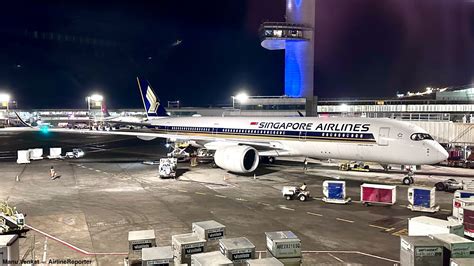
Engineering the A350-900ULR: Range Without Reinvention
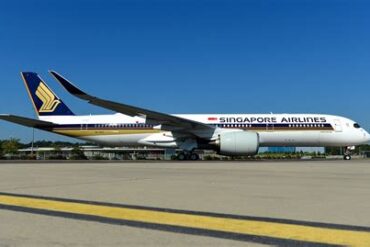
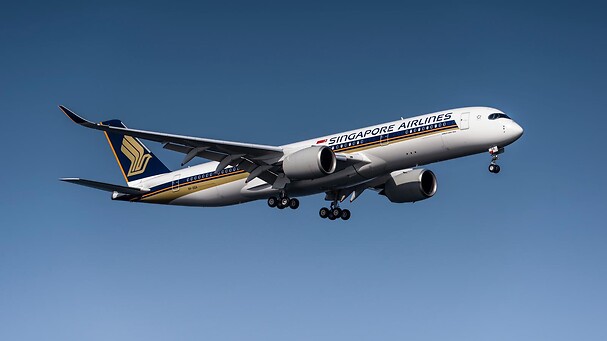
Airbus built the A350-900ULR as an evolutionary branch rather than an entirely new aircraft type. This approach spared operators from extensive crew training differences and allowed the aircraft to remain within the broader A350 operational ecosystem. To achieve the necessary range—up to 9,700 nautical miles—Airbus enhanced the internal fuel architecture, extending tank capacity by roughly 24,000 liters using space within the existing center wing box.
At the same time, the aircraft’s Maximum Takeoff Weight (MTOW) was increased to 280 tons, enabling the payload-to-range balance required for commercial viability. Structural reinforcement was minimal, keeping weight penalties low. Winglets were refined for better aerodynamic performance, a feature later incorporated into subsequent A350 production models.
The overall design philosophy prioritized efficiency enhancement rather than radical redesign. That focus was reflected internally as well. Singapore Airlines opted for an all-premium layout—161 seats across Business Class and Premium Economy—to ensure passenger comfort during 18–20 hour journeys and to optimize yield on markets where business travelers value nonstop connectivity.
Passenger Experience as a Performance Multiplier
Airbus’ broader cabin innovation program, known as Airspace, played a significant role in making ULR operations palatable for passengers. Long-haul flying is not only an endurance challenge for the aircraft but a physiological challenge for travelers. The A350’s composite fuselage allowed for lower cabin pressure altitude—around 6,000 feet—along with increased humidity levels, reducing dehydration and fatigue.
Noise reduction technologies, HEPA air filtration cycles every few minutes, and LED-based circadian lighting patterns all contributed to creating a cabin architecture specifically optimized for reducing jet lag. Singapore Airlines’ early adoption of these features proved critical in redefining what passengers could expect from flights lasting nearly a full day. The A350 ULR thus became more than a technical project; it was a reimagining of ultra-long-haul travel as a premium, experience-driven product.
Qantas and Project Sunrise: Pushing to the Edge of the Map
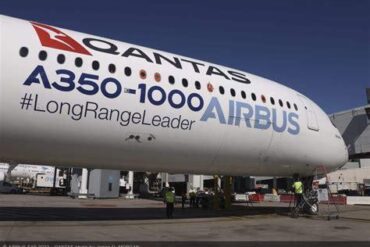
While Singapore Airlines provided the first chapter of the A350 ULR story, Qantas offered the next frontier. The Australian carrier long envisioned nonstop services from Sydney to London and New York—routes that test the very limits of commercial aviation range. Under the ambitious banner Project Sunrise, Qantas challenged manufacturers to deliver an aircraft capable of flying up to 22 hours while carrying a commercially meaningful payload.
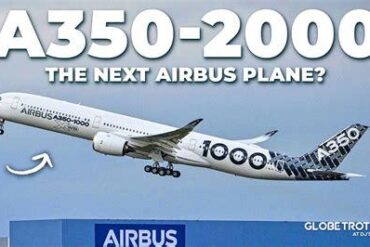
Airbus responded by developing the A350-1000ULR, a variant with enhanced capability beyond the standard A350-1000. The new version incorporates a 20,000-liter auxiliary fuel tank in the rear center fuselage and an increased MTOW of 322 tons. The first aircraft entered final assembly in late 2025, with deliveries slated for the end of 2026.
Qantas’ interior layout demonstrates a commitment to wellness on unprecedented flight durations. With 238 seats spread across First, Business, Premium Economy, and Economy, density is kept intentionally low. The aircraft will also debut a dedicated Wellbeing Zone—a space designed for stretching, hydrating, and light movement to combat the effects of extended travel.
Ultra-Long-Range Performance as a Strategic Niche
The A350 ULR variants remain specialized tools rather than mass-market aircraft. Only Singapore Airlines and Qantas have ordered them, and this is largely by design. Most airlines do not operate routes that demand 18–22 hours of endurance, nor do their network strategies justify such niche capability. For the majority of carriers, the standard A350-900, A350-1000, Boeing 787 family, or upcoming 777X meet their long-haul requirements more flexibly.
Nevertheless, standard A350s continue to prove their range capability. Airlines like Philippine Airlines, Delta Air Lines, Qatar Airways, and Cathay Pacific already deploy the A350 on very long routes—some exceeding 8,000 nautical miles—demonstrating the platform’s underlying strength even without ULR adaptation.
Boeing’s Position and Airbus’ Competitive Calculus
Airbus developed the A350 ULR not solely as a response to customer demand but also as a strategic maneuver in the long-haul market. Boeing’s portfolio included the 787—highly efficient, smaller, and widely ordered—and the forthcoming 777X family, which promised exceptional range and payload performance. The 777-8, for instance, is projected to exceed even the standard A350-1000 in range.
For Airbus to remain competitive, evolving the A350 into ULR form was essential. While Boeing holds an overall lead in Dreamliner deliveries, Airbus’ move enabled carriers with ULH ambitions to select a platform tailor-made for these extreme missions. Moreover, the A350 ULR’s economics avoided the intense fuel burn penalty that had plagued earlier four-engine ULH operations.
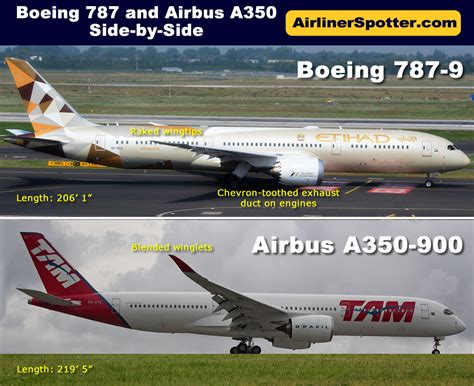
Technological Synergy in the A350 Platform
The A350’s success as a ULR foundation lies in the synergy between its aerodynamic, material, and engine technologies. With more than 70% of its structure composed of composite materials, aluminum-lithium alloys, and titanium, the aircraft achieves weight efficiencies that directly translate to range. The Rolls-Royce Trent XWB engines—among the most efficient large turbofans ever produced—deliver both reliability and reduced fuel burn.
These features, built into the aircraft from inception, created a natural runway for Airbus to explore even more extreme performance envelopes without extensive redesign. The ULR variants are an extension of the original design philosophy: maximizing efficiency while maintaining structural discipline.
Looking Ahead: Will More ULRs Emerge?
The future of ULR aviation remains tied to a balance of demand, economics, and sustainability. While long nonstop flights captivate public imagination and offer unmatched convenience, they require passengers willing to spend extended periods onboard and airlines confident that yield can offset the operational cost. Environmental considerations will also influence the trajectory of ultra-long-haul development; as governments and regulators emphasize carbon reduction, airlines will weigh the efficiency of ULR missions against multi-stop itineraries.
Yet the appeal remains undeniable. For passengers, the ability to fly directly from origin to destination—no connections, no layovers, no missed flights—holds powerful value. For airlines, ULR routes create unique branding opportunities and competitive differentiation. As engine technology advances and materials science progresses, the possibilities for future ULR platforms will expand.
Airbus’ work on the A350 ULR family demonstrates that the industry is capable of stretching the boundaries of long-haul flight while still maintaining economic and operational feasibility. It is likely that the A350 ULR variants will remain specialized, but their existence influences the broader evolution of aircraft design by proving that such extreme missions are both technically and commercially viable.
The next decade will determine whether the ultra-long-haul trend expands beyond the limited circles of premium-focused global carriers or remains a uniquely high-end niche. Whatever the outcome, the A350 ULR has already secured its place as a landmark achievement, redefining what airlines can ask of a twin-engine widebody and reshaping expectations for intercontinental travel at the absolute limits of range.