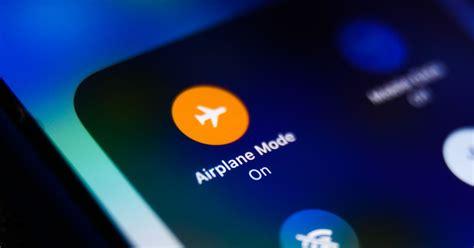
For millions of travelers, enabling airplane mode has become as automatic as fastening a seatbelt before takeoff. The cabin doors close, flight attendants begin their safety demonstration, and passengers instinctively tap the tiny airplane icon on their smartphones without giving it a second thought. Yet behind this long-standing aviation ritual lies a surprising reality: modern evidence increasingly suggests airplane mode no longer serves the technical purpose most people believe it does.
The original fear surrounding mobile phones on aircraft was never really about planes falling from the sky. Instead, regulators worried that cellphone signals could interfere with ground-based cellular networks and potentially create communication issues for towers struggling to track fast-moving devices at cruising altitude. That concern made sense decades ago when mobile technology was primitive, analog networks were fragile, and aviation regulators preferred extreme caution over experimentation.
Today, however, aviation technology, telecommunications infrastructure, and smartphone engineering have evolved dramatically. Aircraft are essentially flying data centers packed with advanced shielding, redundant systems, and electronics specifically tested against radio-frequency interference. At the same time, mobile networks themselves have become smarter, more resilient, and far more capable of handling complicated signal environments than they were in the early 1990s.
The strange part is that despite overwhelming technological progress, the rule itself has barely changed.
The Original Airplane Mode Ban Was Created For Another Era
The Federal Communications Commission first prohibited certain cellphone use on aircraft back in 1991. At the time, mobile phones primarily operated on the 800 MHz frequency band, and regulators worried those signals could disrupt terrestrial cellular systems. Aircraft avionics were not the primary concern. The focus was largely on protecting the integrity of communications infrastructure on the ground.
That distinction matters because modern smartphones rarely rely on the same frequencies or transmission methods that triggered those early fears. Cellular technology has moved through multiple generations, from analog to 2G, 3G, 4G LTE, and now 5G networks capable of handling enormous amounts of traffic with vastly improved efficiency.
Meanwhile, aircraft manufacturers spent years stress-testing airplanes against electromagnetic interference. Boeing and Airbus conducted extensive internal research exposing aircraft systems to radio-frequency signals generated by passenger devices. Their findings repeatedly showed no dangerous interference with navigation or flight-critical systems.
The image many travelers still carry — a single ringing phone somehow confusing a multimillion-dollar aircraft cockpit — belongs more to aviation mythology than engineering reality.
Modern Aircraft Are Built To Resist Electronic Interference
Commercial aircraft are not delicate machines vulnerable to random consumer electronics. They are engineered specifically to survive in electrically noisy environments filled with radar systems, satellite communications, weather equipment, navigation instruments, and countless onboard electronic devices operating simultaneously.
Every modern jetliner already contains hundreds of signal-emitting systems stronger and more complex than the average smartphone. Pilots use radios continuously during flight. Aircraft communicate with satellites. Wi-Fi systems transmit data throughout the cabin. Passengers connect Bluetooth headphones, smartwatches, tablets, and laptops for hours at a time.
If smartphones genuinely posed a major danger to avionics, airlines would never permit onboard Wi-Fi networks in the first place.
The Federal Aviation Administration effectively acknowledged this reality during its own investigations. In 2012, the FAA studied potential interference issues and found no verified cases of mobile phones causing dangerous disruptions to aircraft systems. That conclusion aligned with years of manufacturer testing already conducted behind the scenes.
The evidence simply failed to support the fear.
Europe Quietly Proved Airplane Mode Is Technically Unnecessary
One of the strongest arguments against the continued relevance of airplane mode comes from Europe. In 2022, European regulators formally cleared the way for expanded 5G connectivity onboard aircraft, building upon frameworks that had already existed for years.
European airlines increasingly use onboard picocells — miniature cellular base stations installed inside the aircraft cabin. These systems allow passenger phones to connect locally rather than attempting to blast signals toward distant towers thousands of feet below. Because devices no longer need to search aggressively for ground networks, signal interference concerns become almost irrelevant.
Importantly, European skies did not descend into chaos after these changes. Aircraft continued operating safely, passengers continued flying normally, and aviation systems functioned exactly as expected.
That reality creates an uncomfortable question for regulators elsewhere: if modern aircraft can safely coexist with active mobile connectivity in Europe, why do stricter restrictions remain deeply entrenched in the United States?
The answer has far less to do with engineering than with human behavior.
The Real Fear Is Passenger Chaos, Not Technology
The strongest resistance to eliminating airplane mode has not come from pilots warning about catastrophic equipment failures. Instead, opposition largely emerged from airlines, regulators, unions, and lawmakers concerned about cabin behavior.
Back in 2013, former FCC chairman Tom Wheeler explored lifting restrictions on in-flight cellular use. The proposal immediately encountered backlash, not because of safety data, but because many feared passengers making loud voice calls during flights would create unbearable cabin environments.
That concern sounds trivial until considering how tense modern air travel already feels. Crowded cabins, shrinking legroom, delays, cancellations, and rising passenger frustration have contributed to a dramatic increase in disruptive incidents onboard flights.
Between 2021 and 2023, the FAA recorded more than 10,000 reports involving unruly passengers and air rage incidents. Airlines have little interest in introducing another trigger for confrontation by allowing full-scale phone conversations at 35,000 feet.
A cabin filled with simultaneous FaceTime calls and business negotiations sounds less like a premium travel experience and more like public transportation during rush hour.
In many ways, airplane mode now functions less as a technical safeguard and more as a social control mechanism.
Bureaucracy Keeps The Rule Alive Even Without Strong Evidence
Even if regulators fully accepted that airplane mode serves little technical purpose, changing the rules would still be painfully slow. Aviation regulation moves cautiously by design, and multiple federal agencies share overlapping authority over in-flight communications.
The FAA governs aviation safety under one section of federal law, while the FCC controls telecommunications regulations under another entirely separate legal framework. Altering both systems would require coordination between agencies historically known for conservative decision-making.
Former American Airlines pilot and aviation consultant Richard Levy summarized the situation bluntly when speaking to Popular Science, noting that U.S. regulators tend to wait for overwhelming proof of zero risk before changing long-standing policies.
That standard becomes nearly impossible to satisfy because proving absolute safety is fundamentally different from proving a lack of evidence for danger.
As a result, the easier institutional choice is maintaining the status quo. Passengers already understand the rule, airlines already enforce it, and regulators avoid political backlash by leaving everything untouched.
Airplane Mode Survives Because Nobody Wants The Headache
Ironically, airplane mode has become one of the least meaningful yet most universally obeyed rules in commercial aviation. Most passengers comply automatically, even though many now use onboard Wi-Fi systems capable of supporting messaging, streaming, and internet browsing throughout flights.
The technical justification has weakened considerably over time, but the cultural habit remains deeply embedded in air travel routines. Regulators avoid reopening a politically inconvenient debate, airlines avoid potential passenger conflicts, and travelers continue pressing the same familiar button before takeoff.
In practical terms, modern aircraft are already capable of safely handling active electronic devices. The continued existence of airplane mode says far more about bureaucracy, public behavior, and institutional caution than about actual technological necessity.
For now, though, the tiny airplane icon is staying exactly where it has been for decades — less because aviation needs it, and more because the industry finds it easier not to ask what happens without it.