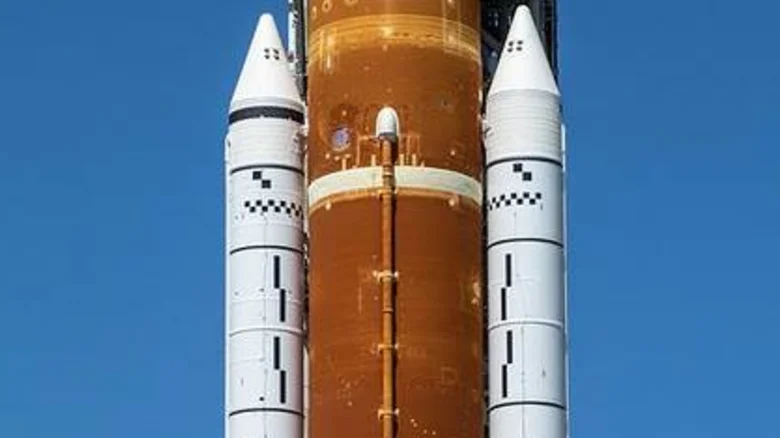
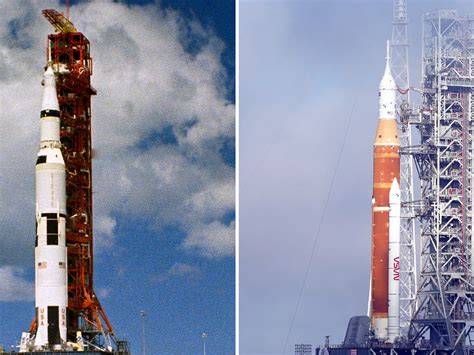
Rockets often carry a distinctive black-and-white checkered pattern across their bodies, a design that can look decorative at first glance. On vehicles such as NASA’s Saturn V and Space Launch System (SLS), these squares and rectangular markings stand out against otherwise functional hardware. Yet the unusual paint scheme is not primarily about appearance. It is a practical visual tool that helps engineers and scientists reconstruct exactly how a rocket moves during flight.
During a launch, a rocket does not simply travel vertically into space. After liftoff, it gradually pitches over and follows a carefully controlled trajectory toward orbit. Cameras positioned around the launch area track the vehicle throughout this process, but determining its precise movement from ordinary footage can be difficult. The high-contrast checkerboard markings give those cameras recognizable reference points that can be followed frame by frame.
The principle is relatively straightforward. As a rocket moves through the camera’s field of view, the apparent positions and shapes of its markings change. By analyzing those changes, engineers can determine information about the vehicle’s position, orientation, rotation, and motion. Multiple cameras can observe the same markings from different angles, allowing the collected imagery to provide three-dimensional information about the rocket’s movement.
How Rocket Checkerboard Patterns Help Tracking Cameras
The important feature of the markings is their strong visual contrast. Black squares placed beside white sections remain easy for specialized tracking cameras to distinguish even when a rocket is moving rapidly across the sky. Rather than treating the entire vehicle as one large object, engineers can use individual markings as identifiable reference features.
This becomes particularly valuable during dynamic events such as liftoff and stage separation. A rocket can accelerate rapidly, rotate, bend slightly under aerodynamic loads, and change its orientation during flight. When different parts of the vehicle carry identifiable patterns, cameras can monitor how those areas move relative to one another.
NASA has described the markings on its SLS boosters in similar terms. During flight analysis, cameras can track specific crosshair-like markings and combine observations from multiple patterns. Engineers can then use those measurements to reconstruct the vehicle’s motion after the flight, providing detailed information that ordinary launch video cannot provide by itself.
The Checkerboard Pattern Dates Back to the V-2 Rocket
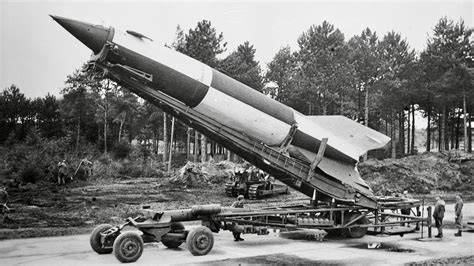
The technique is much older than NASA’s lunar program. Black-and-white rocket markings were already being used on the German V-2 during World War II, when engineers needed ways to study the behavior of one of the earliest long-range ballistic missiles.
The V-2’s distinctive paint patterns were therefore part of an engineering and measurement system rather than simply a visual design choice. The high-contrast sections made it easier for cameras and observers to determine how the rocket was moving during its ascent.
After World War II, American rocket development incorporated expertise from German engineers and scientists, including Wernher von Braun, who later became a major figure in the United States space program. The visual tracking techniques associated with early rocketry continued to influence later programs, eventually appearing on launch vehicles associated with America’s human spaceflight efforts.
Why NASA Still Uses Black and White Rocket Markings
Modern rockets have vastly more sophisticated sensors, telemetry systems, navigation computers, and onboard guidance equipment than their predecessors. That might make painted tracking patterns seem unnecessary. In reality, external optical measurements still provide an important independent source of information.
Ground-based cameras can record what the rocket physically does from outside the vehicle. This makes optical tracking especially useful when engineers are studying events such as stage separation, structural movement, or unexpected motion. Comparing camera-derived measurements with telemetry can help investigators understand exactly what happened during a flight.
The patterns also demonstrate an enduring engineering principle: sometimes a remarkably simple solution remains useful even as technology becomes dramatically more advanced. Those familiar black-and-white squares are therefore not merely part of rocket history. They are a practical measurement system, linking the V-2 era of rocketry with modern NASA launch vehicles.