The image of a 70-year-old bomber carrying one of the most advanced nuclear weapons ever built sounds almost contradictory—like mounting a supercomputer inside a vintage typewriter. Yet this is precisely the strategic reality unfolding in 2026. The B-52 Stratofortress, first flown in 1952, is not fading into history. Instead, it is being rearmed, reengineered, and repositioned at the center of modern nuclear deterrence with the AGM-181 Long Range Stand-Off (LRSO) missile.
This pairing is not accidental. It is the result of calculated decisions rooted in cost efficiency, operational flexibility, and evolving global threats. As adversaries deploy increasingly sophisticated air defense systems, the United States is doubling down on a paradox: combining a Cold War-era airframe with next-generation stealth technology to maintain strategic dominance.
The Enduring Power of the B-52 Stratofortress
The B-52 Stratofortress was never designed to last this long. When it entered service in 1955, the world was still transitioning into the jet age. Its expected lifespan was measured in decades—not nearly a century. Yet here it stands, projected to remain operational into the 2050s, potentially becoming the first combat aircraft to serve for 100 years.
What explains this extraordinary longevity is not nostalgia—it is capability.
The aircraft’s defining advantage lies in its unmatched payload capacity and range. With the ability to carry up to 70,000 pounds of ordnance, the B-52 operates less like a traditional bomber and more like a strategic weapons platform. Its range, extending over 4,480 miles without refueling, becomes virtually unlimited when paired with aerial tankers. This allows it to operate across continents without ever approaching hostile airspace.
Equally important is its adaptability. The B-52’s large fuselage and external hardpoints make it uniquely suited to carry evolving weapons systems. Unlike stealth bombers, which must conceal their payload internally, the B-52 embraces its role as a “missile truck”, prioritizing capacity over invisibility.
This adaptability is being reinforced through modernization efforts, including the Commercial Engine Replacement Program, which replaces aging engines with Rolls-Royce F130 turbofans. These upgrades are not cosmetic—they significantly extend operational life, improve fuel efficiency, and reduce maintenance demands.

Why Aging Aircraft Still Outperform New Alternatives
At first glance, it might seem logical to replace the B-52 with newer bombers like the B-2 Spirit or the emerging B-21 Raider. However, this assumption overlooks the fundamental differences in mission design.
The B-2 and B-21 are penetration bombers, engineered to slip through enemy defenses undetected and deliver weapons directly over targets. They rely on stealth to survive.
The B-52 operates on a completely different principle: stand-off warfare. Instead of entering contested airspace, it launches weapons from hundreds or even thousands of miles away, allowing the missile—not the aircraft—to face enemy defenses.
This distinction is crucial. Penetration and stand-off capabilities are not competing strategies; they are complementary layers of deterrence. The B-52’s role is to deliver overwhelming missile firepower at scale, something stealth bombers—with their limited payload and smaller fleets—cannot match.
Numbers matter in deterrence. With 76 operational B-52H bombers, the United States can deploy a far greater volume of nuclear-capable missiles than its stealth fleet alone would allow. This creates strategic redundancy, ensuring that even in the face of advanced defenses, enough weapons remain viable to deter aggression.
The Problem with the AGM-86B: A Missile Out of Time
For decades, the B-52 has relied on the AGM-86B Air-Launched Cruise Missile (ALCM). Introduced in 1982, it was designed for a vastly different threat environment—one dominated by Cold War-era Soviet radar systems.
Its intended lifespan? Just ten years.
Instead, it has remained in service for over four decades. While continuous upgrades have kept it operational, the underlying reality is unavoidable: the ALCM is a legacy system struggling against modern threats.
Today’s adversaries deploy integrated air defense networks that combine advanced radar, satellite tracking, and layered interception systems. These defenses are specifically designed to detect and neutralize weapons like the AGM-86B, which rely on older stealth concepts and predictable flight profiles.
Maintaining the ALCM has also become increasingly complex. Many of its components are no longer in production, forcing engineers to rely on custom replacements and workarounds. Over time, the cost and difficulty of sustaining such a system begin to outweigh its operational value.
The conclusion was inevitable: a replacement was not just desirable—it was essential.
Enter the AGM-181 LRSO: Redefining Nuclear Stand-Off Capability
The AGM-181 Long Range Stand-Off missile represents a generational leap in air-launched nuclear weapons. Developed by Raytheon Technologies (RTX), this missile is designed from the ground up to survive in highly contested environments.
With an estimated cost of $14 million per unit, the LRSO is a significant investment. But its capabilities justify the price.
At its core, the missile combines advanced stealth shaping, low-observable materials, and next-generation guidance systems. Unlike older cruise missiles that relied on speed or altitude, the LRSO focuses on invisibility and unpredictability. It is not meant to outrun defenses—it is designed to avoid detection altogether.
Its payload is equally formidable. The missile carries the W80-4 nuclear warhead, a modernized version of an existing design with a yield of up to 150 kilotons—roughly ten times the power of the Hiroshima bomb. This ensures that even a limited number of successful penetrations can achieve strategic objectives.
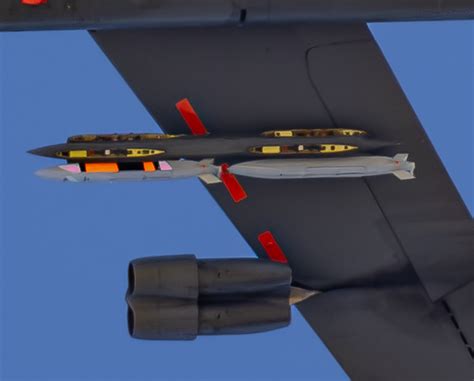
The LRSO’s defining feature is its stand-off range. By allowing the B-52 to launch from outside enemy air defenses, it eliminates the need for the aircraft to risk exposure. This dramatically increases survivability while maintaining offensive capability.
Stealth Over Speed: A Strategic Shift in Missile Design
One of the most interesting aspects of the LRSO is what it is not. It is not hypersonic. It does not rely on extreme speed.
Instead, it represents a strategic shift toward stealth-first design philosophy.
This approach acknowledges a key reality: modern air defense systems are increasingly capable of tracking and intercepting fast-moving objects. Speed alone is no longer sufficient. What matters is the ability to remain undetected long enough to reach the target.
By flying at high subsonic speeds and using terrain-following flight paths, the LRSO minimizes its radar signature while maintaining operational flexibility. Its guidance system is designed to adapt to changing conditions, ensuring accuracy even in electronically contested environments.
This combination of stealth, adaptability, and precision makes it far more survivable than its predecessor.
From Secrecy to Visibility: The California Test Flights
For years, the LRSO program remained largely hidden from public view. That changed dramatically with a series of test flights over California in 2025 and 2026.
Photographs captured during these tests revealed a B-52H carrying a single LRSO missile mounted on an external pylon. The missile featured START treaty compliance markings, confirming its nuclear-capable role.
These images were more than just a glimpse into a classified program—they were a strategic signal. By allowing limited visibility, the United States demonstrated progress without revealing critical details.

The tests themselves focused on captive carry evaluations, assessing how the missile behaves when mounted on the aircraft. This includes analyzing aerodynamic stability, structural integrity, and system integration.
Low-level flight routes were chosen deliberately. These environments simulate real-world operational conditions, where terrain and altitude variations play a critical role in mission success.
Why the B-52 Is the Perfect Platform for the LRSO
The decision to pair the LRSO with the B-52 is rooted in practicality as much as strategy.
First, the aircraft’s external payload capability makes integration significantly easier. Unlike stealth bombers, which must carry weapons internally to maintain low observability, the B-52 can mount large missiles externally without compromising its mission profile.
Second, decades of experience with the AGM-86B provide a strong foundation for integration. Engineers are not starting from scratch—they are building on a proven system, reducing risk and accelerating development timelines.
Third, and perhaps most importantly, the B-52 offers scale. A single aircraft can carry multiple cruise missiles, and a fleet of dozens can deploy a massive volume of stand-off weapons simultaneously.
This creates a level of deterrence through saturation. Even the most advanced defense systems can be overwhelmed if forced to engage too many targets at once.
The Role of LRSO in America’s Nuclear Triad
The LRSO is not just a replacement missile—it is a critical component of the United States nuclear triad, which consists of:
- Intercontinental ballistic missiles (ICBMs)
- Submarine-launched ballistic missiles (SLBMs)
- Strategic bombers
Each leg of the triad serves a unique purpose. Bombers, in particular, offer flexibility and recallability. Unlike ballistic missiles, which cannot be stopped once launched, bombers can be redirected or recalled, providing valuable decision-making time during a crisis.
The addition of the LRSO enhances this flexibility by enabling bombers to operate at safe distances while still maintaining credible strike capability.
This ensures that the airborne leg of the triad remains relevant in an era of advanced air defenses.
Modernization and the Road to the 2030s
The LRSO program is part of a broader multi-decade nuclear modernization effort. Alongside it, the United States is developing:
- The B-21 Raider stealth bomber
- The Sentinel ICBM system
- The Columbia-class ballistic missile submarine
These programs are interconnected, each addressing a different aspect of strategic deterrence. The LRSO’s timeline, targeting operational deployment in the mid-2030s, aligns with the development of the W80-4 warhead.
This synchronization is essential. A missile without a warhead—or vice versa—cannot fulfill its mission.
A Strategic Paradox That Works
There is something undeniably striking about the image of a 1960s-era bomber carrying a 21st-century stealth missile. It challenges conventional assumptions about military innovation.
But this is not a contradiction—it is a strategy.
By leveraging the strengths of an existing platform and pairing it with cutting-edge technology, the United States achieves a balance of cost efficiency, operational readiness, and strategic effectiveness.
Replacing the B-52 entirely would require tens of billions of dollars and decades of development. Upgrading it, on the other hand, delivers immediate capability at a fraction of the cost.
Conclusion: Old Airframe, New Power
The continued relevance of the B-52 Stratofortress is a testament to the power of adaptability in military design. Its partnership with the AGM-181 LRSO is not just about extending the life of an aircraft—it is about redefining how that aircraft contributes to modern warfare.
In a world where threats evolve rapidly, the ability to integrate new technology into proven platforms offers a decisive advantage. The B-52, once a symbol of Cold War power, is now a cornerstone of 21st-century nuclear deterrence.
And as long as it can carry the most advanced weapons ever built, its age becomes irrelevant.