The story of the F-14 Tomcat’s swing wings is not just a tale of engineering ingenuity—it’s a narrative forged at the intersection of physics, naval warfare, and raw operational necessity. Designed during the unforgiving tension of the Cold War, the aircraft had to master two completely opposite flight regimes: blistering supersonic interception and slow, controlled carrier landings on a pitching deck. These conflicting demands forced engineers to abandon conventional wing design and embrace one of the most visually striking and mechanically complex solutions ever flown—the variable-sweep wing.
To understand why the Tomcat’s wings had to move at all—let alone sweep back during flight—you have to step into the aerodynamic paradox at the heart of naval aviation. The same wing that slices cleanly through the air at Mach 2 becomes a liability when the aircraft slows down to land. And when that landing happens on a floating runway barely a few hundred feet long, the margin for error shrinks to almost nothing.
The Dual Personality of the F-14 Tomcat
The F-14 was not built for a single purpose—it was designed to dominate two extremes. On one hand, it needed to intercept enemy bombers at high altitude and supersonic speeds. On the other, it had to return safely to an aircraft carrier, descending at low speeds with absolute precision.
This duality created a fundamental aerodynamic conflict.
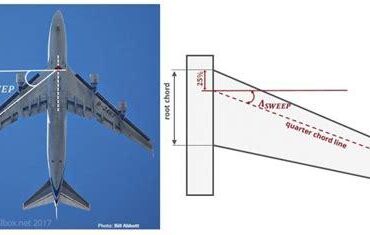
At high speeds, aircraft require wings that are swept back sharply. This reduces drag and delays the formation of shockwaves as the plane approaches and exceeds the speed of sound. A swept-back wing effectively “tricks” the airflow, allowing the aircraft to move faster without tearing itself apart with aerodynamic resistance.
But that same swept-back wing becomes dangerously inefficient at low speeds. It produces less lift, increases stall speed, and demands higher angles of attack—conditions that are unacceptable when landing on a carrier deck that is constantly moving with the sea.
The Tomcat’s solution was radical: instead of choosing one wing shape, it would use both.
Why Carrier Landings Demand a Completely Different Wing
Landing on an aircraft carrier is widely considered one of the most difficult tasks in aviation. Pilots must guide a high-performance jet onto a narrow strip of deck that’s not only short but also moving unpredictably. Unlike conventional runways, there is no room to “float” or adjust—every approach must be precise.
For such landings, aircraft need maximum lift at low speeds. This typically means:
- Broad wings with minimal sweep
- High camber to increase lift
- Stable handling at slow speeds
A straight or slightly swept wing excels here, allowing the aircraft to remain airborne at slower speeds without stalling. It gives pilots the control and margin they need during the critical final seconds before touchdown.
However, designing a jet fighter with such wings would severely limit its top speed and combat effectiveness. A wide, straight wing creates massive drag at high speeds, effectively putting a ceiling on performance.
The F-14 couldn’t afford that compromise.
The Aerodynamic Breakthrough: Variable Geometry Wings
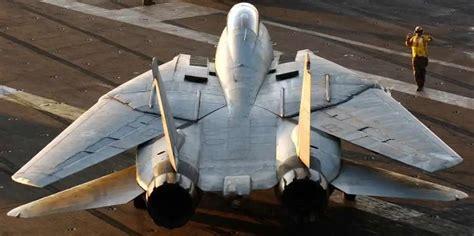
Instead of forcing a compromise, engineers designed a wing that could physically change shape in flight. The F-14’s wings pivoted on massive titanium structures, allowing them to sweep forward or backward depending on speed and flight conditions.
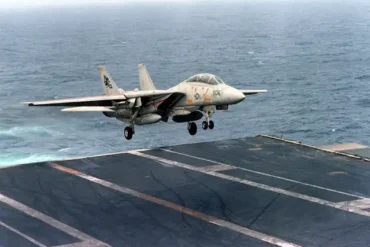
At low speeds—especially during takeoff and landing—the wings automatically swept forward. This increased their surface area and improved lift, allowing the aircraft to fly slower without stalling.
At high speeds, the wings swept back dramatically, reducing drag and enabling the aircraft to push past Mach 2.
This wasn’t just clever engineering—it was a necessity.
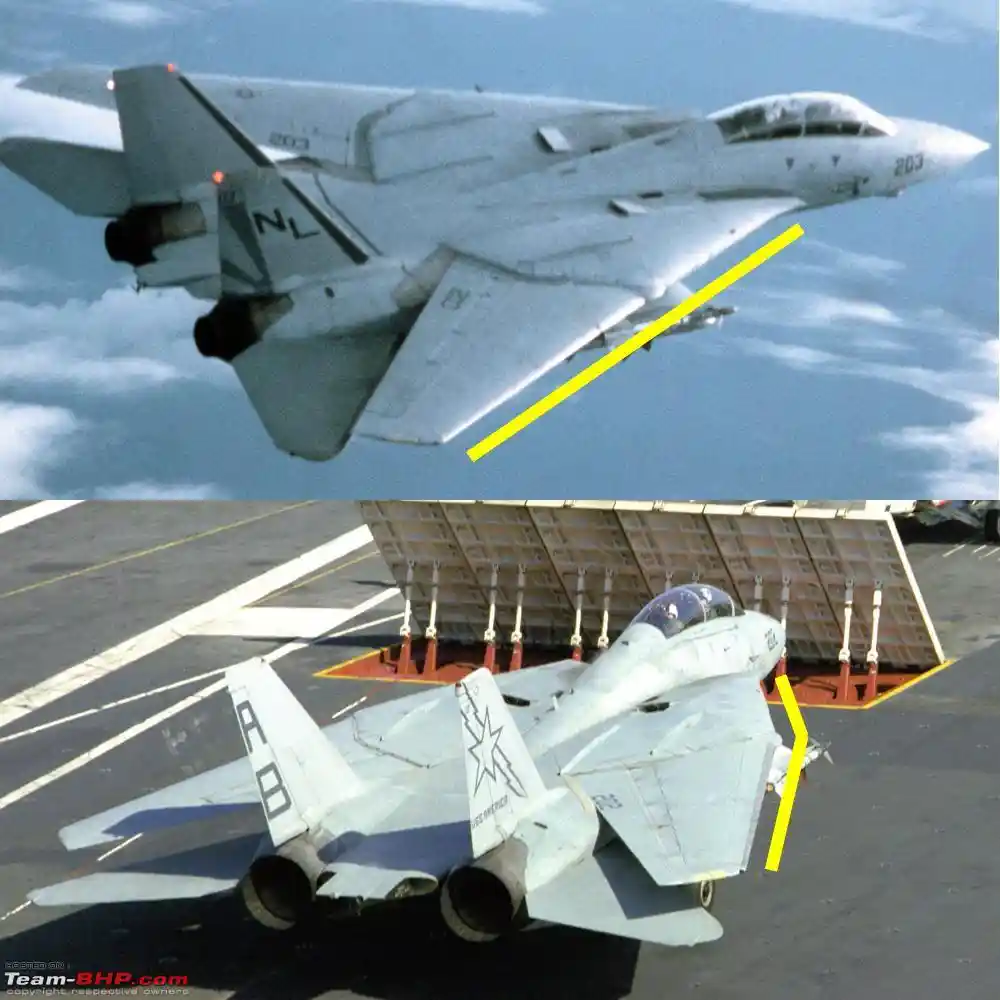
Without this system, the Tomcat would have been either an excellent interceptor that couldn’t land safely on a carrier, or a carrier-friendly aircraft that couldn’t fulfill its combat role. The swing-wing design allowed it to be both.
Why Sweeping Back Matters Even During Landing
Here’s where things get more interesting—and slightly counterintuitive.
While the F-14 typically landed with its wings fully extended forward, the ability to sweep them backward still played a critical role in the landing process. The transition between sweep angles wasn’t binary—it was continuous and dynamic.
During approach, the onboard flight computer adjusted wing position based on speed and altitude. As the aircraft slowed, the wings gradually moved forward, optimizing lift. But in certain conditions—such as higher approach speeds, turbulence, or deck movement—the wings might not be fully forward until the final moments.
This flexibility allowed pilots to maintain better control authority and adapt to real-time conditions.
In emergency scenarios, the Tomcat could even land with partially or fully swept-back wings. It wasn’t ideal—stall speeds would be higher, and handling more difficult—but it demonstrated just how robust and versatile the system was.
The Physics Behind the Sweep
To appreciate why wing sweep is so important, you need to look at how air flows over a wing.
At subsonic speeds, lift is generated by the pressure difference between the upper and lower surfaces of the wing. A larger wing with more curvature generates more lift, especially at lower speeds.
But as speed increases toward the sound barrier, airflow begins to compress. Shockwaves form, dramatically increasing drag—a phenomenon known as wave drag. Sweeping the wings back reduces the effective airflow velocity perpendicular to the wing, delaying these shockwaves and allowing higher speeds.
In simple terms:
- Forward wings = more lift, better for slow flight
- Swept-back wings = less drag, better for high-speed flight
The F-14 didn’t just balance these factors—it actively optimized them in real time.
Engineering the Swing-Wing Mechanism
Designing a wing that moves in flight is one thing. Making it reliable enough for combat operations is another entirely.
The F-14’s wings were mounted on a central pivot system built from high-strength titanium. This structure had to endure enormous aerodynamic forces, especially during high-speed maneuvers.
An onboard computer controlled the sweep automatically, adjusting wing position based on:
- Airspeed
- Altitude
- Angle of attack
Pilots could override the system manually if needed, but in most cases, the automation handled transitions seamlessly.
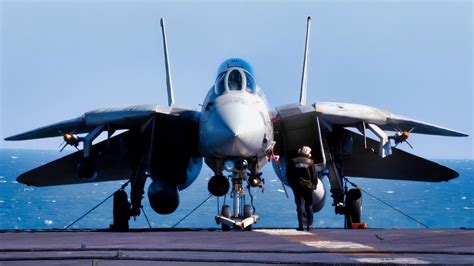
The wings could move between approximately 20 degrees (fully forward) and 68 degrees (fully swept for flight), with an additional 75-degree position used for carrier deck storage.
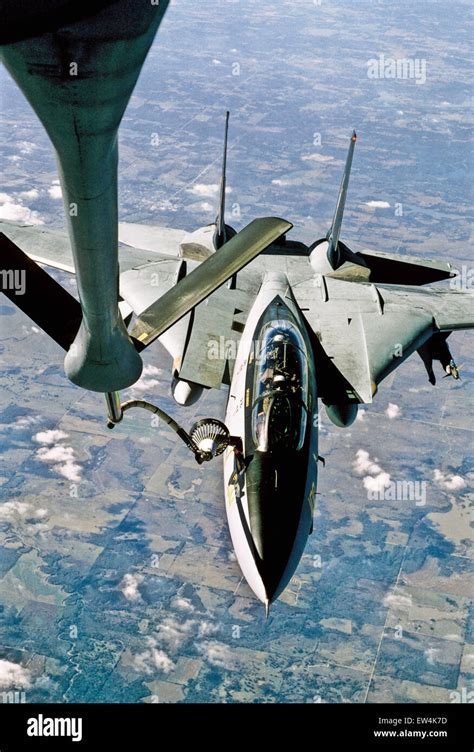
Despite its complexity, the system proved remarkably reliable. Not a single F-14 was lost due to wing sweep failure—a testament to the robustness of its design.
How the Swing Wings Transformed Dogfighting
The benefits of variable geometry extended far beyond carrier operations. One of the F-14’s greatest strengths was its agility in aerial combat—a surprising trait for such a large aircraft.
Earlier fighters struggled with maneuverability because they were optimized for speed and missile engagement rather than close-range dogfighting. The F-14 broke that mold.
By adjusting its wing sweep dynamically, the Tomcat could:
- Tighten its turning radius at lower speeds
- Maintain stability during aggressive maneuvers
- Transition smoothly between high-speed pursuit and close combat
This adaptability gave it a significant edge, allowing it to outperform aircraft that were limited by fixed wing designs.
Why Not Use Delta Wings Instead?
Some aircraft solve the high-speed versus low-speed dilemma using delta wings—triangular designs that perform reasonably well across a wide speed range. These wings are common on supersonic aircraft and offer structural simplicity.
However, delta wings come with trade-offs.
They tend to generate less lift at low speeds compared to traditional wings, requiring higher landing speeds and longer runways. For carrier operations, this is a serious limitation.
The F-14 required exceptional low-speed handling, not just adequate performance. The variable-sweep wing provided superior control during landing—something delta wings of the era couldn’t match.
The Cost of Complexity
For all its brilliance, the swing-wing system came at a price.
Maintaining the mechanism required extensive labor, specialized parts, and constant inspection. The added weight also reduced efficiency compared to simpler designs.
As technology advanced, engineers found alternative solutions—such as advanced aerodynamics and fly-by-wire systems—that could achieve similar performance without moving parts.
Eventually, the high cost of operating the F-14 contributed to its retirement. Newer aircraft offered better reliability, lower maintenance, and sufficient performance for modern missions.
The Legacy of the Swing-Wing Design
The F-14 was not the only aircraft to use variable geometry wings, but it remains the most iconic. Few designs have captured the imagination quite like the Tomcat, with its wings sweeping dramatically as it accelerated across the sky.
In the end, the swing-wing wasn’t just a feature—it was the defining solution to an impossible problem. It allowed a single aircraft to dominate both the high-speed skies and the unforgiving environment of carrier operations.
That’s why the wings had to move. Not as a gimmick, not as an experiment, but as a direct response to the brutal realities of physics and war.
And that’s what makes the F-14 Tomcat more than just a fighter jet—it makes it a masterpiece of adaptive engineering, built to thrive where compromise simply wasn’t an option.