The United States Navy is in the midst of one of the most consequential fleet transformations since the end of the Cold War. From nuclear-powered aircraft carriers to stealthy ballistic missile submarines, modernization is underway across nearly every class of vessel. Yet one of the most strategically revealing decisions involves a ship that is neither massive nor glamorous: the new Medium Landing Ship, a workhorse platform designed to put Marines ashore where ports do not exist and time is a luxury the United States may not have.
Rather than commissioning a clean-sheet American design, the Navy made a calculated and highly unconventional choice. In late 2025, it selected an existing foreign blueprint from the Dutch shipbuilding firm Damen, betting that proven engineering, faster construction timelines, and lower developmental risk matter more than national origin. The result is the LST-100, a vessel that reflects a shift in how the Navy thinks about shipbuilding under pressure.
This decision did not occur in a vacuum. U.S. naval planners are acutely aware that traditional ship procurement has become slow, costly, and vulnerable to supply chain disruptions. Delays affecting everything from destroyers to the future USS Enterprise have forced the Navy to rethink how it acquires platforms critical to near-term readiness. In that context, the LST-100 is less a compromise and more a statement of urgency.
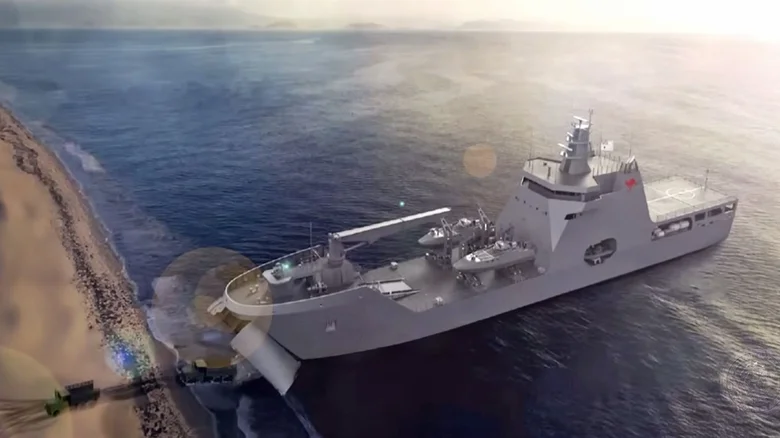
A Medium Landing Ship Built for Modern Expeditionary Warfare
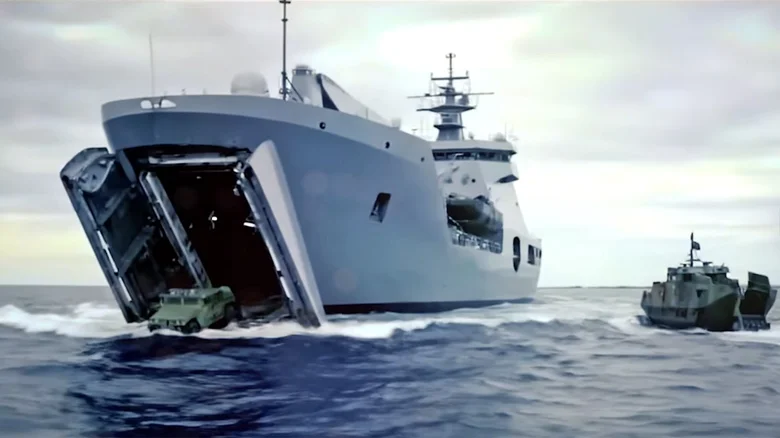
The Landing Ship Medium (LSM) occupies a vital niche between massive amphibious assault ships and smaller landing craft. Designed to deliver forces directly onto contested or undeveloped shorelines, the LST-100 embodies this mission with deliberate simplicity. It features a stern loading ramp, bow-mounted clamshell doors, and internal vehicle decks optimized for rapid embarkation and offload.
At approximately 4,000 tons, the LST-100 can transport more than 230 Marines along with their vehicles and equipment. Its operational range of roughly 3,400 nautical miles enables sustained operations across the vast distances of the Indo-Pacific. A stern helipad supports helicopters and unmanned aerial systems, expanding the ship’s utility beyond pure beach landings into reconnaissance, logistics, and command support roles.
Although owned and crewed by the U.S. Navy, the ship exists primarily to serve the U.S. Marine Corps, which lacks organic sealift assets. Marine Corps leadership played a central role in selecting the design, ensuring it aligns with evolving expeditionary concepts such as distributed maritime operations and expeditionary advanced base operations.
Why the Navy Looked Overseas for Answers
Selecting a foreign-designed ship marks a notable departure from tradition, but it reflects hard-earned lessons. The Damen LST-100 is not a prototype; it is a mature, operationally tested design. That maturity dramatically reduces engineering risk, accelerates production schedules, and limits the cascading delays that have plagued recent U.S. ship programs.
Crucially, the Navy is not outsourcing construction. While the intellectual design originates overseas, the ships themselves will be built in American shipyards by a yet-to-be-selected domestic builder. This hybrid approach preserves U.S. industrial capacity while bypassing the slow and expensive design phase that has become a recurring obstacle.
In practical terms, this decision acknowledges that speed now rivals superiority as a strategic requirement. In a potential high-end conflict, particularly in the Western Pacific, the ability to field numerous, reliable platforms quickly may matter more than marginal performance gains.
Strategic Implications in the Indo-Pacific Theater
The LST-100’s true importance becomes clear when viewed through the lens of Indo-Pacific security dynamics. Any conflict involving China would likely unfold across dispersed island chains, shallow littorals, and austere coastlines. Large amphibious ships are powerful but scarce, while smaller craft lack endurance and protection.
Medium landing ships bridge that gap. They enable Marines to move frequently, operate unpredictably, and avoid presenting lucrative targets. By deploying forces without reliance on established ports, the Navy and Marine Corps gain operational flexibility that complicates adversary planning.
The urgency surrounding the program reflects this reality. The Navy aims to begin construction as early as 2026, with the first delivery targeted for 2029. Long-term plans call for a fleet of at least 35 LST-100s, a number that would significantly expand the United States’ ability to sustain distributed amphibious operations.
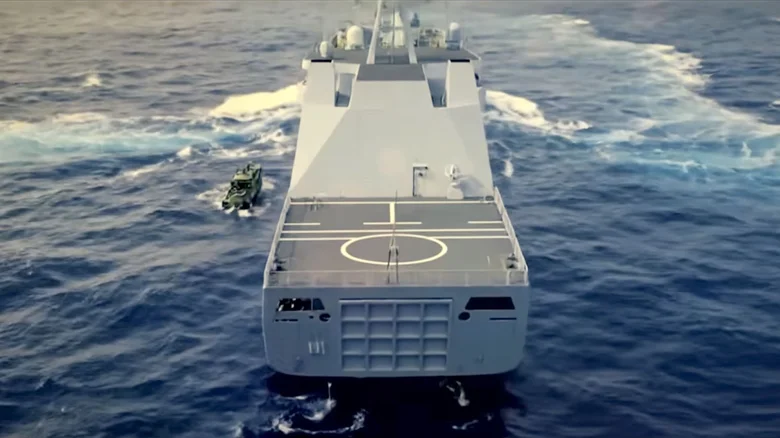
A Shift Toward Pragmatism in Naval Procurement
Beyond its tactical role, the LST-100 represents a philosophical shift. For decades, U.S. naval acquisition has favored bespoke, technologically ambitious platforms that often arrive late and over budget. The decision to adopt a “ready-to-run” design signals a renewed emphasis on practical capability, affordability, and timelines aligned with real-world threats.
This does not diminish American innovation; instead, it reflects confidence in integrating global best practices into domestic production. By focusing on what can be delivered reliably and soon, the Navy is recalibrating its priorities toward fleet resilience and numerical strength.
If successful, the LST-100 program may influence future procurement decisions well beyond amphibious ships. It demonstrates that under the right conditions, borrowing a foreign design is not a weakness, but a strategic accelerant. In an era defined by rapid change and mounting competition, the Navy’s bet on a foreign blueprint may prove to be one of its most forward-looking moves.