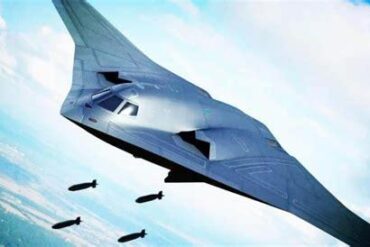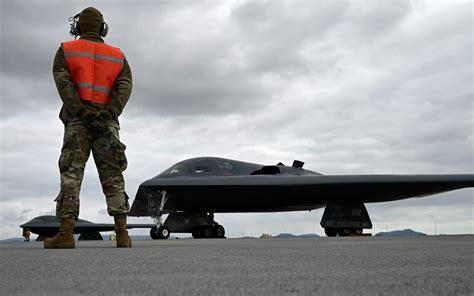
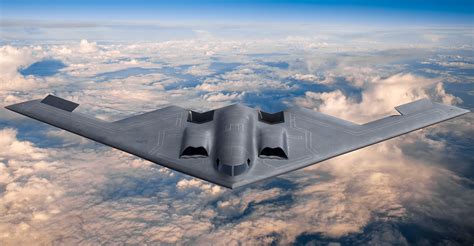
The B-2 Spirit Stealth Bomber, designed by Northrop Grumman, was an unparalleled feat of military aviation engineering — a flying wing capable of evading radar detection while delivering nuclear payloads deep within enemy territory. Yet, despite its revolutionary design and stealth capabilities, the U.S. abruptly ended its production in the mid-1990s. What could possibly justify canceling what many considered the crown jewel of American airpower? The answer lies in a complex convergence of shifting geopolitics, astronomical costs, and evolving military doctrine.
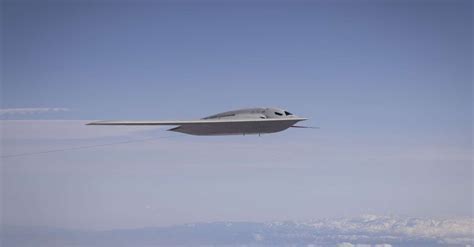
From Cold War Icon to Strategic Afterthought
The B-2 Spirit emerged from the darkest days of the Cold War, when U.S. defense policy revolved around one ominous possibility: nuclear war with the Soviet Union. Designed in secrecy under the Advanced Technology Bomber (ATB) program, the B-2’s development was initiated in the late 1970s and accelerated during the Reagan administration’s military buildup of the 1980s. Its purpose was singular: to penetrate deep into Soviet airspace, undetected by radar, and deliver thermonuclear destruction at will.
By the time the B-2 first flew in 1989, however, the geopolitical terrain had shifted dramatically. The Berlin Wall had fallen. The Soviet Union was unraveling. When the B-2 became operational in 1993, its primary adversary had ceased to exist. The logic behind a stealth nuclear bomber was rapidly evaporating.
With President George H.W. Bush taking strategic bombers off high-alert in 1991, and with an urgent national conversation underway about the cost of defense, the B-2’s raison d’être was fading. Military and civilian leaders alike began questioning whether such a pricey aircraft still had a place in the post-Cold War arsenal.
The Cold Math of a Hot Price Tag
Each B-2 unit carried a mind-boggling price tag of over $2 billion (adjusted for inflation), making it the most expensive aircraft ever built. Originally, the U.S. Air Force intended to procure 132 bombers, but this number was slashed dramatically following the Cold War’s end — first to 75, then 20, with just 21 B-2s ultimately produced.
Budget constraints were tightening. Domestic concerns like healthcare, education, infrastructure, and deficit reduction took center stage in the early 1990s. President Bush addressed these concerns directly in his 1992 State of the Union speech, arguing that halting B-2 production could save the government $50 billion over five years. The math was persuasive. Even within the Pentagon, there was tacit agreement that those billions might be better spent modernizing or downsizing existing forces rather than investing in Cold War-era platforms.
Shifting Priorities, Shrinking Threats
The Strategic Air Command (SAC), once responsible for launching immediate nuclear response missions, was dissolved in 1992. In its place came U.S. Strategic Command (USSTRATCOM), reflecting a more flexible, integrated deterrence philosophy that reduced dependence on manned bombers.
Furthermore, American adversaries were changing. The primary threats were no longer vast, industrialized militaries but asymmetric ones: terrorist networks, rogue states, and cyber attacks. These emerging dangers did not require nuclear deterrence delivered by stealth bombers but rather intelligence, precision strike capability, and agile deployments.
Even the Joint Chiefs of Staff and Secretary of Defense supported the reduction, recognizing that traditional Cold War platforms no longer fit into the U.S. military’s evolving doctrine. The military wasn’t getting weaker — it was becoming more adaptive. Ending the B-2 production symbolized a broader transition to post-Cold War defense priorities.
Operational Complexity and Maintenance Burdens
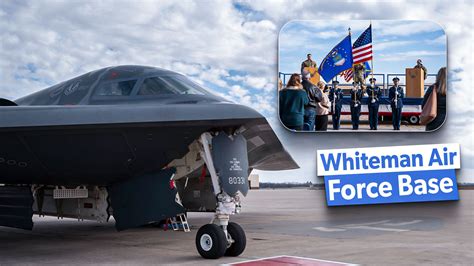
Aside from cost, the B-2 was notoriously complex to operate and maintain. Its stealth skin required extensive upkeep, often demanding controlled environments and hours of labor for every flight hour. The B-2 also required Whiteman Air Force Base in Missouri to invest in unique infrastructure, from specialized hangars to climate-controlled maintenance bays.
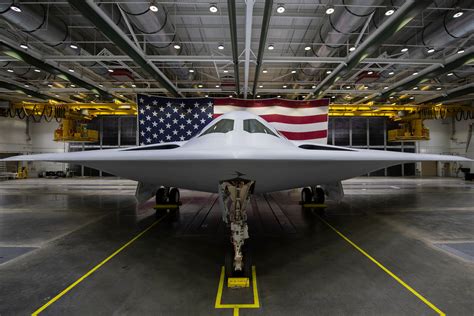
Unlike newer stealth platforms that integrated radar-absorbent materials directly into the structure, the B-2’s composite coating was fragile and needed frequent replacement. This made rapid deployment difficult and logistical planning cumbersome. The operational challenges made it harder to justify in an era of faster, more deployable strike assets.
The Rise of the B-21 Raider and Modern Strategic Thinking
The B-2’s fate was finally sealed with the birth of its spiritual successor: the B-21 Raider. Announced in 2015 and developed by Northrop Grumman, the B-21 is designed to address many of the B-2’s shortcomings — lower cost, easier maintenance, and enhanced stealth against next-generation air defenses.
The B-21 embodies a new strategy: multi-domain warfare, where air, cyber, and space capabilities converge. It reflects lessons learned from the B-2 — most notably that a stealth bomber must be affordable, scalable, and suited for the unpredictable threats of the 21st century.
Although the B-2 remains in limited service, the Pentagon has already planned its retirement by the early 2030s, with the B-21 expected to assume full operational duties. This transition reinforces the reality that the B-2, while revolutionary in its day, was also a product of a vanished era.
A Legacy of Innovation, Not Obsolescence
To say the B-2 failed would be incorrect. Despite its limited production, it has served in numerous roles — from conventional strikes in Kosovo, Iraq, and Afghanistan, to strategic deterrence missions over North Korea. Its psychological effect on adversaries alone was worth millions.
What ultimately doomed the B-2 was not a failure of vision, but a triumph of changing reality. It was built to fight a war that never came. And when the world changed, the bomber — for all its brilliance — was left behind by design.
The U.S. didn’t cancel the B-2 because it was ineffective. It canceled it because the world that required it had disappeared. The bomber’s fate was tied not to its performance, but to timing. In war, as in politics, timing is everything.
Conclusion: A Ghost from a Vanished War
The B-2 Spirit remains a symbol of unmatched technological ambition, a ghost from a time when nuclear war seemed not just possible, but inevitable. Its retirement was not a rejection, but a recalibration — a pivot toward threats that could not be solved by radar-evading wings alone.
Today, as the U.S. military readies the B-21 Raider and pursues more dynamic strategies, the B-2 endures as both a reminder of Cold War fears and a testament to American innovation. It soared into the skies at the very moment its reason for existing disappeared beneath it.