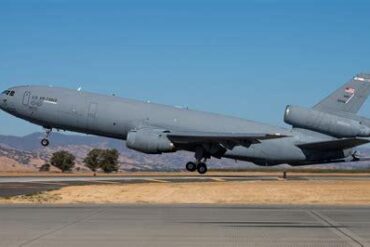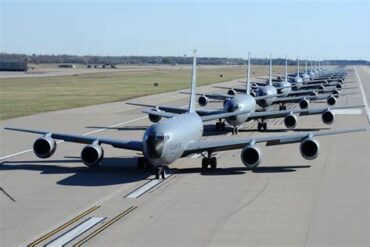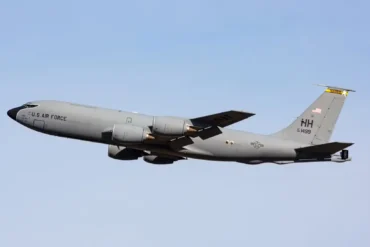
For nearly seven decades, the Boeing KC-135 Stratotanker has quietly enabled almost every major American military operation across the globe. It has outlasted presidents, survived the Cold War, adapted to the jet age, and remained indispensable through conflicts ranging from Vietnam to Iraq. Yet in 2026, the United States Air Force finds itself confronting a difficult truth: the aircraft that once symbolized strategic endurance is now becoming a strategic liability.
The Air Force’s decision to spend $3.9 billion annually on the KC-46A Pegasus is not simply a procurement exercise. It is an urgent response to mounting operational pressure, rising maintenance burdens, and the growing vulnerability of aging tankers in contested airspace. Aerial refueling is the invisible infrastructure behind American airpower. Fighters cannot patrol distant skies without it. Bombers cannot strike deep targets without it. Surveillance aircraft cannot maintain persistent coverage without it. Remove the tanker fleet from the equation, and the entire architecture of US global military reach begins to collapse.
What makes the current transition remarkable is that the aircraft being replaced first entered service in 1957, while the replacement itself is still battling technical deficiencies serious enough to trigger Pentagon warnings. The Air Force is effectively trapped between an aging Cold War workhorse and a modern successor still struggling to mature operationally.
The result is one of the most consequential aviation transitions underway anywhere in the world.
The KC-135’s story began during the height of Cold War nuclear strategy. Designed around the doctrine of strategic deterrence, the aircraft’s original mission was brutally simple: ensure that American bombers carrying nuclear weapons could reach Soviet territory and return if necessary. The concept transformed aerial refueling from a support capability into a cornerstone of national survival.
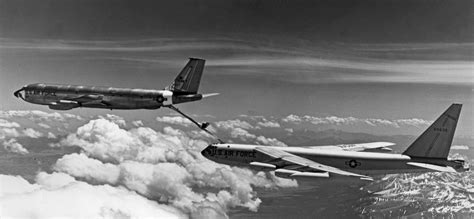
At the time, Strategic Air Command needed a tanker capable of sustaining fleets of B-52 Stratofortress bombers on intercontinental missions. The KC-135 delivered exactly that. Built from Boeing’s revolutionary jet transport architecture, the aircraft became the first jet-powered tanker in Air Force history and immediately changed the operational range of US aviation.
By the time production ended in 1965, Boeing had delivered more than 800 Stratotankers.
The aircraft’s true value became obvious during real-world operations. During the Vietnam War alone, KC-135 crews flew more than 194,600 sorties and offloaded approximately 1.4 billion gallons of fuel. That number remains staggering even by modern standards. Every long-range bombing campaign, every fighter escort mission, and every reconnaissance operation depended on tankers orbiting high above the battlefield.
Unlike glamorous fighters or stealth bombers, tankers rarely attracted public attention. Their importance emerged indirectly through the endurance of other aircraft. A fighter that could normally remain airborne for two hours suddenly became capable of operating for six or eight. A bomber mission once limited by fuel reserves could now span continents.
That strategic flexibility fundamentally changed how the United States projected power.
Retired Air Mobility Command personnel have often described the tanker fleet as the circulatory system of the Air Force. Without fuel transfer in the sky, American global reach shrinks dramatically. The famous quote from retired navigator Maj. Jim Hickman captures the point with unusual bluntness:
“The tankers were the lifeblood for the B-52s. Without the KC-135s, the bombers may or may not have reached their destination.”
The astonishing part is not merely that the KC-135 survived into the 21st century. It is that it remained operationally relevant long after its expected lifespan expired.
A major reason for this longevity was the extensive KC-135R modernization program, which replaced the original engines with CFM56 turbofans. The upgrade dramatically improved fuel efficiency, reliability, and performance while reducing noise levels and maintenance costs. Structural reinforcement programs further extended service life, allowing aircraft built during the Eisenhower administration to continue flying alongside fifth-generation fighters.
Still, physics eventually wins.
Metal fatigue accumulates. Maintenance costs rise exponentially. Spare parts become increasingly difficult to source. More importantly, the operational environment changes faster than old airframes can adapt.
The KC-135 was designed for an era in which the United States expected to operate in relatively uncontested airspace. Modern warfare looks very different. Long-range missiles, integrated air defense systems, anti-access strategies, and drone surveillance have transformed the risk profile facing support aircraft.
A tanker is no longer simply a flying fuel station. It is now a high-value target.
That reality explains the urgency behind the Air Force’s accelerating investment in the KC-46 Pegasus.
The fiscal year 2027 defense budget requests $3.9 billion for the procurement of 15 KC-46A aircraft, marking a major increase over previous spending levels. The Air Force intends to ramp production further, reaching procurement rates of 18 aircraft annually through the early 2030s.
At first glance, the numbers appear enormous. Yet the economics become more understandable when viewed through the lens of operational dependence. Tankers are not niche assets. They underpin virtually every long-range mission the Air Force conducts.
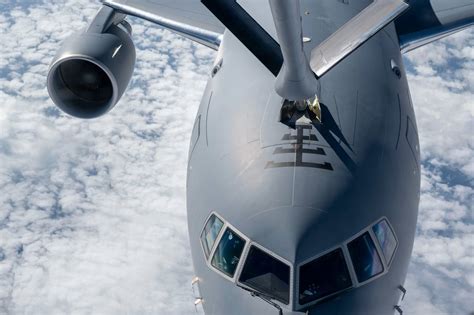
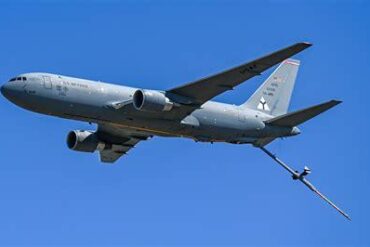
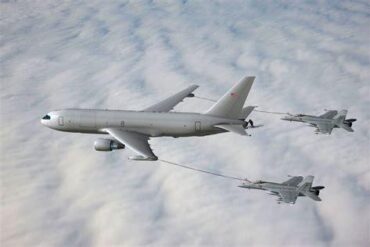
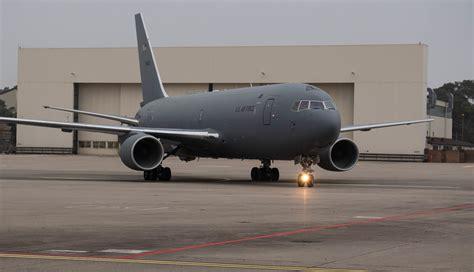
The KC-46 itself is based on Boeing’s 767-2C commercial airframe, but the military adaptation goes far beyond a simple conversion. The aircraft incorporates a modernized cockpit architecture derived from the Boeing 787 Dreamliner, advanced communications systems, defensive countermeasures, and a sophisticated fly-by-wire refueling boom.
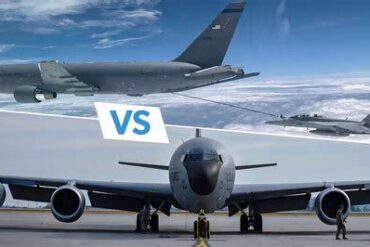
Compared with the KC-135R, the Pegasus represents a generational leap in capability.
The aircraft can carry up to 212,000 pounds of fuel, slightly exceeding the KC-135R while simultaneously supporting both boom refueling and hose-and-drogue operations. That dual capability matters enormously because it allows the Pegasus to refuel not only Air Force aircraft but also Navy, Marine Corps, and allied platforms that rely on probe-and-drogue systems.
Interoperability has become a central feature of modern coalition warfare. During multinational operations, the ability to service allied aircraft seamlessly can determine sortie generation rates and mission persistence.
Cargo flexibility is another major advantage. The KC-46 can transport 18 standard 463L pallets, triple the KC-135’s capacity and equivalent to a C-17 Globemaster III. The aircraft can also carry up to 114 passengers, more than double the Stratotanker’s capacity.
This flexibility transforms the Pegasus into a genuine multi-role platform.
On one sortie, it may deploy personnel and equipment across the Atlantic. Hours later, after reconfiguration, it may launch as a tanker supporting combat operations. The Air Force increasingly values aircraft capable of performing multiple missions because global logistics demands continue rising while fleet sizes remain constrained.
Medical evacuation capabilities further expand the Pegasus mission set. The aircraft supports enhanced aeromedical configurations with independent power systems and emergency oxygen infrastructure designed for critical care transport. During large-scale military operations or humanitarian crises, these features significantly expand strategic mobility options.
Perhaps most important, the KC-46 incorporates defensive systems specifically designed for contested environments.
The KC-135 never possessed meaningful self-protection capabilities because its designers assumed it would operate far from hostile threats. The Pegasus reflects a different era entirely. Missile warning systems, defensive countermeasures, and hardened mission architecture acknowledge that future tankers may operate within reach of sophisticated enemy weapons.
That shift illustrates how dramatically aerial warfare has evolved.
Despite these impressive capabilities, the KC-46 program has been plagued by years of delays and technical setbacks that continue to shadow the aircraft’s reputation.
The most serious problems center on the Remote Vision System, or RVS.
Unlike the KC-135, where boom operators physically observed refueling operations through windows, the KC-46 uses a camera-based remote system. In theory, the approach improves ergonomics and situational awareness. In practice, the system initially suffered from severe depth perception issues, glare problems, and visual distortions that complicated precise boom control.
These flaws were not minor inconveniences. They represented potential flight safety hazards serious enough to qualify as Category 1 deficiencies, the Pentagon’s highest level of operational concern.
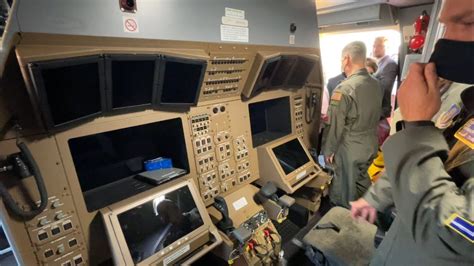
Air Force leadership repeatedly expressed frustration with the delays surrounding corrective upgrades. Boeing ultimately developed RVS 2.0, an extensively redesigned system featuring 4K full-color imaging, improved 3D visualization, and additional panoramic cameras.
The first flight of the upgraded configuration occurred in late 2025, but operational deployment has slipped several years beyond original expectations.
Remarkably, Boeing has absorbed more than $7 billion in financial losses tied to the KC-46 program under the structure of its fixed-price development contract. Those losses have become a significant burden on Boeing’s defense division and underscore the immense complexity involved in modern military aircraft integration.
Yet despite these ongoing deficiencies, the Air Force continues accelerating procurement.
That decision reveals a critical strategic reality: the service can no longer afford to wait for perfection.
Operational events during the 2026 Iran crisis highlighted exactly why.
During Operation Epic Fury, the United States conducted sustained air operations against Iranian-linked targets across the Middle East. Tanker demand surged immediately. According to operational reporting cited by defense analysts, approximately one-third of the Air Force’s mission-capable tanker fleet became tied to the operation.
That level of commitment exposed the fragility of America’s aerial refueling infrastructure.
Tankers must simultaneously support overseas combat operations, homeland defense missions, pilot training, strategic mobility requirements, NATO obligations, and Indo-Pacific deterrence patrols. A major regional conflict rapidly strains available capacity.
Then came the losses.
In March 2026, a KC-135 was destroyed in western Iraq following a midair refueling-related collision involving another Stratotanker. Shortly afterward, Iranian missile strikes damaged multiple KC-135s at Prince Sultan Air Base in Saudi Arabia.
For an aircraft fleet already stretched thin, the incidents carried enormous implications.
Every tanker lost reduces sortie generation capacity across entire theaters of operation. Unlike fighters, which exist in relatively large numbers, tankers are limited strategic assets with disproportionate operational value. Their destruction immediately affects the endurance of dozens of dependent aircraft.
The incidents also reinforced concerns about survivability.
Aging tankers parked at exposed forward operating locations are increasingly vulnerable to missile attacks, drone strikes, and sabotage operations. Modern warfare punishes logistical concentration. Aircraft once considered safely distant from front-line combat zones now face credible threats from precision weapons capable of reaching hundreds of miles beyond traditional battlefields.
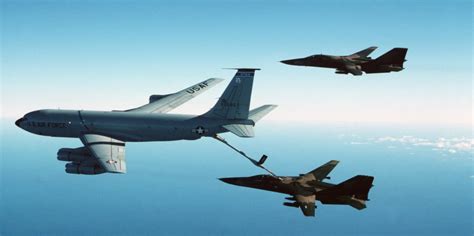
This environment fundamentally changes tanker planning.
The Air Force no longer measures aerial refueling platforms solely by fuel capacity or transfer rates. Survivability, mobility, distributed operations, and rapid redeployment have become equally important metrics.
That evolution helps explain why the Air Force continues investing aggressively in the Pegasus despite unresolved technical issues.
The alternative is continued dependence on a fleet approaching 70 years of age.
There is also a broader geopolitical dimension driving the tanker transition. American military strategy increasingly focuses on potential high-end conflict scenarios involving near-peer competitors such as China. The Indo-Pacific theater presents extraordinary distances that magnify the importance of aerial refueling.
A stealth bomber operating from the continental United States toward targets in the Pacific may require multiple refuelings. Fighters defending carrier strike groups require persistent tanker support. Surveillance aircraft tracking naval movements across the South China Sea depend heavily on aerial refueling to sustain coverage.
In many ways, future wars may be decided less by the number of fighters available and more by the logistics network capable of sustaining them.
That reality places tankers near the center of strategic planning.
The Air Force understands that replacing the KC-135 fleet entirely will take decades. The official KC-46 program of record currently stands at 263 aircraft, which still will not fully replace every Stratotanker in service.
As a result, KC-135s are expected to remain operational into the early 2030s and potentially beyond in limited roles.
Interestingly, even cutting-edge aircraft continue relying on the aging tanker. In April 2026, the Northrop Grumman B-21 Raider completed aerial refueling certification using a KC-135. The moment symbolized the strange overlap between generations: America’s newest stealth bomber connecting with one of its oldest operational support aircraft.
That image captures the transitional nature of the current moment perfectly.
Meanwhile, the Air Force is already looking beyond the KC-46 toward concepts associated with the Next-Generation Aerial Refueling System, or NGAS. Early proposals explored stealth tankers, autonomous operations, blended-wing-body aircraft, and radically different survivability concepts.
However, budget priorities are shifting.
Rather than pursuing an entirely new tanker platform immediately, the Air Force has redirected funding toward survivability enhancements and advanced mission systems for existing aircraft. The decision effectively acknowledges that a true next-generation tanker is unlikely to enter operational service before the mid-2030s.
In practical terms, the KC-46 will become America’s primary tanker backbone for at least the next two decades.
That reality makes the current $3.9 billion annual investment appear less extravagant and more unavoidable.
The United States cannot maintain global military reach without reliable aerial refueling capacity. Every carrier strike group, bomber task force, rapid deployment operation, and strategic deterrence patrol depends on tankers functioning continuously behind the scenes.
When tankers succeed, they remain largely invisible to the public.
No headlines celebrate a routine midair fuel transfer over the Atlantic. Few people notice the aircraft orbiting quietly hundreds of miles from conflict zones while enabling fighters to remain airborne for hours beyond their original limits. Yet these missions collectively sustain the operational tempo underpinning American military power.
The KC-135 performed that mission for nearly seventy years with extraordinary reliability.
Now the Air Force is attempting one of the most important aviation handovers in modern military history. The Pegasus may still carry developmental scars, unresolved deficiencies, and lingering skepticism from operators frustrated by delays. But the strategic pressures driving its procurement have become impossible to ignore.
The era when the United States could indefinitely rely on Cold War tankers is ending.
Replacing the KC-135 is not merely about modernization. It is about preserving the ability of the US military to operate globally in an age where distance, endurance, and survivability matter more than ever before.