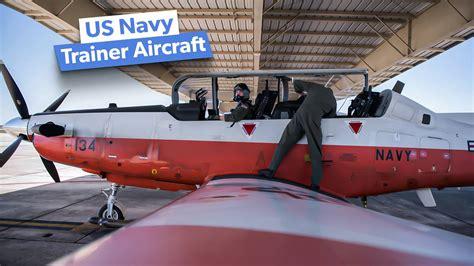
Becoming a U.S. Navy aviator begins long before a student ever lands on an aircraft carrier or climbs into an F/A-18 Super Hornet. Naval aviation demands a progression of increasingly complex skills, and the training system is designed to introduce those skills in controlled stages. Instead of placing inexperienced pilots directly into high-performance combat aircraft, the Navy uses a carefully structured fleet of training aircraft that teaches everything from basic flight control to advanced instrument procedures, multi-engine operations, carrier approaches, tactical maneuvering, and rotary-wing flight.
The modern pathway has its roots in the early history of naval aviation. When Theodore Gordon “Spuds” Ellyson became Naval Aviator No. 1 in 1911, military aviation was still in its infancy. Aircraft were fragile, relatively slow, and enormously different from the sophisticated machines flown by today’s naval aviators. More than a century later, the training system has become a specialized pipeline in which students progressively move from turboprops to jets or helicopters depending on their eventual aviation career.
T-6A and T-6B Texan II Build the Foundation
The first major aircraft in the fixed-wing training pipeline is the T-6 Texan II, which exists in both T-6A and T-6B configurations. The turboprop trainer is used by the Navy and Marine Corps to teach fundamental flying skills before students advance toward more specialized aircraft. The T-6A entered Navy and Marine Corps service in November 2002, while the T-6B followed later, becoming operational in April 2010.
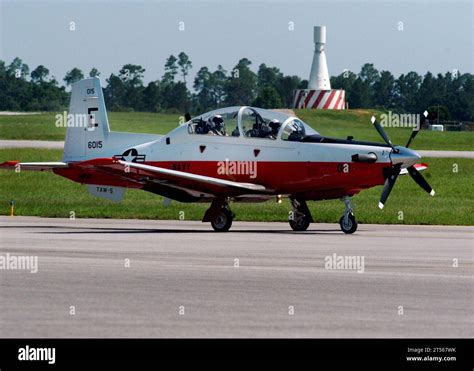
Powered by a Pratt & Whitney Canada PT6A-68 producing approximately 1,100 horsepower, the T-6 is considerably more capable than a conventional civilian trainer. It can climb at roughly 3,100 feet per minute and reach 18,000 feet in less than six minutes. Its maximum altitude is approximately 31,000 feet, while its maximum speed is about 311 mph at low altitude. A range of around 1,036 miles gives students enough endurance to conduct substantial training sorties without making the aircraft unnecessarily expensive to operate.
The T-6A and T-6B use tandem seating, placing the instructor and student one behind the other. The arrangement provides a familiar cockpit environment for military flight training while allowing instructors to demonstrate procedures and intervene when necessary. The aircraft also incorporates ejection seats, pressurization, advanced avionics, and an anti-G system, introducing students to equipment and procedures that become increasingly important as they progress through the Navy’s training pipeline.
The T-6B is particularly important because its avionics provide students with a more sophisticated digital cockpit environment. Rather than treating basic flight training as merely learning how to control an airplane, the program begins developing the instrument, navigation, communication, and workload-management skills required in modern military aviation.
T-44C Pegasus Introduces Multi-Engine Flying
After mastering the fundamentals in the T-6, students destined for multi-engine aircraft move into a more advanced turboprop environment. For decades, that role has been performed by the T-44 Pegasus, with the modern T-44C incorporating substantial upgrades over the original aircraft.
The T-44 first entered operational service in 1977, making it one of the oldest aircraft types still associated with the Navy’s training system. Unlike the single-engine T-6, the T-44C is powered by two Pratt & Whitney PT6A-34B turboprop engines. Each produces approximately 550 shaft horsepower, giving the aircraft a combined output of roughly 1,100 horsepower.
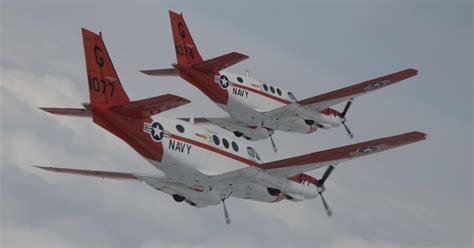
The aircraft is pressurized and can operate at altitudes up to approximately 31,300 feet, while its range is around 1,496 miles. Its maximum speed is close to 282 mph. Those figures are less important than the skills students develop inside the cockpit. The T-44C teaches pilots how to manage a larger aircraft with multiple engines, more complex systems, and a substantially different workload from the T-6.
One particularly important lesson is asymmetric engine handling. If one engine loses power, the aircraft does not simply become a slower version of itself. The remaining engine creates an imbalance in thrust that requires immediate and precise pilot inputs. Learning to recognize and manage that situation in a training aircraft gives students valuable preparation for the multi-engine aircraft they may eventually fly operationally.
The T-44C can accommodate an instructor and two students, allowing one student to fly while another monitors communications and procedures. Its glass avionics, integrated flight management system, autopilot, anti-icing equipment, and modernized cockpit make it substantially more advanced than the aircraft’s original configuration.
However, the T-44C is now approaching the end of its long career. The Navy has been replacing it with the T-54A Marlin II, creating a gradual transition toward a more modern multi-engine training system.
T-54A Marlin II Modernizes Advanced Navy Flight Training
The T-54A Marlin II represents the next generation of Navy multi-engine training. The aircraft reached initial operating capability on June 10, 2025, and began training naval aviators as the service continued its transition away from the aging T-44C.
The T-54A is designed around the requirements of modern naval aviation rather than simply extending the life of an older trainer. Its cockpit features modern avionics and navigation systems, while its pressurized cabin uses side-by-side seating for the student and instructor. This configuration allows the instructor to monitor the student’s actions closely while providing a cockpit environment that differs from the tandem arrangement of the T-6 and T-44.
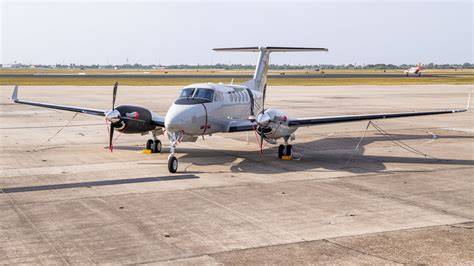
The aircraft is intended to teach advanced instrument procedures and multi-engine handling, including the challenges created when an engine becomes unavailable. Those skills are especially relevant to students who will eventually fly aircraft such as the E-2 Hawkeye airborne early warning aircraft or the P-8A Poseidon maritime patrol aircraft.
The Marlin II also incorporates improved data-collection capabilities. Training organizations can use aircraft-generated information to monitor performance and aircraft condition, potentially helping identify maintenance requirements before they become more serious problems. That is an important consideration for a training fleet, where aircraft accumulate large numbers of flight hours.
The Navy had procured at least 15 of the planned 64 aircraft at the time covered by the reference material. The first four naval aviators trained on the T-54A graduated on September 12, 2025, marking an important milestone in the replacement of the T-44C.
T-45C Goshawk Moves Students Into Jet Aviation
For students progressing toward carrier-based tactical aviation, the transition from propeller-driven aircraft to jets is one of the most significant steps in the entire training pipeline. The aircraft responsible for that transition is the T-45C Goshawk.
The T-45C is a tandem-seat, carrier-capable jet trainer developed specifically to support naval aviation training. It became operational in 1999 and remains the Navy’s principal fixed-wing jet trainer for preparing pilots for carrier operations. It is also used in tactical strike training and supports the Advanced Tactical Maneuvering Stage of naval flight officer instruction.
The aircraft’s Rolls-Royce Turbomeca F405-RR-401 non-afterburning turbofan allows it to reach approximately 645 mph, or Mach 0.84. That represents a dramatic performance increase over the T-6, T-44C, and T-54A. The T-45C can climb into an operational environment reaching approximately 42,500 feet, with a range of about 805 miles.
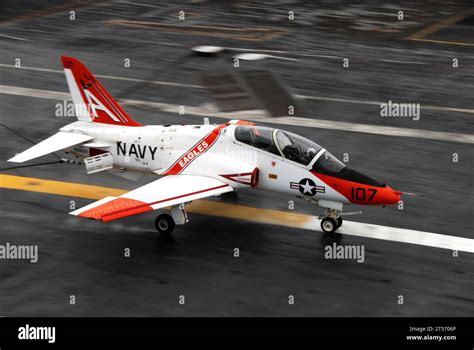
The aircraft’s importance goes beyond raw speed. A future carrier aviator must learn to operate an aircraft precisely while managing high workload, rapid energy changes, navigation, communications, and tactical maneuvering. Eventually, those skills must be applied during demanding carrier approaches and landings, where there is little room for error.
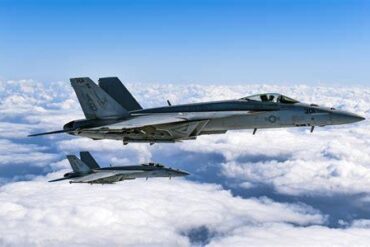
The T-45C’s digital glass cockpit also helps bridge the technological gap between training and operational aircraft. Students eventually destined for platforms such as the F/A-18E/F Super Hornet or F-35C Lightning II encounter increasingly sophisticated avionics throughout the training pipeline rather than facing an enormous technological jump at the end.
TH-73A Thrasher Trains Navy Helicopter Pilots
Not every naval aviator will fly a fixed-wing aircraft. The Navy also requires pilots for helicopters and tilt-rotor aircraft, creating a completely different training pathway. The central aircraft in that system is the TH-73A Thrasher.
The TH-73A replaced the long-serving TH-57 Sea Ranger, which had been used for approximately 57 years before its retirement in October 2025. Although the Navy began introducing the TH-73A in 2021, the retirement of the TH-57 marked the completion of a major generational change in rotary-wing training.
The Thrasher is powered by a Pratt & Whitney PT6B-37A turboshaft engine and can reach approximately 175 mph. Its ceiling is around 15,000 feet, while its range is approximately 411 miles. Those numbers are less important than the helicopter-specific skills it teaches, including hovering, maneuvering, autorotation, instrument procedures, and the unique power-management requirements of rotary-wing flight.
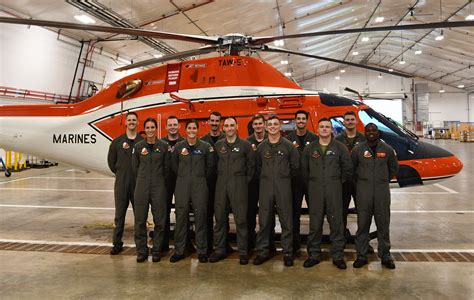
The aircraft forms part of the Advanced Helicopter Training System, supporting rotary-wing and tilt-rotor training for the Navy, Marine Corps, and U.S. Coast Guard. That makes it especially significant for pilots who may eventually operate aircraft such as the V-22 Osprey. Before a student can manage the complexities of a tilt-rotor aircraft, they must first understand the fundamentals of helicopter flight.
The Navy accepted its 100th TH-73A in October 2024, reinforcing the scale of the transition to the new trainer. Training is centered at Naval Air Station Whiting Field in Florida, where students learn advanced instrument flight rules and the practical skills necessary to progress toward operational rotary-wing aircraft.
A Training System Built Around Progressive Complexity
Taken together, these five aircraft reveal how deliberately the U.S. Navy flight training pipeline is structured. The T-6 establishes fundamental fixed-wing skills. The T-44C and newer T-54A introduce multi-engine operations and more advanced instrument flying. The T-45C then moves selected students into high-performance jet aviation and carrier-oriented training, while the TH-73A provides a separate pathway for helicopter and tilt-rotor pilots.
The aircraft themselves are also changing. The T-44C represents a training design that has served the Navy for decades, while the T-54A and TH-73A demonstrate the service’s effort to introduce modern avionics, improved data collection, and more capable training environments. Even the T-6B provides a more contemporary cockpit experience than earlier generations of trainers.
The result is a system in which students do not simply learn to fly. They progressively learn how to manage military aircraft, complex avionics, multiple engines, high workloads, tactical maneuvering, instrument procedures, and eventually carrier or rotary-wing operations. By the time a student reaches an operational naval aircraft, the training fleet has already exposed that aviator to many of the fundamental challenges that define life in U.S. naval aviation.