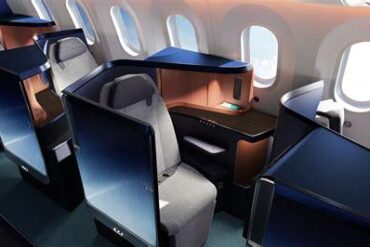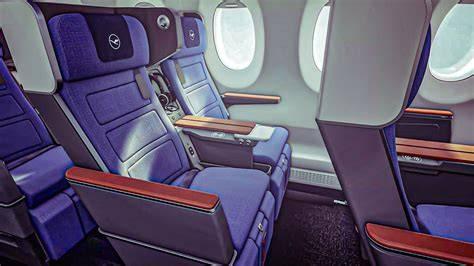
Premium economy has become one of the most appealing ways to cross the Atlantic without paying business-class prices. On a long flight between North America and Europe, the difference between a conventional economy seat and a genuinely roomy premium economy seat can be substantial. More legroom, a wider seat, greater recline, better support, and a quieter cabin can make the hours in the air considerably easier, particularly on overnight services.
There is, however, an important distinction between airlines when it comes to how that extra space is delivered. Many carriers advertise premium economy as offering a significant improvement over economy, yet the actual dimensions can be surprisingly similar from one airline to another. A 38-inch seat pitch has become something of an industry standard, while seat width generally falls somewhere between 18.5 and 19 inches. The differences become more noticeable when recline, cabin density, seat design, and the overall layout are considered together.
For this look at the most spacious transatlantic premium economy seats, the focus is on seven major carriers serving the North Atlantic: British Airways, Virgin Atlantic, Delta Air Lines, United Airlines, Lufthansa, Air France, and American Airlines. The comparison centers primarily on their Boeing 787-9 premium economy products where applicable, with Delta evaluated using its Airbus A350-900 Premium Select cabin because the airline does not currently operate the 787.
That makes this a useful snapshot for travelers deciding which premium economy product deserves their money. Although the differences may look modest on paper, an additional two inches of pitch, a wider seat, or a more generous recline can become surprisingly valuable after several hours in the air. Just as importantly, the cabin around the seat can determine whether those dimensions actually feel as spacious as they sound.
British Airways World Traveller Plus Premium Economy
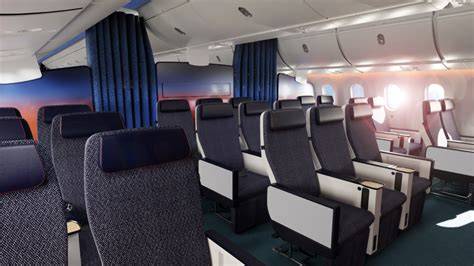
British Airways has long positioned World Traveller Plus as a substantial step above standard economy, and its relatively low-density aircraft configurations help reinforce that positioning. The airline’s Boeing 787-9 is particularly interesting because it carries just 216 passengers, consisting of eight first-class seats, 42 business-class seats, 39 premium economy seats, and 127 economy seats. Boeing’s typical two-class 787-9 configuration is much denser, so British Airways devotes considerably more of the aircraft to premium cabins.
The 39 World Traveller Plus seats are arranged in a 2-3-2 configuration, giving passengers seven seats across rather than the nine-seat economy arrangement found on many 787s. The Recaro PL3530 seats provide an 18.7-inch width, a 38-inch pitch, and approximately 10 inches of recline. They also feature four-way adjustable headrests and retractable bi-folding tables, while additional lumbar, head, and foot support contributes to the more substantial feel.
British Airways describes World Traveller Plus as a quieter and more spacious cabin with fewer rows, and the configuration backs that up. The 38-inch pitch is not exceptional by itself, but the combination of width, recline, and relatively low cabin density makes this one of the more appealing transatlantic options. Passengers also receive an increased baggage allowance and priority services, adding practical value beyond the physical seat.
Virgin Atlantic Premium Economy
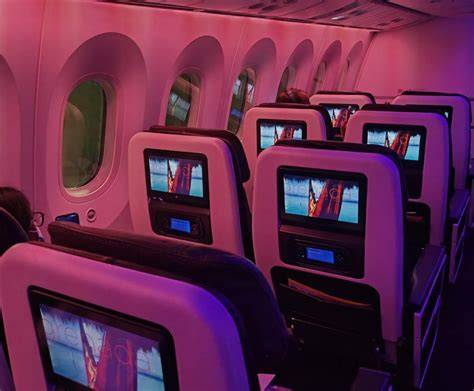
Virgin Atlantic’s Premium cabin takes a slightly different approach. The airline is heavily focused on long-haul flying and has built much of its identity around the transatlantic market, making premium economy an important part of its proposition. Unlike British Airways, Virgin Atlantic does not operate a first-class cabin, allowing its premium cabin structure to concentrate on business class, Premium, and economy.
Its Boeing 787-9 aircraft feature 35 Premium seats in a 2-3-2 arrangement, alongside 31 Upper Class seats and 192 economy seats. The Premium seats are Sixty Aerospace Reverb models, now associated with Safran’s seating portfolio, and are upholstered in leather. They offer a 38-inch pitch and an 18.7-inch width, putting them almost exactly alongside British Airways in those two key measurements.
The main difference is recline. Virgin Atlantic’s Premium seat provides approximately 8 inches of recline, two inches less than the British Airways configuration described above. That does not necessarily make the Virgin seat uncomfortable, but it can matter during an overnight flight when passengers are trying to sleep. Virgin compensates with a broader premium experience that includes a welcome drink, upgraded dining presentation, proper cutlery, and generous checked-baggage benefits.
The result is a premium economy seat that is not dramatically larger than British Airways’ offering but remains highly competitive. For travelers who value the complete onboard experience rather than simply maximizing seat dimensions, Virgin Atlantic Premium remains one of the strongest ways to cross the Atlantic.
Delta Air Lines Premium Select
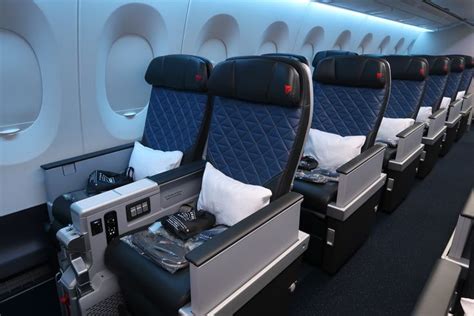
Delta Air Lines does not currently operate the Boeing 787, so its Delta Premium Select product has to be evaluated on other widebody aircraft. The Airbus A350-900 provides one of the clearest examples, with Collins Aerospace MiQ seats arranged in a 2-4-2 configuration. That eight-abreast arrangement is important because it creates a different cabin environment from the seven-abreast premium economy cabins used by several competitors’ 787-9s.
On the A350-900, Delta Premium Select seats have a 38-inch pitch and an 18.5-inch width, making them slightly narrower than British Airways, Virgin Atlantic, United, Lufthansa, and Air France. Recline is approximately 7 inches. Each seat includes a four-way adjustable headrest, while the overall seat design is intended to provide a noticeable improvement over standard economy.
Delta positions Premium Select as a genuine premium cabin rather than simply a roomier economy product. Passengers receive enhanced dining, premium beverages, priority airport services, and other benefits, although the exact package can vary depending on fare type and itinerary. The Premium Select cabin is particularly attractive for travelers who value the Airbus A350 itself, whose modern cabin environment, quieter operation, and spacious-feeling fuselage complement the upgraded seating.
Delta’s future fleet plans also make its premium economy strategy worth watching. The airline has ordered Boeing 787-10 aircraft, but for travelers booking today, the A350 remains the key reference point for evaluating its long-haul Premium Select seat.
United Airlines Premium Plus
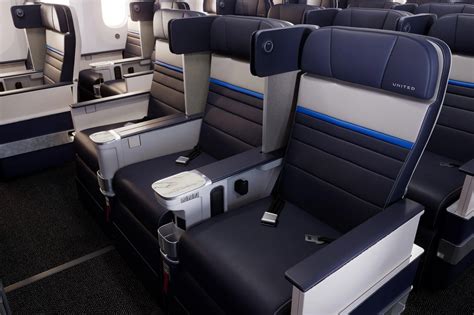
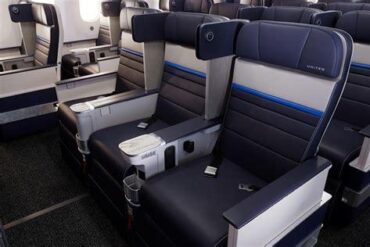
United Airlines calls its premium economy product Premium Plus, and its Boeing 787-9 provides a straightforward example of the modern transatlantic premium economy format. The aircraft uses Collins Aerospace MiQ seats arranged in a 2-3-2 configuration, with a standard 38-inch pitch and 18.7-inch seat width.
Where United falls behind some competitors is recline. The Premium Plus MiQ seat offers up to approximately 6 inches of recline, making it the least generous figure among several of the premium economy products examined here. That difference may sound small, but recline becomes increasingly important when passengers are spending seven, eight, or more hours in the same seat.
United nevertheless adds considerable value around the seat. Premium Plus passengers receive priority check-in and boarding, access to dedicated security lanes where available, priority baggage handling, upgraded meals and dinnerware, complimentary alcoholic beverages, and noise-canceling headphones. Those features help create a more complete premium experience than the seat measurements alone might suggest.
United also has a particularly broad Premium Plus network. The product is available across the airline’s international widebody fleet, meaning travelers flying between the United States and Europe can encounter it on numerous routes. For passengers who prioritize availability and network breadth as much as physical space, that makes United an important option even if its recline figure is not class-leading.
Lufthansa Premium Economy
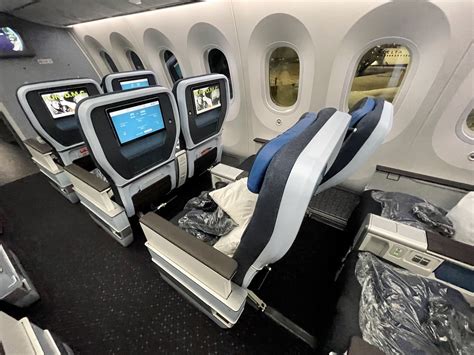
Lufthansa’s current premium economy product combines a familiar seat design with an important transition toward the airline’s new Allegris cabin. Existing Boeing 787-9 aircraft use Collins Aerospace MiQ premium economy seats in a 2-3-2 configuration, with 38 inches of pitch, 18.7 inches of width, and around 7 inches of recline.
Lufthansa emphasizes the additional personal space provided by its premium economy cabin, along with benefits such as two checked bags of up to 50 pounds, a welcome drink, and enhanced service. Those practical advantages can make a meaningful difference on a transatlantic trip, particularly for passengers traveling with substantial luggage.
The more interesting development is the introduction of Allegris Premium Economy, which is designed to refresh the passenger experience across Lufthansa’s long-haul fleet. The new seats are expected to provide approximately 39 inches of pitch, giving them a modest but useful advantage over the existing 38-inch configuration. That extra inch will not transform the cabin, but it could make Lufthansa more competitive as the new interior becomes more widely available.
For travelers booking a specific flight, aircraft selection therefore matters. A Lufthansa premium economy ticket does not necessarily mean every aircraft will offer exactly the same seat experience, and checking the operating aircraft and seat map before booking can be worthwhile.
Air France Premium Economy
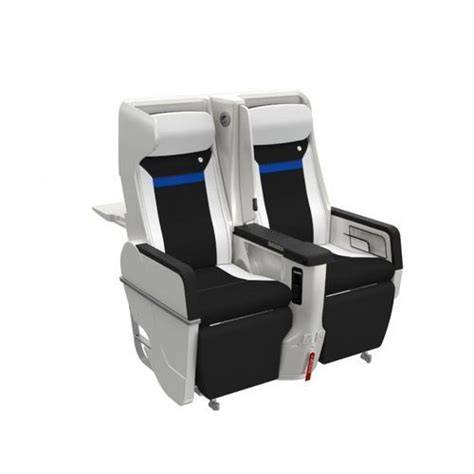
Among these seven airlines, Air France stands out most clearly on seat dimensions. Its Premium Economy cabin uses Safran Airgo FX fixed-shell seats in a 2-3-2 configuration, and the figures are notably more generous than the standard measurements used by most competitors.
Air France offers approximately 40 inches of seat pitch and 19 inches of seat width, giving passengers an extra two inches of pitch compared with the 38-inch standard and a slightly wider seat than most of the other airlines. More unusually, the seat provides a generous 130-degree recline. Because the Airgo FX is a fixed-shell design, the seat reclines within its own space rather than simply pushing the seatback into the passenger behind.
The Boeing 787-9 configuration contains 21 Premium Economy seats, alongside 30 business-class seats and 228 economy seats. That relatively small premium cabin contributes to an intimate environment, while individual features include lumbar support, a footrest, and an individual gooseneck reading light.
Air France also provides the broader collection of premium-economy benefits travelers expect, including priority services, a welcome drink that is typically champagne, additional checked baggage, enhanced meals, and noise-canceling headphones. Taken together, the 40-inch pitch, 19-inch width, and 130-degree recline give Air France the strongest numerical case for the most spacious premium economy seat on this list.
American Airlines Premium Economy
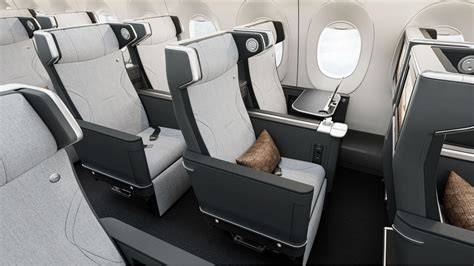
American Airlines offers a premium economy product across several international widebody aircraft, including the Boeing 787-9, 787-8, 777-200ER, and 777-300ER. The airline is also refreshing its long-haul cabins, making American’s premium economy product one that is gradually evolving rather than remaining fixed.
The refreshed cabin uses 32 Safran Z535i recliner seats in a 2-3-2 arrangement. These seats provide a 38-inch pitch, 19-inch width, and around 8 inches of recline. The seat width matches Air France’s impressive 19-inch figure, while pitch remains at the common 38-inch standard. Older American Airlines 787-9 configurations use 21 Collins Aerospace MiQ premium economy seats, with the same 38-inch pitch, 19-inch width, and 8-inch recline.
That means American is particularly appealing to travelers who place a premium on seat width. At 19 inches, it is wider than the 18.5-inch Delta seat and slightly wider than the 18.7-inch seats found on British Airways, Virgin Atlantic, United, and Lufthansa aircraft in the configurations discussed here.
The airline’s ongoing cabin refresh is also significant. American is introducing its new Flagship Suite in business class alongside a refreshed premium economy product, creating a more modern long-haul experience from front to back. For passengers who care primarily about the premium economy seat itself, the 19-inch width and 8-inch recline make American one of the strongest choices among the US carriers.
Which Transatlantic Premium Economy Seat Has the Most Space?
Looking strictly at the published dimensions, Air France has the strongest claim to the most spacious transatlantic premium economy seat. Its 40-inch pitch is two inches greater than the common 38-inch figure, while its 19-inch width is tied with American Airlines for the widest seat in this group. The 130-degree recline also gives Air France an unusually strong specification for a premium economy cabin.
Behind it, the differences become much closer. British Airways combines 38 inches of pitch and 18.7 inches of width with a particularly generous 10-inch recline. American offers a wider 19-inch seat with 8 inches of recline, while Virgin Atlantic provides the same 38-inch pitch and 18.7-inch width with 8 inches of recline. Lufthansa and United use similarly wide seats, although United’s 6-inch recline is comparatively restrained.
Delta’s 18.5-inch Premium Select seat is the narrowest of the group, but its A350 cabin still provides a substantial improvement over economy. Meanwhile, Lufthansa’s new Allegris Premium Economy could strengthen its position as more aircraft receive the refreshed 39-inch-pitch cabin.
Ultimately, the most spacious premium economy seat is not determined by one measurement alone. Seat pitch affects legroom, width affects personal shoulder and hip space, and recline matters enormously on overnight flights. Cabin density, footrests, headrests, seat construction, privacy, service, baggage allowances, and the aircraft itself all influence how comfortable the journey feels.
For travelers specifically seeking maximum physical space on a transatlantic flight, however, Air France currently has the clearest advantage on paper. Its combination of 40-inch pitch, 19-inch width, and 130-degree recline is difficult to overlook. British Airways follows closely for travelers who value recline, while American stands out for its wide 19-inch seat. The best choice ultimately depends on the exact aircraft and route, but all seven airlines demonstrate why premium economy has become an increasingly compelling middle ground between economy and business class.