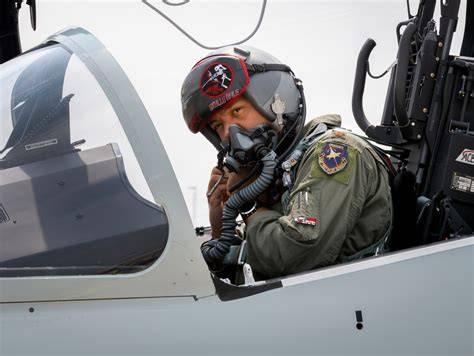
The US Air Force fighter community is facing a serious personnel problem, with Fiscal Year 2027 budget documents projecting that fighter aviator manning will fall to just 67.2%. The decline is striking because the service remains capable of conducting demanding operations across multiple theaters while simultaneously preparing for a potential major-power conflict. The figures suggest that the Air Force’s ability to generate combat power today is increasingly dependent on a workforce operating with little margin for error.
The projected 67.2% level represents another step downward from 75.4% in Fiscal 2025 and 69.4% in Fiscal 2026. In other words, the fighter community has lost more than eight percentage points of manning in only two budget cycles. The situation is particularly concerning because fighter aviation depends heavily on experienced personnel. Training a combat-ready fighter pilot requires years of instruction, operational experience, and significant investment, making experienced aviators difficult to replace quickly when retention declines.
The problem also extends beyond the cockpit. A fighter force needs pilots, maintainers, weapons specialists, engineers, logisticians, and countless other personnel to transform aircraft inventory into usable combat power. An aircraft sitting on a ramp may represent considerable technological and financial investment, but without qualified people to fly, service, arm, and support it, its military value is sharply reduced. That distinction is becoming increasingly important as the Air Force attempts to sustain high operational demands while modernizing its aging fleet.
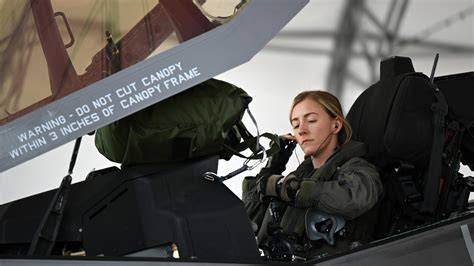
Air Force Fighter Manning Has Fallen Rapidly
The FY2027 budget documents provide an unusually direct look at the personnel pressure facing the Air Force’s aircraft communities. To address falling manning, the service is seeking additional funding for its aviation bonus program. The stated purpose is to influence the retention decisions of experienced aviators and encourage them to remain in uniform for longer periods.
The proposed approach is significant because simply increasing recruiting cannot immediately solve a shortage of experienced fighter personnel. A newly commissioned pilot still requires extensive training before becoming capable of operating advanced combat aircraft in demanding conditions. Even after completing formal training, an aviator needs additional experience before reaching the proficiency associated with senior operational assignments. Retention therefore becomes one of the fastest ways for the Air Force to protect the experience already inside the force.
The bonus program is designed to encourage aviators to enter contracts earlier and accept longer service commitments. It also applies across several specialized communities, including enlisted personnel, nuclear officers, aviation officers, and members possessing other critical skills. The broader strategy reflects the reality that the Air Force is competing not only with other military services but also with civilian aviation and technical industries for highly trained personnel.
The numbers show why such measures are becoming increasingly urgent. Fighter aviation is projected to have the lowest manning level among the Air Force’s major aircraft communities in FY2027, at 67.2%. The bomber community is close behind at 68.7%, while mobility is projected at 88.4%, special operations at 84.0%, and rescue at 89.2%. Overall active-duty aircraft-community manning is expected to fall to approximately 88.5%.
A 67% Manning Rate Does Not Mean 67% Combat Effectiveness
One of the easiest mistakes when interpreting these figures is treating manning percentages as direct measurements of combat effectiveness. They are not. A fighter squadron operating at 77% personnel strength does not necessarily possess 77% of the combat capability of a fully staffed squadron.
The identity and experience of the missing personnel matter enormously. Losing several junior positions may have a different operational effect from losing experienced instructors, flight leads, evaluators, or commanders. Similarly, a unit might have enough pilots but lack maintainers capable of keeping its aircraft available. Personnel shortages therefore interact with one another rather than producing a simple mathematical reduction in capability.
This is especially important for fighter aircraft because modern combat aviation has become extraordinarily complex. Advanced fighters require extensive maintenance, sophisticated software support, specialized components, mission planning, weapons integration, intelligence support, and highly trained crews. The aircraft itself is only one part of the combat system.
The Air Force’s own discussion emphasizes that pilot manning must be considered alongside broader aircraft-community personnel requirements. The service is not simply counting people sitting in cockpit seats. It is attempting to ensure that the entire aviation enterprise has enough personnel to sustain operations over time.
Air National Guard Fighter Manning Is Better, But Still Concerning
The Air National Guard provides a somewhat more encouraging picture. Its FY2026 fighter-community manning level was approximately 77.5%, compared with 69.4% for the active-duty fighter community during the same fiscal year. That gives the Guard a meaningful numerical advantage, although a level below 80% is hardly evidence of a fully healthy personnel system.
The Guard’s experience also demonstrates that the manning challenge is not uniform across the Air Force. In FY2026, ANG bomber manning was 77.8%, compared with 75.1% for active-duty bombers. Rescue was even stronger at 93.3%, versus 90.0% for active-duty units. However, the Guard was less fully staffed in several other areas, including mobility, special operations, command and control/intelligence/surveillance/reconnaissance, and remotely piloted aircraft.
These differences are important because the Air Force relies on active, reserve, and Guard components as parts of a larger force structure. A shortage in one component cannot always be solved simply by transferring personnel from another. Training requirements, aircraft assignments, geographic distribution, unit structures, and individual qualifications can all limit how easily personnel can move between communities.
For fighter operations, the Guard’s higher percentage therefore offers some additional resilience but does not eliminate the underlying concern. The service still needs a sufficiently large pool of qualified aviators to sustain deployments, training, instructor requirements, leave, medical restrictions, professional development, and unexpected operational demands.
Maintainer Shortages Could Make Fighter Manning Problems Worse
Pilots are only half of the equation. Aircraft maintainers are equally essential to combat readiness, and the Air Force has acknowledged a substantial shortage in this area. In 2026, the service told Congress that it was short more than 9,700 maintainers, equivalent to roughly 10% of its total maintenance workforce requirement.
That shortage matters because aircraft availability depends directly on maintenance capacity. When fewer maintainers are available, the personnel who remain can be required to work additional hours. That may temporarily preserve sortie generation, but it can also increase fatigue and create additional retention problems.
The Government Accountability Office has highlighted similar concerns at Air Force depots. Although the three major depots had filled at least 90% of their positions since 2020, officials reported shortages in specific occupations. Competition with private industry was identified as a major difficulty, particularly for engineers and mechanics.
This creates a potentially damaging feedback loop. Fewer maintainers can mean longer working hours, greater fatigue, slower maintenance turnaround, and reduced aircraft availability. Reduced availability can then increase pressure on the aircraft that remain operational, creating additional maintenance requirements and further increasing the workload on an already undersized workforce.
F-35 Readiness Shows Why Manning Is Only Part of the Problem
The F-35 illustrates the complexity of the Air Force’s readiness challenge. Its aircraft availability rate reportedly declined from 67% in FY2021 to 44% in FY2025, while its full mission-capable rate fell from 38% to 25%.
It would be misleading, however, to attribute those declines entirely to personnel shortages. F-35 readiness has also been affected by spare-parts availability, sustainment infrastructure, corrosion work, software issues, and continued dependence on contractors. The aircraft is an example of how several independent problems can combine to reduce operational availability.
Nevertheless, personnel shortages can amplify those other difficulties. If a maintenance organization lacks sufficient trained specialists, even an available replacement component cannot necessarily be installed immediately. Likewise, if experienced personnel leave, the replacement workforce may require considerable time to acquire the knowledge necessary to perform complex maintenance efficiently.
This is why the projected 67.2% fighter manning level deserves attention even though it is not itself a readiness statistic. It represents a potential constraint on the Air Force’s ability to sustain its aircraft and operations over an extended period.
High-Tempo Combat Operations Are Testing the Force
The timing of the personnel problem is particularly significant because the Air Force has demonstrated that it can conduct extraordinarily demanding operations. During Operation Epic Fury, the service sustained a high operational tempo involving approximately 10,000 missions over 38 days across fighters, bombers, tankers, mobility aircraft, and supporting forces.
That performance demonstrates that the Air Force’s current force structure retains substantial capacity. It also reveals a paradox: an organization can successfully surge today while becoming more vulnerable tomorrow.
High operational tempos consume aircraft life, spare parts, maintenance capacity, and human endurance. Every additional sortie creates work somewhere in the system. Aircraft need inspections and repairs, maintainers work longer hours, pilots accumulate flying demands, and support personnel must sustain deployments and logistics networks.
For an already understaffed fighter community, this creates a particularly difficult equation. A surge can demonstrate impressive combat capability while simultaneously reducing the margin available for future operations. If personnel become exhausted or decide to leave, the force can emerge from a demanding campaign with fewer experienced people than it had before the campaign began.
The Fighter Pilot Shortage Is Part of a Global Problem
The United States is not alone in confronting fighter-pilot shortages. Several air forces have struggled to maintain adequate numbers of experienced aviators, including the Royal Canadian Air Force, Royal Air Force, and Indian Air Force. The problem reflects the increasingly demanding nature of modern military aviation.
Advanced fighter aircraft require years of training and enormous financial investment. The pool of people capable of operating these aircraft is consequently much smaller than the number of aircraft appearing in inventory statistics.
The experience of Russia during the war in Ukraine has also highlighted the importance of trained aircrew. Losing experienced pilots can impose constraints that cannot be solved simply by possessing a large aircraft inventory. An air force may theoretically have hundreds or even thousands of combat aircraft while possessing a much smaller number that can be effectively generated for sustained operations.
This is one reason personnel statistics deserve to be considered alongside aircraft numbers. Aircraft quantity without trained personnel is not equivalent to usable combat power.
Why 2027 Could Become a Critical Year for Air Force Manning
The projected decline to 67.2% does not mean that the US Air Force will suddenly become incapable of operating its fighter fleet in 2027. Rather, it indicates that the service is entering a period in which maintaining existing operational commitments could become progressively harder.
The Air Force is already responding through recruiting, retention initiatives, training reforms, force management, and expanded aviation bonuses. These efforts recognize that the problem cannot be solved through aircraft procurement alone. Buying another advanced fighter does little to improve combat capability if there are insufficient numbers of qualified people to fly and sustain it.
The challenge is particularly acute as the Air Force simultaneously prepares for future aircraft such as the F-35 and B-21, manages legacy platforms, and develops concepts for future combat operations involving increasingly autonomous systems. Modernization creates additional training requirements precisely when experienced personnel are already in short supply.
Autonomous and semi-autonomous systems could eventually reduce some manpower demands, but they are not a simple substitute for experienced aviators today. Technology can change how personnel are used, but it does not eliminate the need for skilled people to operate, maintain, supervise, and adapt complex combat systems.
The Real Air Force Challenge Is Sustaining Combat Power
The most important lesson from the FY2027 budget figures is that airpower is ultimately a human enterprise. The United States possesses an enormous fleet, sophisticated weapons, advanced sensors, worldwide bases, and unmatched operational experience. Yet all of those advantages depend on people.
A projected fighter aviator manning level of 67.2% in 2027 is therefore more than a troubling personnel statistic. It is a warning about the amount of stress being placed on a force expected to maintain global commitments, modernize its aircraft, prepare for major-power conflict, and respond to crises around the world.
The Air Force has demonstrated that it can generate extraordinary combat power under pressure. The harder question is whether it can continue doing so year after year without exhausting the personnel and equipment that make those operations possible.
The answer will depend on whether retention improves, whether recruiting and training pipelines can expand, whether maintainers can be retained against private-sector competition, and whether the service can reduce the operational burden placed on its most experienced personnel. The future strength of the US Air Force will not be measured solely by how many fighter jets it owns, but by how many aircraft it can keep operational and how many trained people it has available to fly and sustain them.