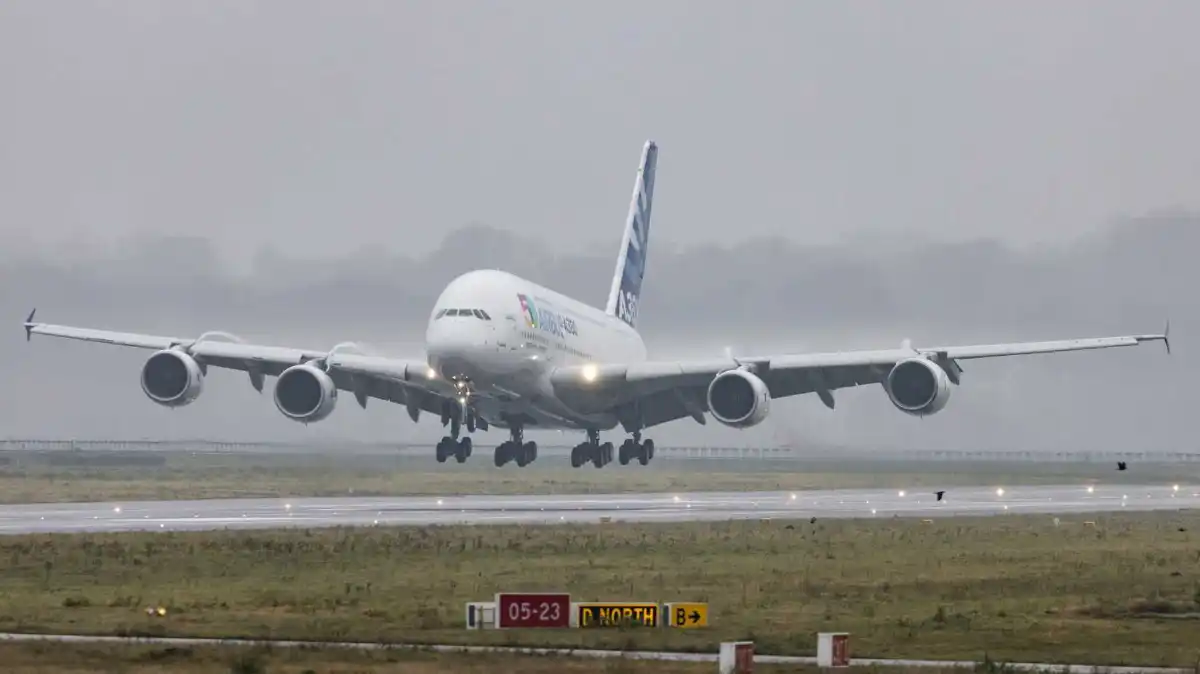
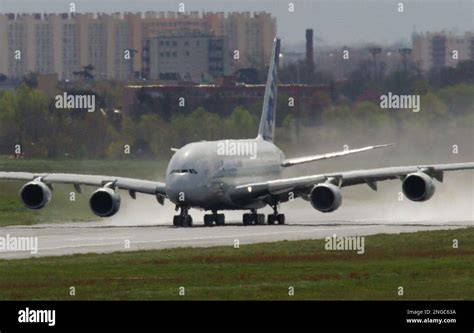
For two decades, F-WWOW has been a familiar sight in the skies above southwest France, but when the first-ever Airbus A380 touched down at Toulouse-Blagnac Airport (TLS) on Wednesday, a different kind of turbulence followed it onto the apron. Within hours, reports spread that the double-decker pioneer had made its final flight, a story that gained momentum because the 96-minute circular test flight looked exactly like the end of a long career. Airbus has since stepped in to correct the record: MSN1, the aircraft that taught the world what a full-length double-decker could do, is not heading for the boneyard. The flight on October 28 marked the conclusion of one test campaign, not the end of the airframe’s working life. For an aircraft that has spent 21 years proving production concepts, certifying siblings, and evaluating engines far too modest in size for its own mammoth frame, that distinction matters enormously.
F-WWOW’s Test Flight Was a Campaign Milestone, Not a Retirement Notice
According to Flightradar24, F-WWOW lifted off at 10:27 AM local time and returned to Toulouse-Blagnac at 12:03 PM, completing a 96-minute circuit over the southwest of France. Airbus framed the sortie as a routine upgrade validation, describing a campaign in which the aircraft successfully flew with improvements “the kind of improvements Airbus continuously, regularly, and proactively carries out across all of its aircraft.” A spokesperson confirmed the more consequential detail: “the next steps for MSN1 (F-WWOW) are currently under study.” The phrasing is deliberately open-ended, which is precisely the point. Airbus has not scheduled a farewell, allocated a museum berth, or filed retirement paperwork, and the European manufacturer wants that understood before online chatter hardens into accepted fact.
Airbus’ First A380 as an Open-Ended Testbed
The ambiguity surrounding F-WWOW’s future reflects something unique about its role. After spearheading the flight-test and certification program for the A380 family, the airframe transitioned into a flying laboratory, carrying Rolls-Royce powerplants for the A350 program and, in 2022, burning Sustainable Aviation Fuel to assess its behavior on the largest passenger jet ever built. Airbus has also hinted at using the A380 as a host for open-rotor engine technology, a concept that hinges on an engine deliberately dwarfed by the aircraft around it. That mismatch is a feature, not a flaw: a test engine mounted on a giant platform can be observed, instrumented, and iterated without the airframe itself dominating the measurements.
Open-Rotor Engine Plans Remain Intact
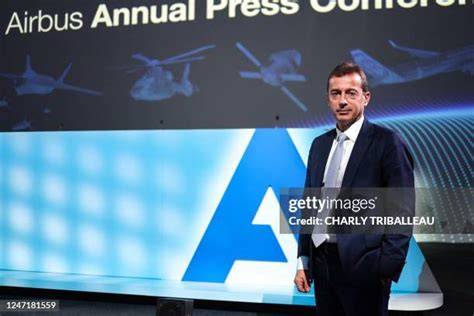
Lars Wagner, Airbus’ Commercial CEO, told Simple Flying’s Tom Boon this month that the manufacturer is “thinking about the technology” and wants to “test fly it and make sure that this is generating the benefits that we currently anticipate,” while cautioning that there has been no change in timeline. Guillaume Faury, Airbus SE’s Chief Executive Officer, has spoken candidly about the trade-offs, calling the A380 testbed convenient but expensive, and noting that “you can test large engines that remain small compared to the size of the aircraft.” Those remarks suggest F-WWOW’s next assignment will be decided by economics as much as engineering, with every potential campaign weighed against the cost of keeping a four-engine giant flightworthy.
A 21-Year-Old Airframe With a Rare Registration
By ch-aviation‘s count, F-WWOW is now 21.52 years old, having first flown on April 27, 2005. It has remained under Airbus ownership for its entire life, carrying a registration that suits its status as the very first of its type. The aircraft has worn the Airbus factory livery throughout, a livery briefly enhanced in 2019 with a “50 Years” sticker honoring the company’s half-century. Interspersed among busy test campaigns have been stretches in storage: nearly two years from February 2017 to January 2019, another from September 2019 to January 2021, and a longer pause from May 2022 to March 2025. F-WWOW is now back in storage once again, which explains why the latest flight triggered speculation in the first place.
Why the A380’s Fate Keeps Making Headlines
Few aircraft carry as much narrative weight as the Airbus A380, a program that promised to reshape long-haul travel and then watched airlines reshape it instead. F-WWOW embodies that history: the first frames built, the first flight tests flown, the certification battles fought, and the subsequent repurposing once the type’s commercial arc was set. Its endurance also offers a useful counterpoint to the broader A380 story, in which parked fleets and revived airframes have made the type a recurring subject of industry fascination. A retired airliner closes a chapter; a testbed airframe keeps it open, ready to be written back into the record. Airbus has not yet decided which of those outcomes awaits MSN1, but by refusing to call it finished, the manufacturer has made one thing clear: the conversation is about next steps, not last flights.