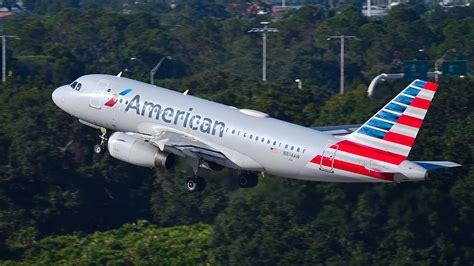
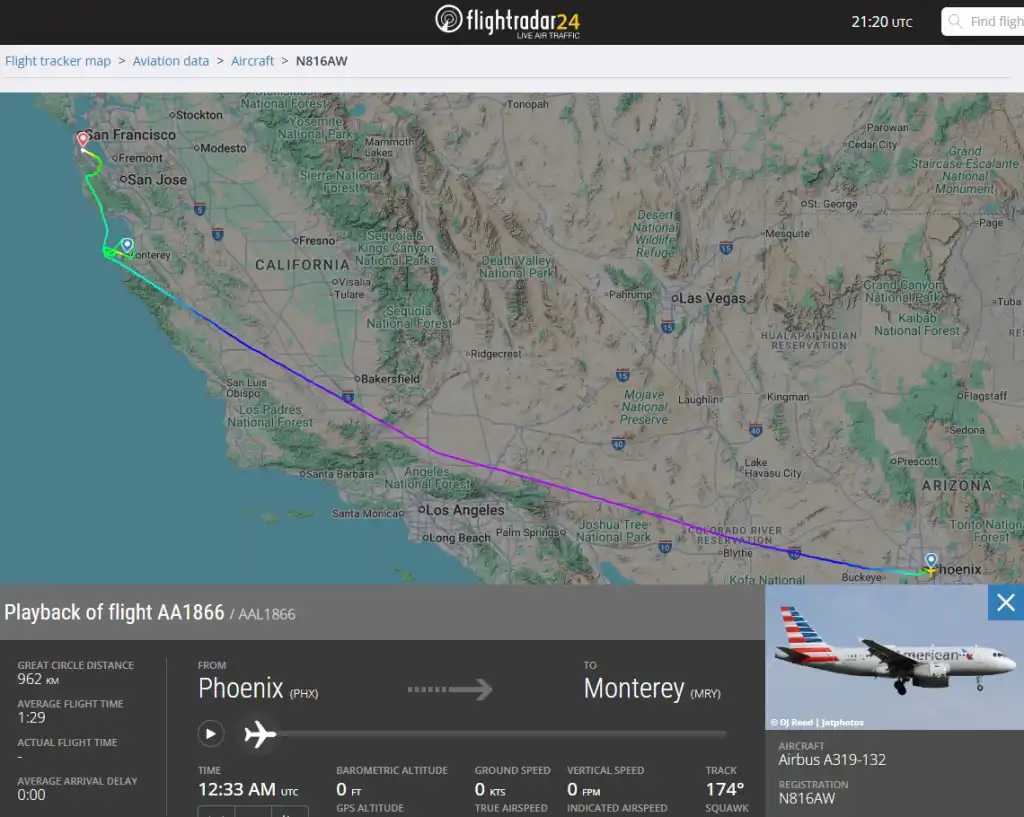
Passengers aboard an American Airlines Airbus A319 expecting a routine evening arrival in Monterrey instead experienced a rare but carefully managed aviation emergency that underscored the importance of crew training, aircraft redundancy, and airport infrastructure. Flight AA1866, operating from Phoenix Sky Harbor International Airport to Monterrey International Airport, was forced to abandon its landing attempt after the aircraft’s landing gear failed to extend during final approach, prompting the flight crew to declare a Pan-Pan and divert to California.
The flight departed Phoenix on January 15 at 6:23 p.m., climbing smoothly to cruising altitude and following an otherwise uneventful route south. With approximately 90 passengers onboard, the Airbus A319-100, registered N816AW, began its descent into Monterrey after a flight of roughly 90 minutes. It was during this critical phase that cockpit indications revealed a potentially serious mechanical issue: the landing gear was not deploying as commanded.
Rather than attempting to force a landing under uncertain conditions, the captain initiated a go-around, a standard safety maneuver allowing pilots to reassess the situation while remaining airborne. Multiple attempts were made to extend the landing gear, but with the malfunction persisting, the crew escalated the situation by declaring “PAN PAN PAN”, an internationally recognized urgency call signaling that the aircraft required priority handling while lives remained safe.
Understanding the Pan-Pan Declaration in Commercial Aviation
A Pan-Pan call sits just below a Mayday in aviation emergency hierarchy, yet it carries significant operational weight. It alerts air traffic control that an aircraft is facing a serious technical issue requiring immediate assistance, priority routing, and contingency planning. In this case, the declaration ensured that airspace, runways, and emergency services could be coordinated swiftly as the situation evolved.
The decision to divert was driven not by panic, but by precision. Monterrey’s runways, while fully capable for normal A319 operations, do not offer the same margin for abnormal landings as larger international hubs. San Francisco International Airport (SFO), by contrast, provides longer runways, extensive emergency response capabilities, and specialized maintenance support—critical advantages when dealing with uncertain landing gear behavior.
The Diversion to San Francisco and Mid-Air Resolution
As the aircraft tracked north along the California coastline, pilots continued troubleshooting procedures outlined by Airbus and American Airlines checklists. During this phase, the crew successfully deployed the landing gear using alternative extension methods, a built-in redundancy designed specifically for scenarios where primary systems fail.
With the gear confirmed down and locked, the aircraft proceeded to Runway 28R at SFO, where emergency vehicles were positioned as a precaution. The landing itself was uneventful, though the aircraft came to a controlled stop on the runway for inspection. Due to non-functioning nose-wheel steering, the Airbus was subsequently towed from the runway, a measure that further emphasized the crew’s conservative and safety-first approach.
Passengers were kept informed throughout the diversion, with the flight crew explaining what to expect upon arrival. According to passenger reports later cited by Aviation Herald, the possibility of a belly landing was mentioned as a theoretical outcome had the gear failed to deploy—an honest but sobering reminder of the stakes involved, though ultimately unnecessary.
Passenger Impact and Aircraft Aftermath
For those onboard, the delay amounted to approximately 35 minutes beyond the original landing timeline, a minor inconvenience considering the circumstances. Once safely disembarked at San Francisco, passengers were reaccommodated to Monterrey via alternate travel arrangements arranged by the airline.
The aircraft itself was removed from service overnight for inspection. The following day, it was ferried back to Phoenix as AA9789, and flight-tracking data indicates it resumed normal operations shortly thereafter without further incident. This rapid return to service suggests the issue was isolated and addressed efficiently.
A Closer Look at the Aircraft Involved
The Airbus A319 at the center of the incident, N816AW, is a 25-year-old A319-132 powered by IAE V2524-A5 engines. First flown in October 2000, the aircraft has served multiple operators, including America West Airlines and US Airways, before joining the American Airlines fleet in 2015. Configured to carry up to 128 passengers across two classes, it represents a mature but widely trusted platform within American’s narrowbody operations.
American Airlines remains the largest global operator of the A319, a testament to the type’s reliability and versatility. Events like this diversion, while rare, demonstrate how layered safety systems—from mechanical redundancies to pilot training and airport selection—work together to protect passengers when unexpected issues arise.
In the end, the successful outcome of Flight AA1866 was not defined by the malfunction itself, but by the disciplined decisions that followed—decisions that turned a potentially serious failure into a controlled, textbook example of modern aviation safety in action.