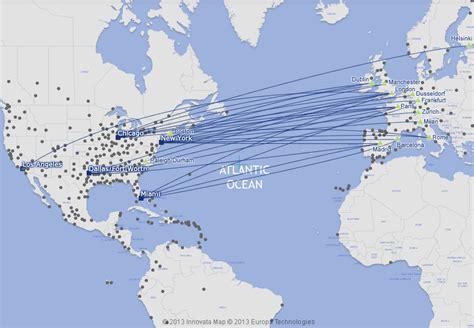
American Airlines’ transatlantic ambitions have entered a new phase, with the carrier now flying to 21 European destinations across 13 countries, marking one of the most deliberate network expansions among U.S. legacy airlines in recent years. The strategy blends business-heavy megahubs with high-demand leisure cities, allowing the airline to capture both corporate travel revenue and seasonal tourism flows without overextending capacity or aircraft deployment.
The backbone of this network remains London Heathrow Airport (LHR), which functions as American Airlines’ most important European gateway. From this single airport, the airline secures access to premium business travelers, global connections, and alliance feed through its oneworld partners. Heathrow alone accounts for a massive share of total European departures, reinforcing how crucial the London market remains in the airline’s long-term transatlantic profitability model.
Beyond London, the network spreads deep into Western Europe while steadily pushing east and south. The airline now connects travelers to major capitals including Paris, Madrid, and Rome, alongside Mediterranean leisure magnets such as Barcelona, Athens, and Nice. This geographic balance gives American Airlines insulation against sudden shifts in travel demand between business and leisure sectors, a pattern that has defined aviation markets since the early 2020s recovery period.
Strategic Growth Through Intentional European Network Expansion
American Airlines is expanding carefully rather than explosively. Industry data from Cirium shows the airline served 17 European airports in 2024, grew to 18 in 2025, and is scheduled to reach 20 airports in 2026 before adding another destination in 2027. This incremental approach allows the airline to test market demand before committing significant aircraft capacity.
Newer additions illustrate this cautious philosophy. Edinburgh joined the network in 2025, while Prague and Budapest launch in 2026 with relatively limited initial frequencies. Each new city begins with modest seasonal schedules, allowing revenue performance, load factors, and cargo demand to determine whether expansion makes financial sense. The next step arrives in 2027, when Porto becomes part of the airline’s growing Iberian footprint.
In total, American Airlines plans more than 20,270 one-way flights to Europe in 2026, representing roughly 6.6% growth compared to 2024 levels. For travelers, the most noticeable impact is expanded nonstop access and more seamless one-stop itineraries through U.S. hubs like Dallas/Fort Worth, Philadelphia, and Charlotte, plus onward connections through European alliance partners.
Mediterranean Focus And Multi-City Italy Strategy
The airline’s European map increasingly tilts toward Southern Europe, reflecting strong leisure demand and growing premium travel tied to luxury tourism and cruise markets. Italy now stands out as a multi-city success story, with service to Rome, Milan, Venice, and Naples forming one of the most diverse U.S.-to-Italy route portfolios among American carriers.
This Mediterranean emphasis extends beyond Italy. Routes to Lisbon, Barcelona, Athens, and Nice give American Airlines strong seasonal revenue potential while still offering year-round business demand. The airline effectively captures travelers heading to coastal tourism regions without abandoning core financial centers.

Heathrow Dominance And Hub Connectivity Economics
Heathrow alone represents approximately 36% of American Airlines’ total Europe departures, equating to around 7,000 flights annually. When combined with Madrid, Paris, Rome, and Barcelona, the top five airports generate roughly 70% of total European capacity, highlighting how concentrated the network remains despite broader geographic coverage.
This concentration is intentional. Large hub airports provide operational reliability, strong connecting passenger flows, and access to premium corporate contracts. Smaller cities, by contrast, are timed around peak travel seasons, allowing aircraft utilization to remain high while minimizing financial risk during off-peak months.
Risk-Balanced Financial Strategy Behind Route Expansion
American Airlines’ European growth mirrors a classic risk-hedged expansion model. Heavy reliance on Heathrow provides strong premium revenue but exposes the airline to high airport fees and intense competition from European flag carriers and other U.S. airlines. By layering smaller seasonal routes onto this foundation, the airline spreads risk across multiple demand segments.
New routes typically launch with limited aircraft allocation and lower weekly frequencies. If routes demonstrate strong unit revenue performance, American gradually increases service. If demand underperforms, capacity can be redeployed quickly to stronger markets, protecting overall network profitability.
Cargo revenue also plays a growing role. Widebody aircraft operating transatlantic routes carry high-value freight ranging from pharmaceuticals to electronics. This cargo income can significantly improve route economics, especially during shoulder travel seasons when passenger demand softens.
What This Means For Travelers In 2026 And Beyond
For passengers, the expansion translates into more nonstop flights, better one-stop connection options, and greater pricing competition across the Atlantic. The mix of business hubs and leisure cities creates flexibility whether travelers are flying for corporate meetings, cultural tourism, or multi-country European trips.
Looking ahead, continued expansion will likely depend on currency trends, fuel prices, aircraft availability, and premium cabin demand. If current travel patterns remain stable, American Airlines is positioned to gradually deepen its European presence without triggering the overcapacity cycles that historically hurt airline profitability.
American Airlines’ 21-destination European network represents more than route growth. It reflects a disciplined long-haul strategy designed to maintain global relevance while adapting to an aviation market where traveler behavior, corporate budgets, and leisure demand shift faster than ever before.