
The rivalry between American Airlines and Delta Air Lines has always been about more than paint schemes and loyalty programs. It is a contest of geography, fleet philosophy, and how each carrier interprets the meaning of “global.” In 2026, that debate feels sharper than ever. Travelers are once again crossing oceans in record numbers, corporate travel has regained much of its pre-pandemic confidence, and airlines are making decisive bets on where the most valuable international demand will live over the next decade. Against this backdrop, the question is not simply who flies to more places, but who truly operates the larger and more meaningful international network.
For passengers choosing where to invest their miles, and for investors gauging strategic resilience, the difference matters. Network size shapes connection options, schedule reliability, aircraft utilization, and ultimately the economics that keep a global airline healthy. Using Cirium schedule exports and industry disclosures from the first half of 2026, a clear picture emerges: American Airlines and Delta Air Lines have taken distinctly different paths to international scale, and those choices define how “large” their networks really are.
At first glance, American Airlines appears unbeatable. Its route map is dense, especially across the Western Hemisphere, and its sheer number of international departures dwarfs most competitors. Delta, by contrast, looks more selective, with fewer total flights but a visibly heavier presence across oceans. The tension between those two models—breadth versus depth—sits at the heart of this comparison.
Two Global Visions Shaping the Same Sky
American Airlines enters 2026 as the carrier with the greatest number of international destinations among US airlines. Serving more than 350 destinations across roughly 60 countries, its network is built around reach and frequency. From Dallas/Fort Worth, Miami, Charlotte, and Phoenix, American pushes aircraft outward in all directions, especially toward Mexico, Central America, South America, and the Caribbean. This design turns geography into an advantage: short stage lengths allow high utilization of narrowbody jets, and multiple daily frequencies make the airline extremely flexible for travelers whose plans are not set in stone.
Delta Air Lines, headquartered in Atlanta, has pursued a more distance-weighted interpretation of network size. While it serves fewer destinations overall, it touches 68 countries, giving it the broader country count. More importantly, Delta has leaned hard into long-haul flying. In the first half of 2026 alone, the airline scheduled 38,538 long-haul international flights, about 20 percent more than American’s 31,914. These flights stretch across the Atlantic and Pacific, anchoring Delta’s identity as a carrier optimized for intercontinental travel rather than regional saturation.
The contrast is not accidental. Pandemic-era decisions forced airlines to rethink fleet complexity and capital allocation. American retired a significant portion of its widebody fleet during that period, prioritizing debt reduction and domestic stability. Delta, with a cleaner balance sheet and a strong operational reputation, kept more long-haul aircraft in service. The result is still visible in 2026: American is rebuilding long-range capacity aggressively, while Delta continues to exploit an established widebody advantage.
Counting Destinations Versus Measuring Distance
When travelers hear “largest international network,” the instinctive metric is destination count. By that measure, American Airlines wins convincingly. Its dominance in Mexico alone is striking, with dozens of cities connected directly to US hubs using Boeing 737-800s and Airbus A320-family aircraft. Add Central America and the Caribbean, and American’s map becomes a dense constellation of short hops, many with multiple daily departures.
Delta’s map looks different. Fewer dots, but longer lines. Its international growth has been concentrated on transatlantic and transpacific corridors, particularly routes linking major US business markets to Europe and Asia. Delta’s strength lies not in touching every possible city, but in offering consistent, high-capacity service on routes that generate significant premium demand.
This divergence highlights why destination count alone can be misleading. A twice-daily flight from Miami to a Caribbean island adds to American’s network size on paper, but it does not carry the same strategic weight as a daily Airbus A350 flight from Atlanta to Tokyo or Los Angeles to Sydney. Distance matters, because distance multiplies seats into available seat miles, the metric airlines use to measure true production.

The Long-Haul Advantage and Widebody Reality
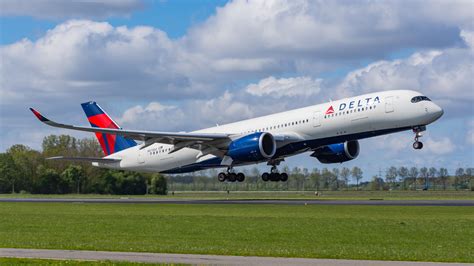
Available seat miles reveal the real story. Despite operating 73,597 fewer international flights than American in the first half of 2026, Delta produced approximately 107.35 billion international ASMs, compared to American’s 99.06 billion. That gap exists because Delta’s international flying relies heavily on widebody aircraft such as the Airbus A350-900 and A330-900, which carry more passengers over much longer distances.
American’s international operation, by contrast, is still heavily concentrated in narrowbody flying. The Boeing 737-800 remains its most common aircraft on international routes, particularly in Latin America and the Caribbean. These flights are numerous, but short. The cumulative effect is impressive frequency, yet lower distance-weighted output.
Delta’s strategy also aligns with its emphasis on premium consistency. Widebody aircraft allow Delta to standardize onboard products, particularly in premium cabins, across long-haul routes. This consistency supports corporate contracts and high-yield travelers who value predictability as much as destination choice. American has begun to close this gap with its new Flagship Suites and refurbished widebodies, but in 2026, Delta’s advantage in heavy aircraft deployment remains substantial.
Hubs as Global Multipliers
Network size is not only about aircraft and routes; it is about how hubs amplify connectivity. American’s Dallas/Fort Worth hub is a marvel of scale, especially for north–south travel. Its geographic position allows efficient connections between the central United States and Latin America, making DFW one of the most powerful international gateways in the Western Hemisphere. Miami plays a similar role, acting as a de facto bridge between North America and South America.
Delta’s hubs tell a different story. Atlanta is the world’s busiest airport by passenger volume, and its connectivity feeds Delta’s long-haul network with remarkable efficiency. New York–JFK and Boston have become premium transatlantic strongholds, while Seattle anchors Delta’s transpacific ambitions. These coastal hubs shorten stage lengths for long-haul flights and improve aircraft utilization, reinforcing Delta’s global production advantage.
The impact of hub strategy becomes especially visible in competitive markets. Raleigh-Durham, a rapidly growing technology and research center, offers a telling example. In early 2026, Delta reclaimed its position as the airport’s leading carrier, serving 84 nonstop destinations and increasing capacity by 5 percent year over year. American’s capacity at RDU declined by 4 percent during the same period, signaling how Delta’s hub-driven, frequency-heavy approach to business markets continues to encroach on territory once considered American strongholds.
Reliability as a Network Asset
A large network is only valuable if it works reliably. Delta has made operational performance a central pillar of its brand, and the data supports the claim. In 2026, Delta earned Cirium’s award for the most on-time US airline for the fifth consecutive year, achieving an 80.9 percent on-time arrival rate across its global operation. This consistency matters disproportionately on long-haul routes, where missed connections can cascade into multi-day disruptions.
Operational reliability effectively expands a network’s usable size. A schedule that passengers trust allows tighter connection banks, better aircraft utilization, and higher yields. Delta leverages this advantage to retain high-value corporate travelers, particularly on transatlantic routes where schedule integrity is often more important than absolute destination count.
American has acknowledged this dynamic and is actively re-banking its Dallas/Fort Worth hub to improve connectivity and reduce misconnect risk. Leadership has framed 2026 as a breakout year, with international growth projected to outpace domestic expansion. The airline’s challenge is not ambition, but execution: rebuilding long-haul scale while maintaining reliability across an enormous, frequency-heavy network is a delicate balancing act.
Premiumization and the Economics of Reach
In 2026, network size is increasingly shaped by premiumization. Airlines are no longer chasing volume alone; they are chasing revenue per seat mile. Delta’s long-haul focus aligns neatly with this reality. Widebody aircraft configured with robust premium cabins allow the airline to extract higher yields from fewer flights, particularly on routes linking financial centers and global capitals.
American’s model captures value differently. Its strength lies in offering travelers choice: multiple departure times, numerous destinations, and strong regional coverage. This appeals to leisure travelers and small-to-medium businesses that prioritize convenience over luxury. The forthcoming Airbus A321XLR plays a critical role in this strategy, allowing American to serve longer thin routes with a narrowbody economics profile. If deliveries remain on schedule, the XLR could blur the traditional boundary between American’s short-haul dominance and Delta’s long-haul supremacy.

The Shadow of a Third Giant
No discussion of international network size is complete without acknowledging United Airlines. While the rivalry between American and Delta captures attention, United often outclasses both in pure long-haul scale. With approximately 230 widebody aircraft and a strategy explicitly built around international expansion, United operates roughly 40 percent more long-haul flights than its legacy peers.
United’s willingness to serve niche international markets further complicates the comparison. Routes such as Newark to Split or Ulaanbaatar illustrate how United uses scale to open city pairs that American and Delta have chosen not to pursue. For travelers prioritizing nonstop access to secondary international destinations, United often emerges as the practical winner.
However, within the American–Delta comparison, United’s presence serves as context rather than contradiction. It underscores that network size can be defined in multiple ways, and that each legacy carrier has chosen a different optimization point along the spectrum of reach, frequency, and distance.
Frequency Versus Production: The Numbers That Matter
The raw numbers tell a paradoxical story. American Airlines operates approximately 195,764 international flights in the first half of 2026, compared to Delta’s 122,167. That difference reflects American’s unparalleled frequency, especially in short-haul international markets. For travelers, this means more departure options and greater schedule flexibility.
Yet production tells a different tale. Delta’s higher ASM output means it is moving more passenger capacity across greater distances, despite flying fewer individual segments. This distinction matters for understanding network power. A carrier that produces more ASMs can generate more revenue opportunities on long-haul routes, where fares and ancillary revenue tend to be higher.
The fleet composition behind these numbers is revealing. Delta’s top ASM generators are widebody aircraft optimized for long-distance efficiency. American’s production is more fragmented, spread across a mix of narrowbody and widebody types. The Boeing 777-200 remains American’s leading ASM generator, but its relative contribution is diluted by the sheer volume of shorter flights elsewhere in the network.
Regional Stability and Geopolitical Exposure
Geography also shapes network resilience. American’s dominance in Latin America and the Caribbean places much of its international capacity in regions with relatively stable demand growth and fewer geopolitical flashpoints. Leisure travel to these markets has proven remarkably resilient, providing American with a dependable revenue base even during periods of global uncertainty.
Delta’s network, with its heavy exposure to Europe and parts of Asia, carries different risks. Geopolitical tensions, regulatory shifts, and economic cycles can have outsized impacts on long-haul demand. While these markets are lucrative, they are also more volatile. Delta’s operational excellence mitigates some of that risk, but exposure remains an inherent feature of its long-haul-centric strategy.
Which Network Is Truly Larger in 2026?
The answer depends on how one defines “larger.” If size is measured by the number of destinations served, the number of flights operated, and the frequency offered to travelers, American Airlines stands on top. Its network is vast, dense, and extraordinarily flexible, particularly within the Western Hemisphere. For travelers who value choice and regional connectivity, American’s international footprint feels immense.
If size is defined by global production, distance-weighted capacity, and the ability to move passengers efficiently across oceans, Delta Air Lines holds the advantage. Its higher ASM output, broader country count, and established widebody fleet give it a network that stretches farther, even if it touches fewer individual cities.
In practical terms, this means American is the king of frequency, while Delta is the master of scale. Each carrier has built a network optimized for different travelers and different economic realities. As American integrates new aircraft and continues its long-haul rebuild, the gap in production may narrow. As Delta continues to refine its premium-focused strategy, its network may become even more distance-intensive.
The skies of 2026 are large enough for both visions to thrive. The true winner is not a single airline, but a competitive landscape that forces each carrier to sharpen its definition of what a global network should be.