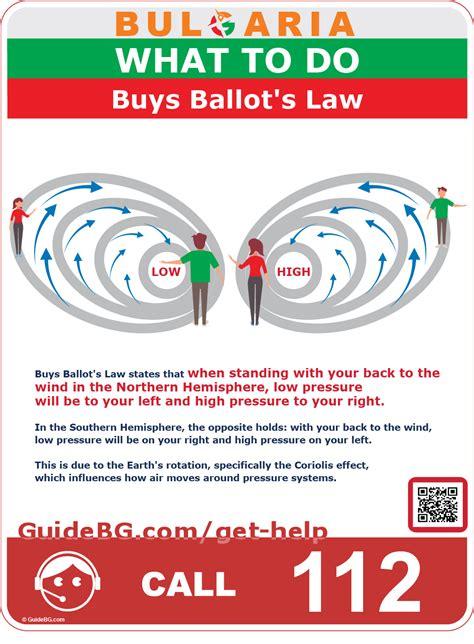
Buys Ballot’s Law explains the relationship between wind direction and atmospheric pressure. In the Northern Hemisphere, if you stand with your back to the wind, you’ll find that low pressure is on your left and high pressure is on your right. This principle was first articulated by Dutch meteorologist C.H.D. Buys Ballot in 1857. Interestingly, he derived it from observations, not realizing that U.S. meteorologist William Ferrel had already worked out the theory. Buys Ballot later acknowledged Ferrel’s earlier findings.
According to this law, a person facing away from the wind will experience high pressure to their right and low pressure to their left in the Northern Hemisphere. The Southern Hemisphere, however, shows the opposite pattern. Theoretically, the angle between the wind direction and the pressure gradient is a right angle. While this holds true in the upper atmosphere, near the ground, the angle is often less than 90 degrees. This occurs due to friction between the air and the Earth’s surface, which causes the wind to shift towards lower pressure areas at the same altitude.
Additionally, the Coriolis effect, a result of the Earth’s rotation, is weak near the equator. Therefore, Buys Ballot’s Law does not apply effectively in those regions.