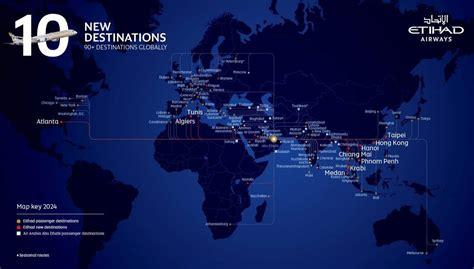
Etihad Airways is preparing one of the most ambitious North American expansions in its history, unveiling plans that will reshape long-haul connectivity between the Middle East, the United States, and Canada. The airline’s newly announced Abu Dhabi–Calgary service is not just another route addition—it is a strategic milestone that pushes Etihad to a record-breaking eight passenger destinations in North America by 2026, surpassing even its pre-pandemic expansion peak. In an industry where network growth is usually incremental and cautious, Etihad’s move stands out as bold, calculated, and deeply strategic.
The Calgary announcement alone rewrites multiple records. It marks Etihad’s first-ever service to more than one Canadian city, Calgary’s longest nonstop international flight, and the first direct passenger link between Alberta and the Middle East. These are not symbolic achievements—they reflect a structural shift in how the Gulf carrier is positioning itself within global aviation flows. Rather than concentrating only on traditional mega-hubs, Etihad is deliberately tapping into high-potential secondary markets with powerful long-haul demand dynamics.
This expansion also elevates Etihad’s North American footprint to a historic scale. With Calgary and Charlotte launching in 2026, and Atlanta already introduced in 2025, the airline will serve Atlanta, Boston, Calgary, Charlotte, Chicago O’Hare, New York JFK, Toronto, and Washington Dulles. That lineup represents a network architecture built not around prestige alone, but around connectivity economics—where passenger flows, diaspora travel, and long-haul hub efficiency intersect.
Calgary Route: A Strategic Leap, Not a Symbolic One
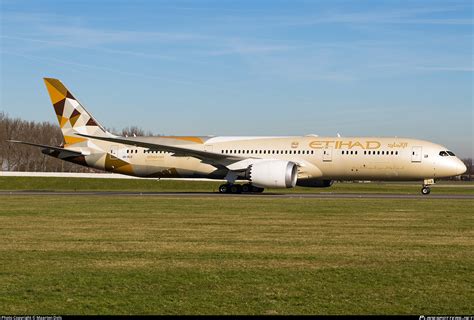
The Abu Dhabi–Calgary route will begin on November 9, timed precisely for the winter travel surge, when demand between South Asia, the Middle East, and North America traditionally peaks. Operated four times weekly using the Boeing 787-9 Dreamliner, the route covers 6,243 nautical miles (11,562 km) each way, instantly becoming one of Etihad’s longest services in its global network. This is not a peripheral route—it is a long-haul backbone corridor.
Calgary’s elevation at 3,606 feet introduces operational complexity, likely requiring payload restrictions on the return leg, but Etihad’s fleet planning suggests confidence in the route’s commercial viability. Industry data strongly indicates the use of the 303-seat 787-9 configuration, a layout optimized for volume rather than premium density, aligning perfectly with the route’s traffic profile and demand structure.
This flight will become Etihad’s sixth-longest service globally, trailing only ultra-long-haul routes like Sydney, Melbourne, Chicago, Atlanta, and the upcoming Charlotte service. In pure network logic, Calgary is being positioned not as a fringe destination, but as a core intercontinental node.
A Route Built on Global Connectivity, Not Local Demand
Local Abu Dhabi–Calgary demand is minimal. But that’s irrelevant to the route’s real purpose. Etihad’s network strength lies in hub connectivity, not point-to-point traffic. The Calgary flight is engineered around transit flows, especially between Canada and South Asia.
Passenger data reveals enormous indirect demand volumes:
Delhi alone accounts for 150,000 annual round-trip passengers from Calgary, dwarfing most other markets. Mumbai, Ahmedabad, Kochi, Bengaluru, Hyderabad, Islamabad, Lahore, Karachi, Bangkok, and Singapore collectively represent hundreds of thousands more travelers annually. These are not speculative markets—they are proven demand corridors currently fragmented across multiple stopover routings.
Etihad’s scheduling amplifies this advantage. The 8:45 am departure from Abu Dhabi aligns with the airline’s primary North America departure bank, while the evening arrival feeds directly into dense South Asia departure waves after 9:00 pm. This creates seamless one-stop connectivity that compresses travel time, simplifies routing, and enhances commercial attractiveness.
In network economics, this is called flow capture strategy—not competing for origin passengers, but for intercontinental traffic streams. Etihad isn’t chasing Calgary demand; it’s intercepting global demand.
The Eight-City North American Network: A Structural Shift
By 2026, Etihad’s North American presence will surpass every previous expansion phase in its history. Even during its pre-pandemic growth era, the airline never exceeded seven active passenger destinations. Eight is not just a number—it’s a network threshold, signaling scale, resilience, and long-term commitment.
Historically, Etihad has served 11 North American airports since 2005, including former routes to Dallas/Fort Worth, Los Angeles, and San Francisco. The difference today is strategic discipline. The current expansion is not driven by prestige routes or brand optics—it is driven by data-driven route economics, fleet optimization, and connection yield modeling.
With over 50 airports added or reinstated globally across 2025 and 2026, Etihad’s resurgence is no longer a recovery story—it is a restructuring story. The airline is building a hub-centric global system, where Abu Dhabi functions as a super-connector between Asia, the Middle East, Europe, and North America.
Why This Expansion Actually Matters
This is not just growth—it’s strategic repositioning. Etihad is transitioning from a regional Gulf carrier into a global connectivity platform airline, designed around long-haul flows rather than local markets. The Calgary route is proof of concept: a non-traditional market activated through intercontinental demand engineering.
Eight North American routes create network gravity. They generate loyalty loops, alliance leverage, cargo synergies, and brand reinforcement across multiple continents. More importantly, they establish Etihad as a structural competitor to legacy transcontinental connectors—not through scale alone, but through routing intelligence.
This expansion is not loud, flashy, or theatrical. It is quiet, surgical, and mathematically elegant. In aviation strategy, that’s the most dangerous kind of growth—the kind built on fundamentals, not hype.
Etihad’s 2026 North America plan is not just a record-breaking milestone. It is the blueprint of a new long-haul model: fewer megahubs, smarter connections, longer routes, deeper flows, and higher network efficiency. This isn’t expansion for visibility. It’s expansion for dominance.