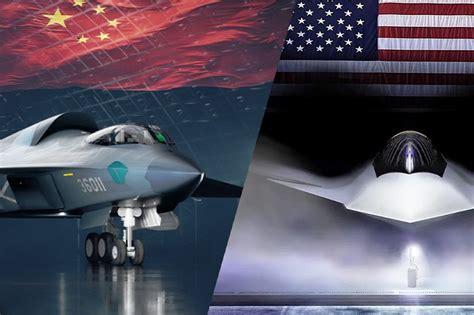
The race for sixth-generation air dominance is no longer a distant strategic vision—it’s a near-term geopolitical reality. As tensions intensify between the United States and China, the focus has shifted to two futuristic war machines: America’s F-47 under the Next Generation Air Dominance (NGAD) program and China’s J-36, a stealth trijet designed for deep-penetration missions. With cutting-edge technologies like AI-piloted swarms, hypersonic payloads, and laser weaponry, this aerial arms race will fundamentally reshape the power balance in the skies over the Indo-Pacific.
The NGAD Initiative: America’s Technological Counterstrike
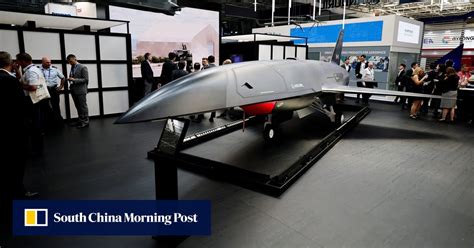
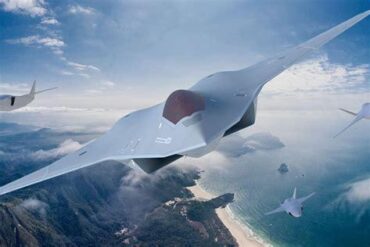
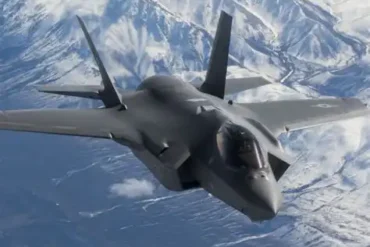
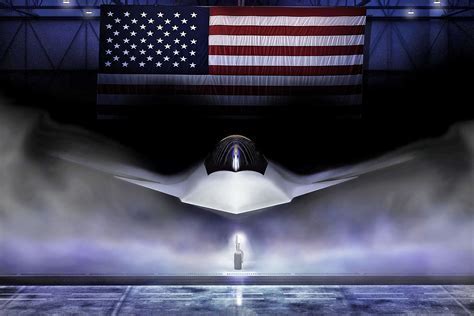
The F-47, developed under the U.S. Air Force’s NGAD program, represents the most ambitious combat aviation initiative in American history. More than just a fighter, it’s envisioned as a “system of systems”—a central manned platform with a fleet of AI-powered uncrewed wingmen, precision-strike capabilities, and modular adaptability for future upgrades.
At the heart of NGAD lies artificial intelligence that doesn’t just assist the pilot—it shares the burden of command and control in real-time battlespace awareness. The jet will reportedly be equipped with high-energy laser weapons, sensor fusion, and even nuclear weapon compatibility. These capabilities give it a strategic flexibility that traditional fighters could never match.
Key technologies in NGAD’s F-47 include:
- AI-driven mission systems for autonomous coordination with drone wingmen
- Adaptive cycle engines for extreme fuel efficiency and thrust variability
- Advanced stealth shaping beyond current radar-evading platforms
- Long-range missile capabilities surpassing even the AIM-260 JATM
Projected unit cost? Over $300 million per aircraft—a staggering figure justified only if it ensures air superiority in the world’s most contested theater.
J-36: China’s Stealth Trijet Steps Up
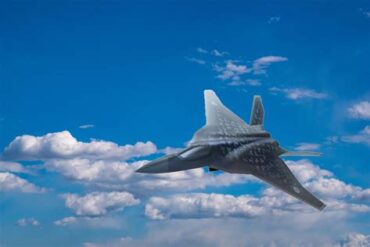
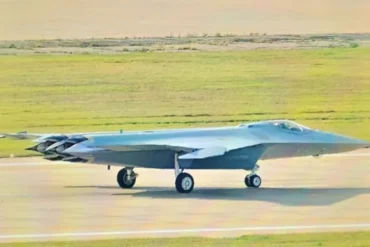
China’s J-36, first seen undergoing flight tests in late 2024, is the People’s Liberation Army Air Force’s (PLAAF) entry into the sixth-generation race. Unlike previous stealth fighters, this platform adopts a tailless, flying wing design and is powered by three engines—an unusual configuration aimed at achieving both stealth and intercontinental range.
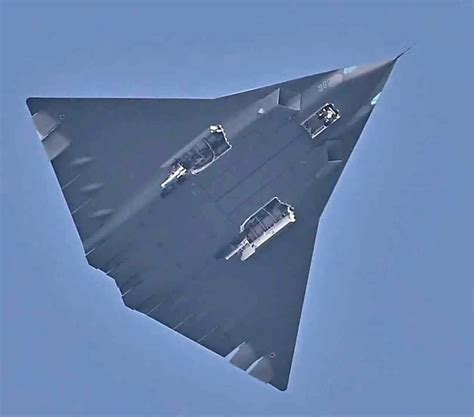
The J-36’s hallmark features center around multi-role survivability and long-range strike ability. With a vast internal weapons bay and compatibility with hypersonic missiles, it’s a clear signal that Beijing is no longer content with air parity—it wants air superiority.
Chinese defense analysts claim the J-36 integrates a proprietary AI battle management suite, capable of controlling multiple unmanned aerial vehicles (UAVs) and conducting deep-penetration missions in a network-denied environment. This would be critical in scenarios involving U.S. electronic warfare assets and satellite jamming.
Yet, significant questions remain over its engine reliability, sensor integration, and pilot-AI coordination interface—issues that could define its combat viability.
Stealth, Range, and Endurance: A Pacific Theater Litmus Test
Both the F-47 and J-36 are purpose-built for operations in the vast Pacific expanse, where range and persistence define strategic value more than maneuverability alone. The F-47 reportedly boasts a combat radius exceeding 1,000 nautical miles, allowing it to operate without frequent reliance on vulnerable mid-air tankers. This is critical when striking well-defended island chains or carrier groups in the South China Sea.
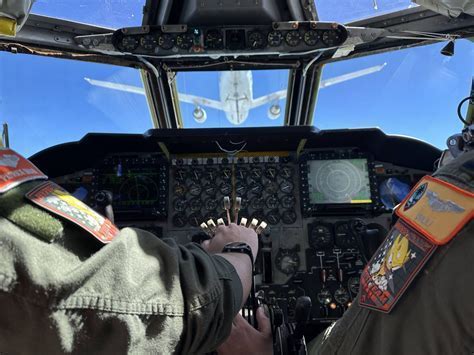
China’s J-36, benefiting from its triple-engine setup, aims to match or exceed that range. This gives it the ability to operate from inland Chinese bases and still reach targets as far as Guam or Darwin. However, this advantage is tempered by the jet’s likely higher infrared signature—a major concern for stealth operations.
Weapons Systems and Kill Web Integration
The F-47 is designed not only to dominate air-to-air combat, but to serve as a battlefield quarterback. Its role as a networked command hub enables it to direct drone swarms, execute electronic warfare attacks, and launch stand-off precision munitions. It will likely carry next-gen weapons like:
- Directed energy weapons (high-energy lasers)
- AIM-260 Joint Advanced Tactical Missiles (JATM)
- Hypersonic cruise missiles
- Cyber warfare modules integrated through modular bays
Meanwhile, the J-36’s massive weapons bay gives it flexibility to carry:
- DF-21-class air-launched hypersonic missiles
- PL-21 long-range air-to-air missiles
- Ground-attack missiles for high-value target strikes
China has made it clear that the J-36 will serve not only as a frontline fighter, but also as an autonomous control hub for UAV operations—mirroring the loyal wingman concept pioneered by the U.S. This signals a convergence in operational doctrine, though the F-47 still leads in AI-enabled autonomy.
The Economic and Industrial Chessboard
Building a sixth-generation fighter is not just a feat of engineering—it’s a test of industrial resilience and economic will. The NGAD program, pegged at over $300 billion, represents a staggering commitment by the United States to maintain air superiority well into the 21st century. Each jet, costing more than an F-22 and F-35 combined, is part of a broader shift toward quality over quantity.
China, despite an increasingly sophisticated aerospace base, still faces limitations in engine manufacturing, material sciences, and reliable electronics sourcing. However, it compensates with speedy prototyping cycles, top-down strategic focus, and access to vast reserves of industrial manpower.
In the long term, it’s not just about building the jet—it’s about maintaining the logistics, software updates, training, and digital infrastructure to keep them combat-effective. The U.S. has decades of experience with such infrastructure, while China is catching up rapidly.
Strategic Outcomes: Who Will Control the Skies?
While the F-47 is likely to debut before the J-36, entry into service is only one part of the equation. Experts point out that operational doctrine, pilot training, and data warfare capabilities will ultimately decide battlefield success.
The United States is integrating its sixth-gen fighters into a Joint All-Domain Command and Control (JADC2) framework, which connects sea, air, land, and space assets into one cohesive digital warfighting web. In contrast, China appears to be testing its own intelligentized warfare strategy with the J-36 at the core.
Combat analysts believe that NGAD’s distributed lethality, enabled through unmanned teaming and dynamic C2 nodes, gives it a first-mover advantage. However, should China manage to resolve its integration hurdles quickly, the J-36 could flood the skies with volume, tipping the scales through sheer deployment density.
The Final Verdict: Superiority Hinges on Time, Not Just Tech
In a vacuum, the F-47 outmatches the J-36 in AI integration, sensor fusion, and autonomous combat support. It is a masterstroke of American aerospace innovation, likely to define air superiority doctrine for decades. But the contest won’t be won solely through specs.
What will determine the true winner are production timelines, maintenance ecosystems, allied interoperability, and combat data feedback loops. The skies of the Western Pacific may become the proving grounds for this unprecedented duel—a sixth-generation clash that could either secure U.S. dominance or herald China’s arrival as a peer military power.
Until then, the question remains not if they’ll clash—but when.