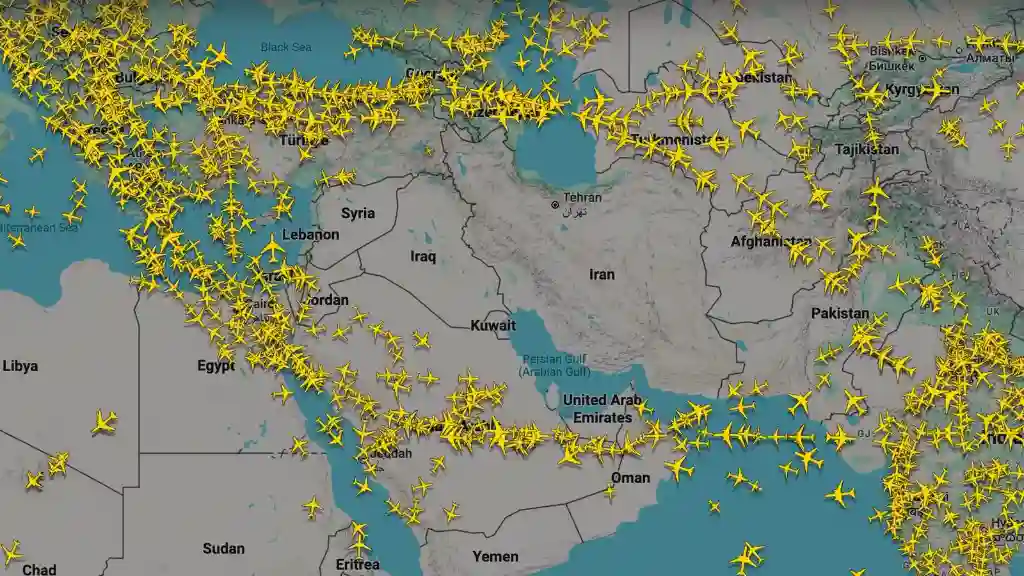
Commercial aviation depends on invisible highways in the sky. When those corridors fracture, the consequences ripple across continents. A journey that once took five efficient hours can now stretch to seven and a half, not because aircraft have slowed down, but because the map itself has changed. A massive new aviation ‘dead zone’—spanning Iranian airspace and compounded by the ongoing closure over Ukraine—has redrawn the geometry of global flight paths, reshaping schedules, costs, and the economics of long-haul travel.
For years, airlines treated the Middle East as a central artery linking Europe and Asia. Aircraft streamed across Iranian skies in steady arcs, stitching together hubs such as Dubai, Doha, and Abu Dhabi with London, Frankfurt, Delhi, and New York. That seamless corridor has now narrowed into two fragile channels—one veering north, another dipping far south—forcing aircraft into elongated detours that add hundreds of nautical miles to routes once considered routine.
Flight-tracking platforms reveal the transformation with stark clarity. What was once a dense lattice of contrails over Iran has become an empty void. Traffic now clings to the periphery, forming tight streams that resemble bypass roads around a closed city center. The shift is not cosmetic. It is operationally seismic.
The Strategic Importance of Middle Eastern Airspace
The Middle East’s airspace is not merely regional—it is structural to global aviation. Positioned between Europe and the Asia-Pacific, it serves as the most direct intercontinental bridge for countless long-haul routes. Airlines such as Emirates, Etihad Airways, and Qatar Airways built their dominance on this geographic advantage, transforming Gulf hubs into the connective tissue of global travel.
Before the latest escalation, a flight from Dubai to Moscow traversed a direct arc across Iran, typically lasting just over five hours. Today, that same route can extend to approximately 7.5 hours, as aircraft swing southward to avoid restricted zones and then curve back north. Multiply that adjustment across dozens of daily rotations, and the cumulative impact becomes staggering.
For airlines operating ultra-long-haul services between India and North America, the disruption cuts even deeper. Carriers that previously crossed Iranian and Ukrainian airspace must now chart alternative routings that stretch aircraft to the limits of range and crew endurance.
When Geography Adds Fuel Stops
Extended flight paths introduce a cascade of technical complications. Aircraft are certified with defined range capabilities, calculated under optimal routing assumptions. A longer path means increased fuel burn. In certain cases, especially on routes already near maximum range, airlines must schedule intermediate fuel stops—a logistical maneuver that was never part of the original timetable.
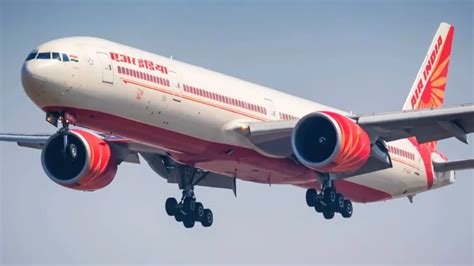
Air India, for example, has adjusted some of its longest services to North America with planned refueling in European airports such as Rome. What was once a seamless nonstop journey becomes a segmented operation, increasing ground handling costs, turnaround times, and passenger inconvenience.
Fuel is only one variable. Every additional minute in the air translates to higher operating expenses. Jet fuel consumption rises exponentially with distance and routing inefficiencies. Airlines must also account for payload limitations, sometimes restricting cargo or passenger capacity to stay within safe weight margins on extended sectors.
Crew Duty Time and the Economics of Delay
Aircraft can technically fly longer routes if they carry sufficient fuel. Human crews, however, operate under strict duty time regulations designed to prevent fatigue. A detour that adds two hours to a scheduled five-hour sector may push pilots and cabin crew beyond allowable limits. When that threshold is crossed, airlines must either roster augmented crews or schedule relief stops—both of which inflate operating costs.
Crew augmentation is not a trivial adjustment. It requires additional personnel, repositioning logistics, hotel accommodations, and regulatory compliance. In a global industry already grappling with staffing pressures, these demands intensify strain on scheduling systems.
The financial markets have taken notice. Airline stocks have experienced volatility as investors factor in prolonged airspace closures and elevated fuel expenditure. The impact is not confined to carriers directly serving the Middle East. European and Asian airlines alike rely on these corridors to maintain efficient east-west connectivity.
Flight Maps Rewritten in Real Time
The transformation of global routing has occurred with startling speed. Within days of airspace restrictions tightening, flight maps displayed a dramatic reconfiguration. Northern detours route aircraft over Central Asia and the Caspian region. Southern alternatives push traffic toward Saudi Arabia, the Arabian Sea, and Egypt before reconnecting with established pathways.
These corridors are narrower and more congested. Air traffic control authorities must manage increased density within compressed airspace bands, heightening coordination complexity. Pilots adjust flight planning daily, recalculating winds, fuel loads, and alternates.
Flights departing from the United Arab Emirates have resumed operations in many cases, yet they operate under new constraints. Even when airports such as Abu Dhabi or Dubai reopen fully, their outbound traffic patterns differ markedly from pre-crisis norms. The physical infrastructure remains intact; the invisible infrastructure of routing has fundamentally shifted.

From Five Hours to Seven and a Half: A Case Study
Consider the Dubai–Moscow sector once more. Pre-closure, the route traced a near-linear path across Iran and Ukraine. Today’s version arcs southward, then climbs north over safer airspace, avoiding both restricted zones. The additional mileage explains the shift from approximately five hours to nearly 7.5.
For passengers, the difference may appear modest—two and a half extra hours. For airlines, the implications compound: increased fuel burn, altered crew scheduling, potential maintenance timing shifts, and cascading delays in tightly synchronized global networks. An aircraft arriving late in Moscow may depart late for its next sector, disrupting onward connections and slot allocations.
In aviation, efficiency is everything. Networks are built on precision, where minutes matter. A structural elongation of routes reverberates across entire fleets.
Aviation’s New Cartography
The emergence of a second major airspace dead zone alongside Ukraine marks a pivotal moment in contemporary aviation. It underscores how geopolitics can instantaneously reshape commercial reality. Aircraft remain technologically capable of spanning oceans and continents with ease, yet their paths are ultimately governed by political stability on the ground below.
As long as these closures persist, global carriers will continue navigating elongated corridors that test the limits of range, endurance, and economic resilience. The world’s flight maps, once defined by the shortest distance between two points, now reflect caution over efficiency.
The skies above Iran and Ukraine may appear empty on tracking screens, but their absence exerts a gravitational pull on every aircraft forced to fly around them. A five-hour journey stretching to seven and a half is not simply a scheduling inconvenience. It is the visible measure of how swiftly global connectivity can bend under pressure—and how aviation, ever adaptive, redraws its routes in response.