Hamburg Airport is one of those aviation landmarks whose history becomes more remarkable the deeper we look. Today, the airport welcomes modern Airbus A320s, Boeing 777s, and other large commercial aircraft to northern Germany, but its story began more than a century ago with machines that looked nothing like today’s airliners. In 1911, the site at Fuhlsbüttel was established as a base for Zeppelin airships, linking it to the earliest experiments in commercial passenger aviation.
That origin gives Hamburg Airport a remarkable distinction. It is widely regarded as the world’s oldest continuously operating commercial airport, although that description requires an important qualification. Older aviation fields still exist, most notably College Park Airport in Maryland, which dates to 1909. However, Hamburg’s claim rests on its extraordinary continuity as a major scheduled-airline airport rather than simply its age as an aviation field.
The distinction matters because the early history of aviation was filled with airfields that changed purpose, disappeared, became military installations, or eventually lost their scheduled passenger services. Hamburg Airport managed to avoid that fate. Across two world wars, the collapse of Germany’s Zeppelin program, British occupation, the Berlin Airlift, the arrival of the jet age, and the rise of giant widebody aircraft, the Fuhlsbüttel site repeatedly reinvented itself.
Hamburg Airport Began With Zeppelins in 1911
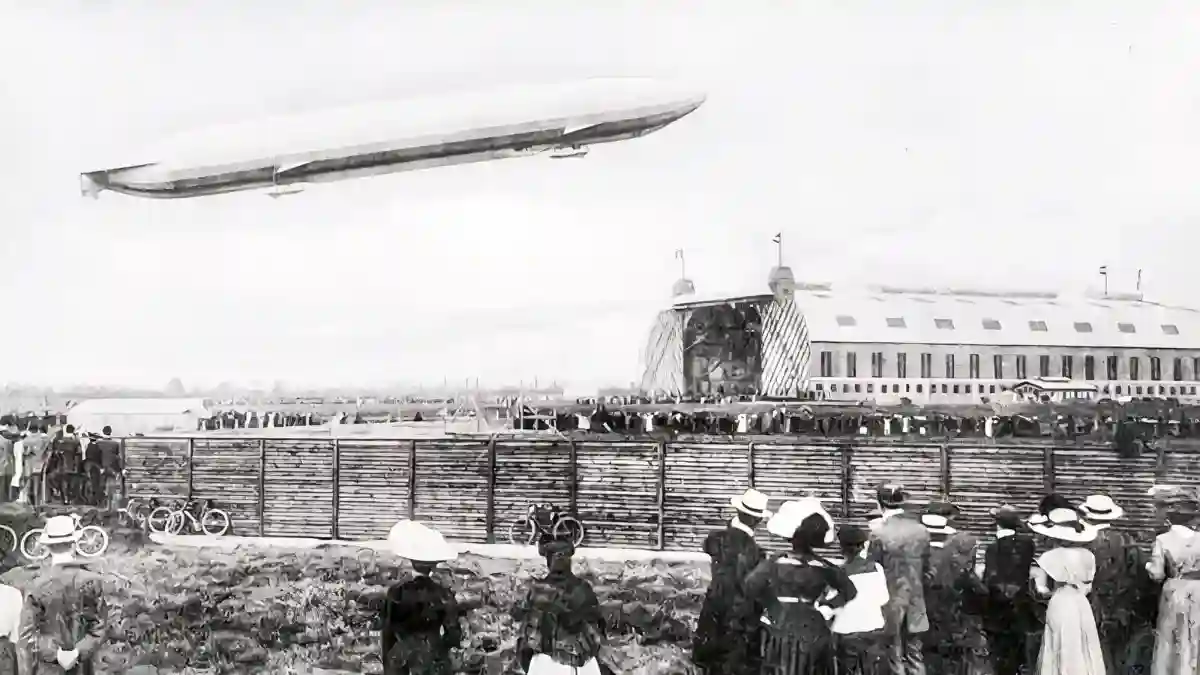
The story of Hamburg Airport begins before an airplane had become a practical tool for mass transportation. In March 1910, Count Ferdinand von Zeppelin addressed residents of Hamburg and promoted the potential of rigid airships for commercial transportation. His message arrived at a moment when aviation was still an emerging technology, but the idea of carrying paying passengers through the sky was already beginning to attract serious investment.
Hamburg responded by establishing an organization dedicated to the airship business. On January 10, 1911, local investors founded Hamburger Luftschiffhallen GmbH, or the Hamburg Airship Hangar Company. Roughly 111 acres, equivalent to about 45 hectares, of grassland near Fuhlsbüttel were selected for an enormous hangar capable of accommodating two Zeppelins.
The decision was strategically important. The location would eventually become the foundation of one of Europe’s major airports, but at the time its purpose was much more specialized. The aviation industry had not yet settled on the airplane as its dominant form of commercial transportation. Large rigid airships appeared capable of offering long-distance travel with an elegance that early airplanes could not match.
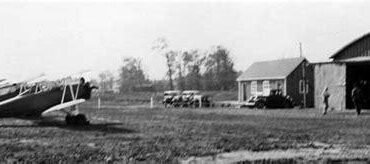
The Fuhlsbüttel hangar was completed in 1912, and its opening was marked by a festival attended by the public. Airships lifted from the site, establishing a connection between Fuhlsbüttel and the pioneering era of commercial air transportation.
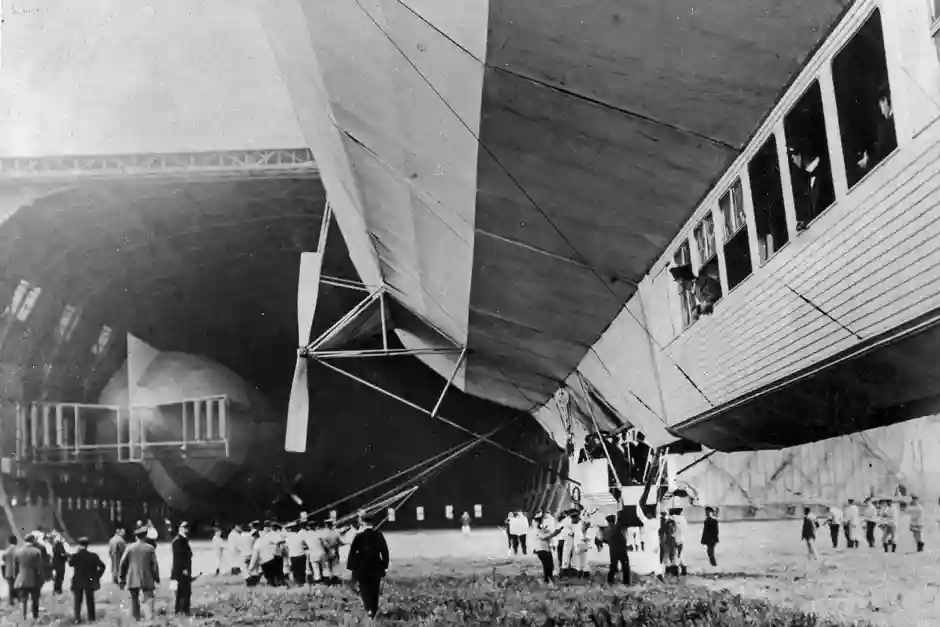
Passengers experienced a very different form of aviation. Instead of entering a pressurized cabin with rows of seats, travelers were carried in open gondolas suspended beneath enormous hydrogen-filled envelopes. The airships could stretch to extraordinary lengths, and their scale was impressive even by modern standards.
The connection with DELAG, the Deutsche Luftschiffahrts-Aktiengesellschaft, made the story even more significant. DELAG is widely regarded as the world’s first airline and had already begun carrying paying passengers on Zeppelin flights from another German location. Hamburg therefore entered aviation history at almost exactly the moment when commercial air travel itself was being invented.
World War I Destroyed Hamburg’s Zeppelin Beginning
The Zeppelin era at Fuhlsbüttel was remarkably short. Only two years after the opening of the airship facilities, Europe entered the conflict that would transform aviation from an experimental transportation technology into a major military instrument.
In 1914, the German military requisitioned the Fuhlsbüttel field. Civilian aviation was pushed aside as governments across Europe took control of aircraft, airfields, factories, and other aviation infrastructure. The First World War demonstrated that aircraft could be used for reconnaissance, bombing, observation, and communications, making aviation infrastructure strategically valuable.
By the end of the war in 1918, the original airship hangar at Fuhlsbüttel had been destroyed. The outcome was particularly significant because the site’s founding purpose had effectively disappeared. The Treaty of Versailles imposed severe restrictions on Germany’s military aviation capabilities and effectively dismantled the country’s rigid-airship ambitions.
Fuhlsbüttel therefore faced a fundamental question: what was an airfield built for Zeppelins supposed to become when the Zeppelin program itself had been crippled?
The answer would shape Hamburg Airport for the next century.
Fuhlsbüttel Became a Commercial Airport
Scheduled aviation returned to Fuhlsbüttel in 1919, giving the site a new purpose almost immediately after the First World War. Instead of serving enormous rigid airships, the field increasingly became part of the emerging network of passenger and cargo aircraft connecting European cities.
In 1920, KLM launched an international route linking Rotterdam, Amsterdam, Hamburg, and Copenhagen. This was an important step because it moved Fuhlsbüttel away from its experimental Zeppelin origins and toward the role that defines Hamburg Airport today: a scheduled commercial gateway connecting Hamburg with other cities.
Passenger numbers in those early years were tiny compared with modern aviation. In 1920, the airport recorded only 241 passengers. By contemporary standards, that number seems almost impossibly small. Yet the significance was not the volume. The important development was that a functioning passenger network was being established.
The airport continued developing throughout the 1920s. In 1929, Fuhlsbüttel opened its first proper terminal building, bringing passenger and cargo handling, administrative facilities, a restaurant, and an observation deck together in one structure.
This was no longer simply a field where pioneering aviators experimented with aircraft. It was becoming recognizable as an airport in the modern commercial sense.
The transformation also explains why Hamburg’s historical claim is more complicated than simply saying it is the oldest airport in the world. The site’s original operation began as a Zeppelin base, while its role as a scheduled aircraft airport developed later. Yet the physical location remained continuously tied to aviation, and that continuity is central to Hamburg’s status.
World War II Turned Hamburg Airport Into a Military Asset
The Second World War again interrupted civilian aviation. On August 28, 1939, just four days before Germany invaded Poland, the Luftwaffe requisitioned Fuhlsbüttel and placed it under national defense requirements.
The airport had already undergone military expansion during 1936 and 1937. During the war, the field supported military aviation operations and became part of Germany’s broader wartime airfield network.
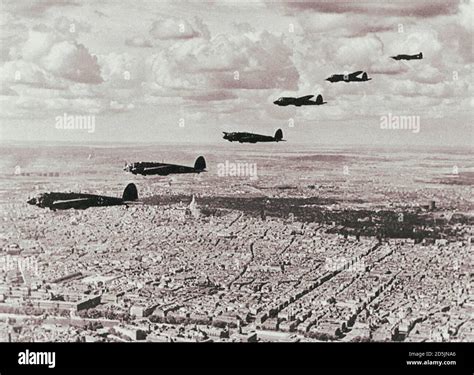
Among the units associated with Fuhlsbüttel was 1.(F)/Aufklärungsgruppe 122, a long-range reconnaissance Staffel equipped with Heinkel He 111 aircraft. The unit operated from Fuhlsbüttel in early 1940 before moving north in connection with Germany’s campaign in Norway.
Hamburg itself became one of the major targets of the Allied bombing campaign. During Operation Gomorrah in July and August 1943, the city suffered devastating air raids that created one of the most destructive firestorms of the war. Thousands of aircraft participated in the campaign, and tens of thousands of people were killed.
Fuhlsbüttel was also bombed, yet the airport survived the war in comparatively usable condition. Hamburg Airport’s historical account notes that the Luftwaffe attempted to camouflage the field using trees, woven materials, and camouflage nets.
The airport’s survival would prove crucial. When Germany surrendered in 1945, Fuhlsbüttel had passed through another world war without disappearing from the aviation map.
British Control and the Berlin Airlift
In May 1945, the Royal Air Force took control of Hamburg Airport. British administration continued until 1950, covering one of the most politically tense periods in postwar European history.
The airport soon acquired an unexpected role in the Berlin Airlift, which began after the Soviet Union blocked land access to West Berlin in 1948. From June 1948 to May 1949, Allied aircraft carried essential supplies into the isolated western sectors of Berlin.
Hamburg became one of the supporting bases for this extraordinary operation. Aircraft departing from the city carried necessities such as coal and food toward West Berlin. Some of these aircraft became popularly associated with the nickname “Raisin Bombers,” reflecting the candy and small packages that Allied crews sometimes dropped to children near Berlin.
The contrast was striking. A field that had begun with elegant Zeppelins was now helping sustain a divided city during the opening confrontation of the Cold War.
After British administration ended in 1950, the airport officially carried the Hamburg Airport name. The next transformation was already approaching: commercial aviation was moving rapidly from piston-powered aircraft toward the jet age.
Lufthansa Brings Hamburg Into the Jet Age
The postwar recovery of German aviation fundamentally changed Fuhlsbüttel. Lufthansa began scheduled domestic services from Hamburg on April 1, 1955, marking a major milestone in the airport’s return to civilian commercial aviation.
Only a few months later, Lufthansa launched its first North Atlantic service, using the Lockheed Super Constellation on a route to New York. Hamburg was increasingly becoming an international aviation gateway rather than simply a regional airport.
Then came the aircraft that changed commercial aviation forever.
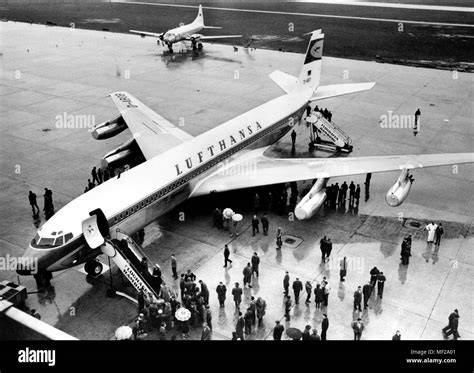
On March 2, 1960, Lufthansa’s first Boeing 707 arrived at Hamburg directly from Seattle. The aircraft represented a dramatic technological leap over the propeller-driven airliners that had dominated the previous generation.
The Boeing 707 was faster, flew higher, and could transform long-distance travel. For Hamburg Airport, however, the jet age created a difficult infrastructure challenge. The airport had been established when aviation meant grass fields and airships. Now increasingly large and fast aircraft required stronger runways, expanded aprons, better terminals, and more sophisticated passenger facilities.
The arrival of the Boeing 747 made the challenge even greater.
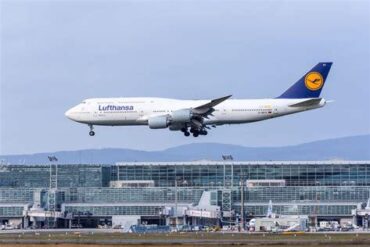
On March 30, 1970, Lufthansa’s first Boeing 747 landed at Fuhlsbüttel. The 747 weighed hundreds of tonnes and required a reinforced apron and a new terminal position. Hamburg installed its first two passenger bridges to accommodate the aircraft.
The airport had now crossed an extraordinary technological divide. The same location that had once launched hydrogen-filled Zeppelins was handling one of the largest commercial aircraft ever built.
HAM21 Rebuilt Hamburg Airport for Modern Aviation
By the beginning of the 21st century, Hamburg Airport faced a familiar problem: historical continuity alone does not keep an airport competitive.
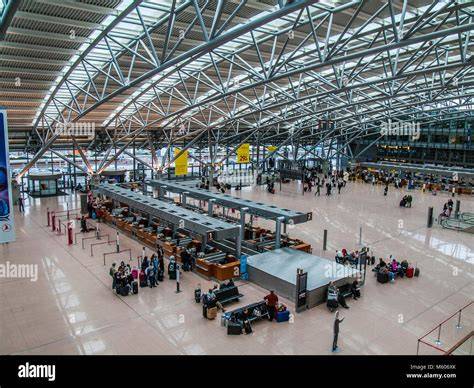
The airport needed to accommodate far more passengers, modern aircraft, changing security requirements, improved ground transportation, and increasingly complex terminal operations. The response was HAM21, a major modernization program carried out from 2001 to 2009.
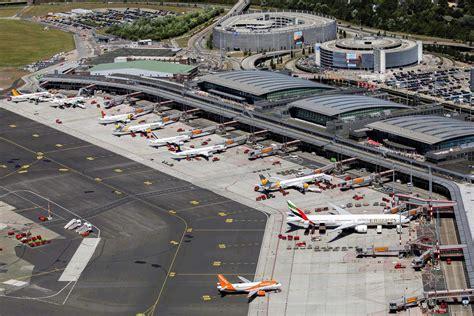
The project cost approximately €356 million, or around $390 million at the time. Rather than simply adding isolated improvements, the program reshaped the airport around two passenger terminals and modernized much of the supporting infrastructure.
A dedicated metro rail station improved access for passengers, while a multistory parking facility, dynamic parking guidance, and wider access roads addressed the ground-side demands of a major metropolitan airport.
The modernization demonstrated something important about Hamburg’s survival. The airport did not remain relevant simply because it was historically important. It remained relevant because successive generations were willing to rebuild and modernize an aging aviation site.
That distinction separates Hamburg from several other historic European airfields.
Hamburg Airport Welcomed the Airbus A380
The arrival of the Airbus A380 provided perhaps the most visually dramatic demonstration of Hamburg’s transformation.
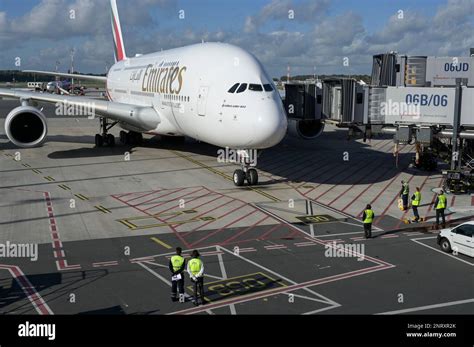
On October 29, 2018, Hamburg Airport became a certified A380 destination and welcomed its first scheduled Emirates Airbus A380. The aircraft’s 79.75-meter wingspan and enormous maximum takeoff weight represented a spectacular contrast with the lightweight aircraft and airships that had once operated from Fuhlsbüttel.
The A380 required specialized infrastructure and sufficient apron space, demonstrating that Hamburg’s century-old location could accommodate one of the largest passenger aircraft ever certified for airline service.
Emirates later replaced the A380 on the Hamburg-Dubai route with Boeing 777-300ER aircraft, but the significance of the 2018 operation remained. A site originally designed around two Zeppelin airships had evolved sufficiently to handle a four-engine superjumbo.
Why Hamburg Airport Is Not Simply the World’s Oldest Airport
The phrase “world’s oldest commercial airport” needs careful interpretation because aviation history contains several competing claims.
The most important rival is College Park Airport in Maryland, near Washington, D.C. The field dates to 1909, when the U.S. Army Signal Corps brought Wilbur Wright there to train America’s first two military pilots.
College Park has remained an active airport ever since, making it older than Hamburg by approximately two years. However, its modern role is fundamentally different.
Today, College Park is primarily a general aviation airport. It supports private flying, flight training, and other smaller-aircraft operations. Its runway is roughly 2,600 feet long, making it appropriate for light aircraft but unsuitable for the large commercial airliners that regularly operate at Hamburg.
This creates the critical distinction.
College Park can claim the title of an older continuously operating airport. Hamburg can claim something more specific: it is widely regarded as the oldest continuously operating major commercial airport with scheduled airline service.
Other historical airports complicate the picture further. Berlin Tempelhof, which opened in 1909 and later became an important hub for Deutsche Luft Hansa, closed permanently in 2008. Its former runways now form part of a public park.
Paris-Le Bourget, meanwhile, remains active but is primarily associated with business aviation rather than conventional scheduled passenger operations. Other historic airfields have similarly changed roles, demonstrating that simply keeping an airport physically open is not enough to preserve its commercial identity.
Hamburg’s Century-Long Survival Is the Real Story
The most impressive aspect of Hamburg Airport’s history may therefore be less about the title itself and more about continuity through transformation.
Few aviation sites have experienced so many different eras without losing their basic function. Fuhlsbüttel began with Zeppelins, endured military control during World War I, returned to scheduled civilian flights, became a Luftwaffe facility during World War II, survived Allied bombing, operated under British administration, supported the Berlin Airlift, returned to German commercial aviation, entered the jet age, accommodated the Boeing 747, underwent a major 21st-century reconstruction, and eventually handled the Airbus A380.
Every technological revolution could have made the site obsolete.
Instead, each revolution forced another reinvention.
That is particularly important because airports are unusually difficult pieces of infrastructure to preserve. Aircraft become larger. Runways require strengthening. Terminals become outdated. Security standards change. Passenger volumes increase. Rail connections and roads must evolve. Environmental expectations become more demanding.
Hamburg has repeatedly responded to those pressures rather than treating its historic status as an excuse to stand still.
Today, the airport is pursuing measures aimed at reducing emissions from its own operations while supporting the broader aviation industry’s transition toward lower-carbon technologies, including sustainable aviation fuel infrastructure. The details of aviation’s energy transition remain uncertain, but Hamburg’s history suggests that adaptation is deeply embedded in the site’s identity.
From Zeppelin Gondolas to Boeing 777s
There is an almost surreal quality to the airport’s evolution.
In the early 1910s, passengers could board a hydrogen-filled airship from a grass field and travel beneath an enormous envelope suspended above them. More than a century later, passengers arriving at Hamburg can step into a modern terminal, pass through sophisticated security systems, board a widebody jet, and cross continents at hundreds of miles per hour.
The machines changed completely. The airport’s fundamental purpose did not.
That is why Hamburg Airport remains such a fascinating landmark in commercial aviation history. Its significance is not based on a single record-breaking aircraft or one famous flight. Instead, it lies in the extraordinary survival of one aviation location through generations of technological, political, and economic change.
The old Zeppelin base did not become a museum. It became an international airport.
Hamburg Airport’s Place in Aviation History
Whether Hamburg should be called the world’s oldest commercial airport depends on how we define commercial, airport, and continuous operation. College Park is older. Tempelhof had an earlier aviation history but is now closed. Other historic European fields remain open but have moved away from scheduled airline service.
Hamburg’s case is compelling because the site has maintained a direct connection with commercial air transportation across more than a century of upheaval.
Its story began with a vision of commercial Zeppelin travel in 1911. The first airship facilities were soon destroyed by war. Scheduled airplane services followed. The airport survived another world war, supported the Berlin Airlift, embraced Lufthansa’s postwar expansion, entered the jet age, and continued rebuilding itself for aircraft that its founders could never have imagined.
The contrast between the first machines at Fuhlsbüttel and the aircraft seen there today is almost impossible to overstate. Yet that contrast is precisely what makes the airport historically valuable.
Hamburg Airport’s greatest achievement is not simply surviving for more than a century. It is surviving by changing.
From a Zeppelin base in 1911 to a modern international gateway capable of accommodating aircraft such as the Airbus A380, Fuhlsbüttel demonstrates how aviation infrastructure can evolve without abandoning its original place in history.
The next century will bring another series of challenges, from decarbonization and sustainable fuels to new propulsion technologies and changing passenger expectations. If Hamburg follows the pattern established during its first 115 years, the airport will not remain relevant by trying to preserve the past.
It will remain relevant by continuing to reinvent it.