Navigating an aircraft across vast skies requires more than sharp instincts and visual reference points. Today’s aviation industry demands precise, reliable, and technologically advanced navigation systems that enable pilots to safely and efficiently guide aircraft from departure to arrival, regardless of environmental conditions. In this article, we explore in detail how an aircraft’s navigation system works, uncovering its sophisticated components and essential operational principles.
Understanding the Aircraft Navigation System
An aircraft navigation system is the electronic network responsible for providing pilots with critical information related to the aircraft’s position, speed, direction, and environmental surroundings. It integrates both onboard systems and external radio aids, ensuring that pilots can monitor flight paths accurately and respond effectively to dynamic flight conditions.
Historically, early aviators relied on a magnetic compass and rudimentary dead-reckoning methods, often calculating their position using estimated speed and time over a mapped route. However, these methods were notoriously prone to cumulative errors. With the advent of radio navigation technologies and later satellite-based systems, aviation navigation underwent a revolutionary transformation.

Core Components of Modern Aircraft Navigation Systems
Today’s sophisticated navigation systems are built on multiple interconnected platforms. These include the Global Navigation Satellite System (GNSS), the Inertial Reference System (IRS), and the Flight Management System (FMS).
Each system plays a crucial role in offering real-time positioning, autonomous data collection, and dynamic flight management to ensure that pilots can concentrate on decision-making and aircraft control.
Global Navigation Satellite System (GNSS)
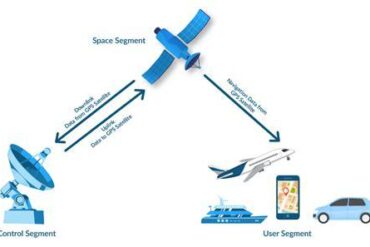
The Global Navigation Satellite System (GNSS) refers to a constellation of satellites that transmit positioning data to receivers onboard the aircraft. Through the calculation of signals from at least four satellites, the aircraft’s exact position, speed, and altitude can be determined with impressive accuracy.
The most widely utilized GNSS networks are:
- GPS (Global Positioning System) — Managed by the United States, it is the backbone of most aircraft navigation systems.
- GLONASS (Global’naya Navigatsionnaa Sputnikovaya Sistema) — Russia’s satellite navigation system.
- Galileo — Europe’s independent, high-precision satellite navigation initiative.
By continuously communicating with these satellites, the onboard GNSS receiver provides critical positional data even in remote regions where traditional radio aids would fail.

Inertial Reference System (IRS)
The Inertial Reference System (IRS) offers a different approach to navigation. Unlike GNSS, the IRS is a self-contained system that does not rely on external signals. Using highly sensitive accelerometers and gyroscopes, the IRS measures the aircraft’s movement across all three axes.
At the start of the flight, pilots input the aircraft’s known latitude and longitude. From that fixed starting point, the IRS calculates the aircraft’s continuous position by integrating acceleration and rotational data. This process is known as inertial navigation and is especially critical when satellite signals are weak, obstructed, or compromised.
Advantages of the IRS include:
- Independence from external radio or satellite signals.
- High reliability over short- to medium-term flights.
- Critical redundancy for GNSS-based navigation systems.
Flight Management System (FMS)
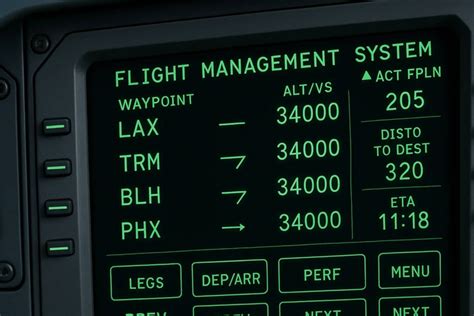
Often referred to as the brain of the aircraft, the Flight Management System (FMS) integrates navigation inputs and automates complex flight planning and execution tasks.
Pilots input the intended route into the FMS before departure, programming waypoints, airways, departure and arrival procedures, and alternate airports. Throughout the flight, the FMS continuously updates positional information by combining data from the GNSS and IRS.
Key functions of the FMS include:
- Autopilot Configuration: Controlling the aircraft’s flight path according to programmed routes.
- Fuel Optimization: Recommending flight profiles that minimize fuel consumption.
- Performance Calculations: Computing optimal speeds, altitudes, and engine settings.
- Communication Assistance: Managing and displaying air traffic control (ATC) communications.
By reducing pilot workload, the FMS enhances flight safety, fuel efficiency, and overall operational precision.
Pre-Flight Setup and In-Flight Monitoring
Prior to takeoff, a pilot’s duties regarding the navigation system include meticulous setup. This involves entering the entire flight plan, confirming departure and arrival procedures, establishing initial positional references for the IRS, and verifying the GNSS’s satellite signal integrity.
During the flight, pilots monitor:
- Aircraft’s Current Position: Cross-verifying GNSS and IRS data.
- Environmental Factors: Detecting adverse weather, terrain, or air traffic congestion.
- Route Deviations: Responding promptly to any drift from the intended path.
This rigorous in-flight oversight ensures continuous situational awareness and the ability to respond dynamically to unexpected developments.
Evolution from Early Navigation Methods
In aviation’s early decades, navigation was a precarious art. Pilots, using only a magnetic compass and a mechanical clock, would estimate their location based on their heading and airspeed over time. Known as dead reckoning, this technique was prone to serious errors, particularly when accounting for wind drift or instrument inaccuracies.
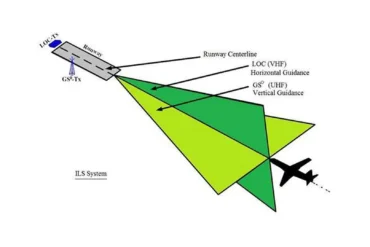
The introduction of radio beacons significantly improved navigation by enabling pilots to home in on ground-based transmitters. Systems like VOR (VHF Omnidirectional Range) and ADF (Automatic Direction Finder) provided pilots with real-time bearings, greatly enhancing their ability to fly accurate routes, especially in poor visibility conditions.
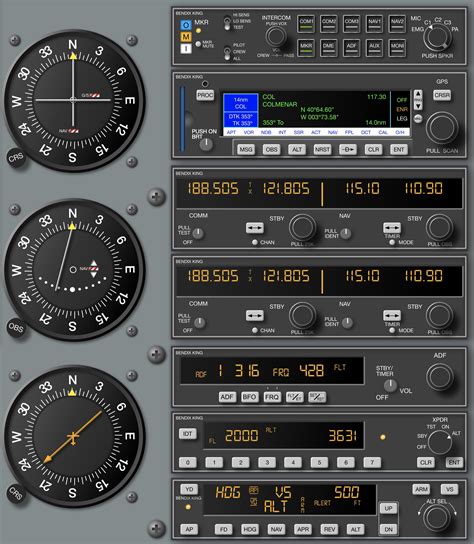
Today, however, the marriage of satellite navigation with inertial guidance and digital flight management has rendered navigation not only more accurate but also far more efficient and resilient against failures.
Why Mastering the Navigation System is Essential for Pilots
Mastery of an aircraft’s navigation system is not optional; it is fundamental for ensuring flight safety, operational efficiency, and regulatory compliance. A professional pilot must be able to program, monitor, troubleshoot, and dynamically adapt the navigation system based on evolving flight conditions and air traffic control directives.
Training programs, such as those offered by EAS Barcelona, emphasize extensive theoretical and practical instruction in navigation systems. Graduates are thoroughly prepared to handle the complexities of modern air navigation and obtain certifications recognized by agencies such as AESA (Spanish Aviation Safety Agency) and EASA (European Union Aviation Safety Agency).
The Future of Aircraft Navigation
The next evolution in navigation technology promises even greater automation, precision, and reliability. Developments on the horizon include:
- Enhanced GNSS Systems: Greater accuracy through multi-frequency signals and augmented satellite networks.
- Satellite-Based Augmentation Systems (SBAS): Improving GNSS data reliability and integrity.
- Artificial Intelligence Integration: Predictive algorithms that assist with route planning, hazard detection, and automated decision-making.
- Hybrid Navigation Platforms: Merging inertial, satellite, and visual navigation into unified systems for robust redundancy.
As aviation technology advances, pilots will need to stay ahead of these innovations, maintaining a sharp understanding of how evolving systems interact to deliver unparalleled navigational capabilities.
Conclusion
An aircraft’s navigation system is a masterpiece of modern engineering, representing decades of technological evolution and operational refinement. Through the combined power of GNSS, IRS, and FMS, pilots are equipped with the tools necessary to navigate today’s increasingly complex airspace safely and efficiently. Mastery of these systems is an indispensable skill, ensuring that each flight, regardless of conditions or challenges, reaches its intended destination with precision and safety.