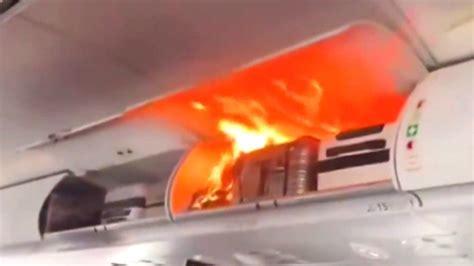
What began as a routine domestic hop from Delhi to Chennai turned into a harrowing airborne ordeal on Sunday when a passenger’s power bank spontaneously ignited inside an overhead storage bin aboard an IndiGo Airbus A321neo. Flight 6E 6115 was cruising at altitude when smoke began pouring from the luggage compartment, forcing the crew to declare an emergency and divert to Hyderabad’s Rajiv Gandhi International Airport. The incident, captured in a now-viral video, shows terrified passengers scrambling to contain the blaze while flight attendants worked to move travelers away from the immediate danger zone. No injuries were reported, but the episode has reignited urgent questions about the growing threat posed by lithium-ion batteries in commercial aviation.
The Terrifying Sequence of Events Aboard Flight 6E 6115
IndiGo flight 6115 had departed Delhi Indira Gandhi International Airport (DEL) en route to Chennai International Airport (MAA), a route that typically takes just under three hours. Somewhere over the Indian subcontinent, a personal electronic device stored in the overhead bin erupted into flames, filling the cabin with acrid smoke. The video footage that subsequently circulated online depicts a chaotic scene: passengers frantically passing bottles of water and attempting to smother the fire while crew members directed people toward the rear of the aircraft. The pilots executed an expedited descent and diverted the A321neo, registered as VT-NOE, to Hyderabad, where the aircraft touched down safely. IndiGo swiftly arranged an alternative aircraft to ferry the shaken passengers onward to Chennai, and the airline confirmed that a full investigation into the defective backup battery device would be conducted.
IndiGo’s Policy Violation and the Airline’s Official Response
The incident represents a clear violation of IndiGo’s stated safety protocols, which explicitly permit power banks and spare lithium batteries only in hand baggage while strictly prohibiting their storage in overhead compartments or checked luggage. An IndiGo spokesperson issued a statement confirming that smoke was detected from a customer’s personal electronic device, praising the cabin crew for their prompt response and confirming that the situation was brought under control. The airline’s handling of the aftermath, from the emergency diversion to the rapid deployment of a replacement aircraft, demonstrated operational competence, yet the root cause remains a passenger’s failure to comply with well-publicized safety regulations.
Understanding Thermal Runaway: The Science Behind Lithium-Ion Catastrophes
The technical mechanism that transforms a compact power bank into a deadly incendiary device is known as thermal runaway, a chemical chain reaction that ranks among the most perilous in-flight emergencies. Unlike conventional fires, a lithium-ion battery blaze generates its own oxygen and produces temperatures exceeding 600°C (1,112°F). This intense heat causes adjacent cells within the battery to rupture and explode in sequence, creating a torch-like flame that instantly ignites surrounding luggage, clothing, and synthetic materials. Even after visible flames are suppressed, the internal reaction can persist, causing the device to reignite minutes later without warning. The proliferation of increasingly powerful consumer-grade backup batteries has dramatically elevated this risk across the aviation industry, transforming what was once a rare occurrence into a recurring safety concern.
Why Overhead Bins Magnify the Catastrophic Potential
An overhead storage bin functions as a pressurized oven, concentrating heat and trapping dense, toxic smoke while accelerating the ignition of adjacent materials. Because the compartment is enclosed, a fire can smolder undetected for critical minutes until sufficient pressure builds to blow the door open, unleashing a flashover directly into the passenger cabin. Directly above the ceiling panels of modern airliners like the A321neo lie essential electrical wiring looms, control lines, and composite structures. Should a fire breach the top of a luggage bin, it could compromise the aircraft’s flight control and navigation systems. Compounding this danger, smoke inhalation kills far more rapidly than flames; a cabin fire produces a lethal cocktail of carbon monoxide, hydrogen cyanide, and vaporized plastic. Historical aviation data indicates that once an uncontained cabin fire takes hold, flight crews typically have only 15 to 19 minutes to land the aircraft before dense smoke renders both cabin and cockpit uninhabitable.
The Broader Implications for Aviation Safety and Passenger Compliance
The IndiGo incident underscores a pressing industry-wide challenge: as passengers carry more powerful electronic devices, the margin for error in handling lithium-ion batteries shrinks dramatically. While flight attendants receive training in fire containment procedures, including the use of fire-resistant bags and specialized extinguishing agents, the most effective defense remains prevention through strict adherence to carry-on regulations. Airlines globally have intensified messaging around power bank safety, yet compliance ultimately rests with passengers who may underestimate the catastrophic potential of a device small enough to fit in a pocket. The successful outcome of Flight 6E 6115 owed much to the crew’s swift recognition of the threat and the pilots’ decisive emergency descent. Nevertheless, the event serves as an unambiguous warning that the next thermal runaway incident may not end so fortunately.