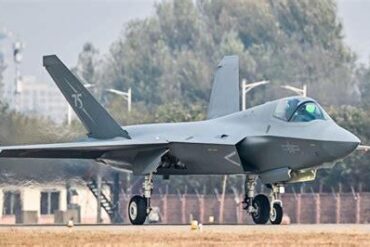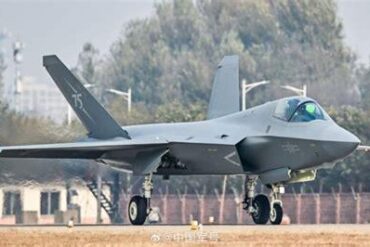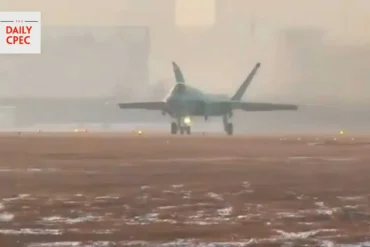
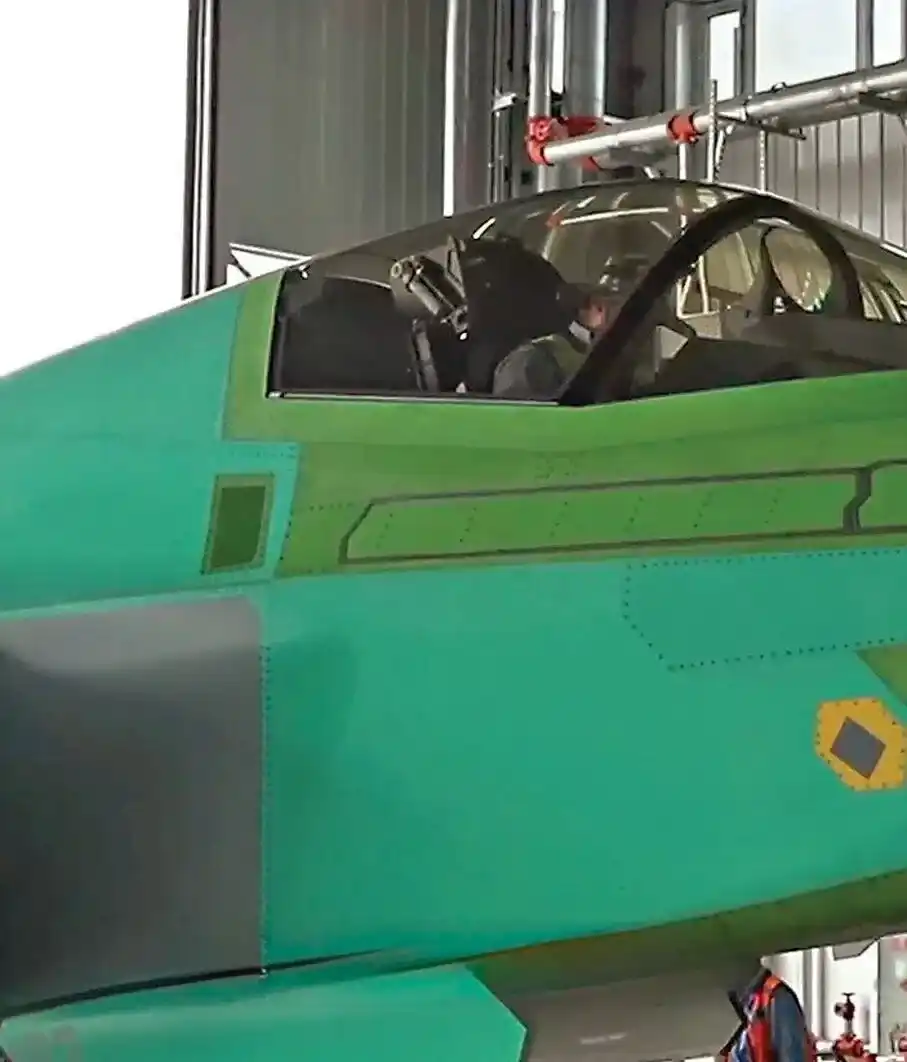
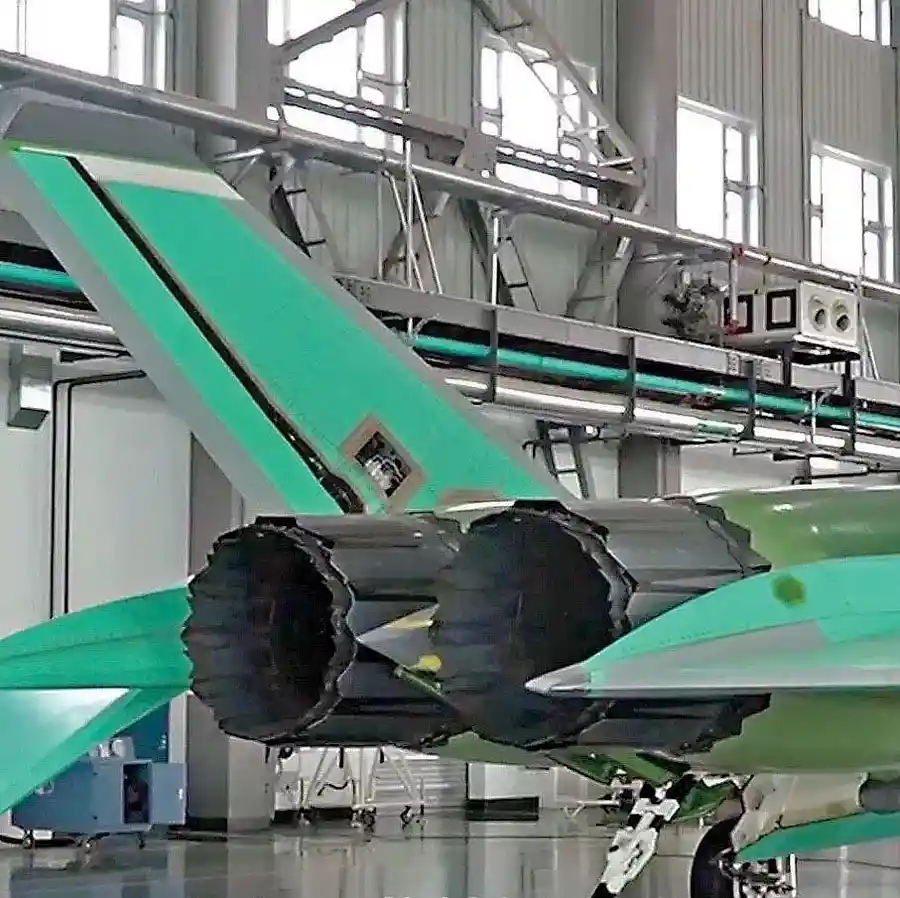
The veil over China’s next-generation stealth fighter family has been partially lifted. In a rare move, state broadcaster CCTV granted exclusive access inside the Aviation Industry Corporation of China’s (AVIC) Shenyang Aircraft Corporation facility, revealing the J-35 and J-35A fighters in various stages of assembly. This marks the first public glimpse inside the hangars producing both the naval and air force variants of China’s new fifth-generation twin-engine stealth fighters, signaling rapid strides in the nation’s military aviation modernization program.
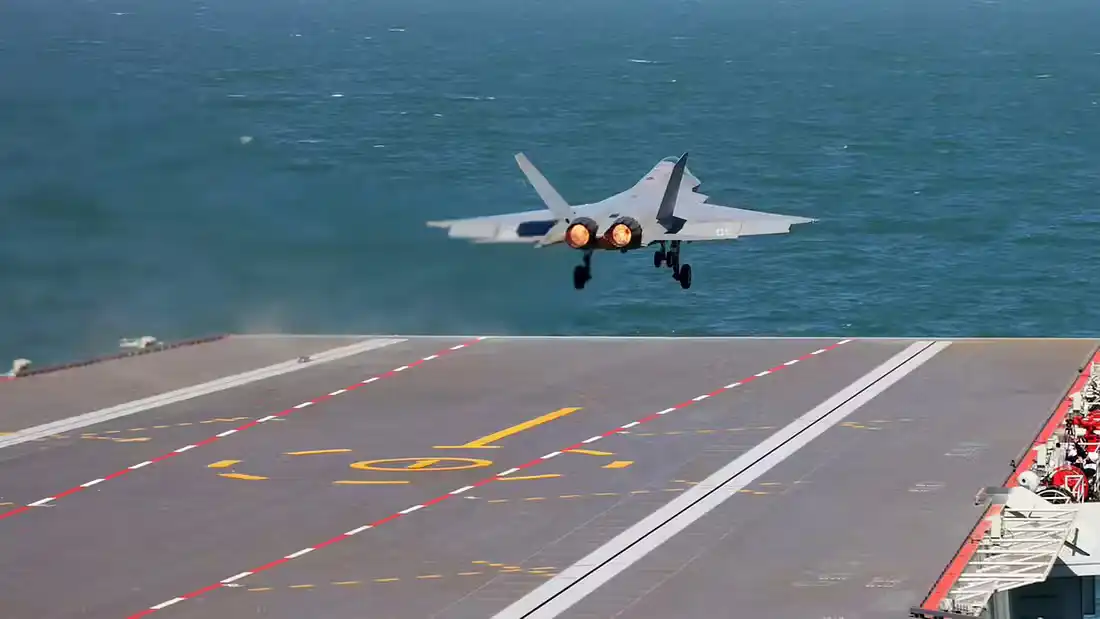
The disclosure comes just weeks after the J-35 and J-35A performed a joint flyover during the September 3rd national parade, where they soared over Tiananmen Square — a moment symbolizing the maturation of China’s stealth capabilities. The event was followed by the announcement that the J-35 had successfully completed electromagnetic catapult launches and arrested landings aboard the Type 003 aircraft carrier Fujian, marking a major milestone for the People’s Liberation Army Navy (PLAN).
The First Look Inside Shenyang’s Stealth Production Line
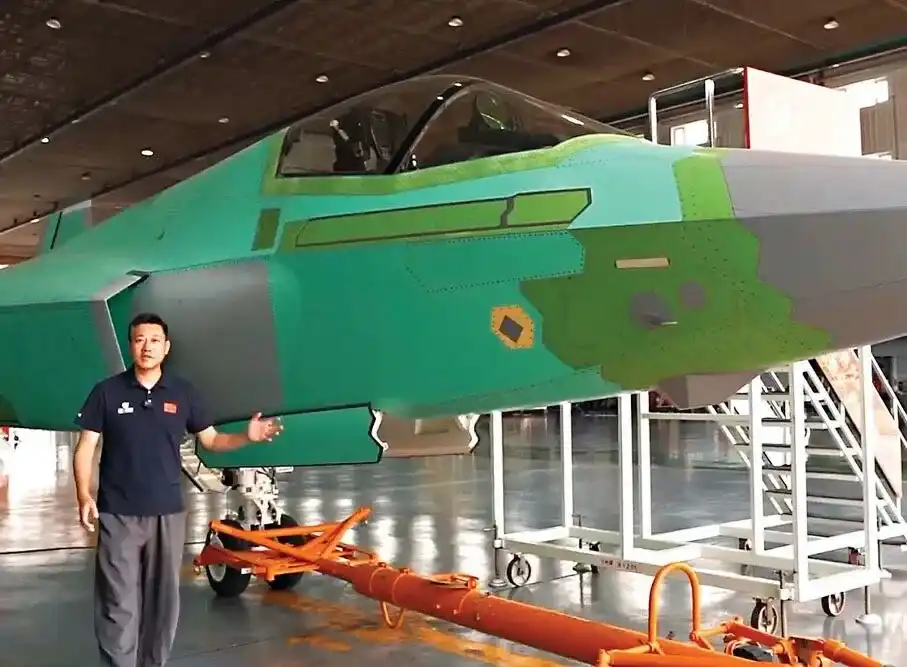
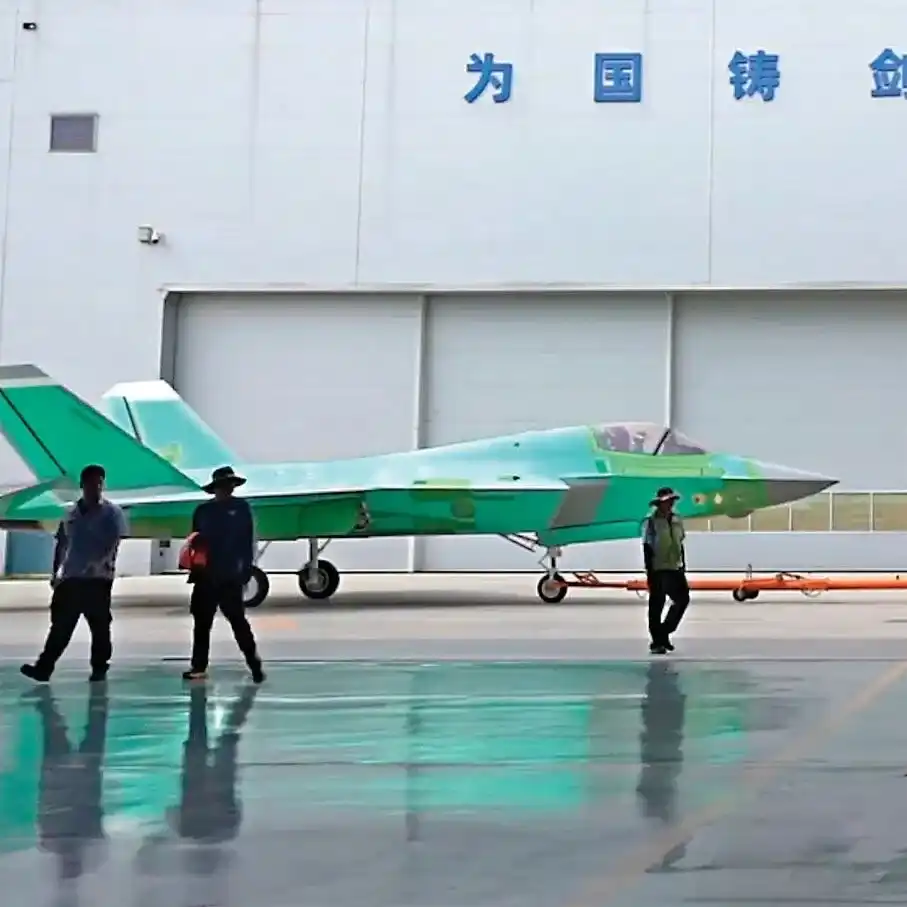
Within the vast assembly hangars of the Shenyang Aircraft Corporation, CCTV cameras captured an unfinished J-35 standing amidst technicians and ground equipment. The aircraft lacked its final naval gray-blue coating, yet key structures — including the landing gear, folding wing mechanism, arrestor hook, and twin-engine nacelles — were already installed. Each detail revealed careful design optimization for carrier-borne operations, with emphasis on compactness, corrosion resistance, and modular maintainability.
Sun Cong, academician of the Chinese Academy of Engineering and chief designer of several naval fighters, highlighted that the J-35’s defining advantage lies in its stealth profile. Compared to the bulkier J-15, the J-35 embodies a leap in information warfare capability. Sun explained that it was designed from the ground up for first-strike air dominance, integrating low observability with advanced sensor fusion, allowing the pilot to detect, decide, and strike before being seen.
Stealth and Supermaterials: Engineering a Ghost in the Sky
China’s stealth engineering has long been a closely guarded domain, but recent reports shed light on its progress. The J-35 series reportedly features radar-absorbing materials and superstructures that reduce its radar cross-section (RCS) to levels smaller than a human hand. The combination of planform alignment, internal weapons carriage, and plasma-resistant coatings results in an aircraft that merges seamlessly with the electromagnetic environment.
The fuselage contours exhibit a continuous curvature, eliminating radar hotspots, while the engine inlets feature serpentine ducts to conceal the compressor faces — a notorious radar reflector in conventional jets. Composite airframe panels further reduce weight and surface gaps, while specialized infrared-suppressing exhaust design limits thermal visibility, crucial for naval operations where carrier groups depend on minimizing detection.
Sun Cong noted that China’s indigenous metamaterials play a key role in the J-35’s stealth coating, enabling adaptive radar absorption across multiple frequency bands — a capability once believed to be monopolized by U.S. designs such as the F-35 and F-22.
The J-35A: The Air Force’s Silent Spear
Equally striking was CCTV’s footage of the J-35A, the land-based variant tailored for the People’s Liberation Army Air Force (PLAAF). At least three airframes were visible, each at different production stages. One notable unit, marked serial number 3557, was shown fully painted in the low-visibility gray camouflage typical of PLAAF stealth assets. The visual cues — from the absence of naval arresting gear to its reinforced tricycle landing system — confirm its optimization for land-based strike and air superiority missions.
The J-35A differs subtly but meaningfully from its naval sibling. Its refueling probe is repositioned for longer endurance missions, and avionics architecture appears fine-tuned for networked air combat, likely integrating seamlessly with KJ-500 early warning aircraft and future sixth-generation command networks. The J-35A’s dual data-link channels suggest simultaneous uplink and downlink capability with other stealth platforms, forming a distributed sensor grid — a step toward China’s “system-of-systems” doctrine.
Carrier Integration: Fujian and the Rise of Catapult Aviation
Perhaps the most defining context for the J-35’s evolution is its integration with the Type 003 carrier Fujian, China’s most advanced flattop to date. Unlike its predecessors Liaoning and Shandong, which rely on ski-jump takeoff systems, Fujian employs electromagnetic catapults (EMALS) — a revolutionary leap allowing heavier aircraft launches with greater payload and fuel efficiency.
Recent reports confirmed that the J-35 completed both electromagnetic catapult launches and arrested landings aboard Fujian, validating its flight deck compatibility. This milestone marks the birth of a new generation of Chinese carrier aviation, parallel to the U.S. Navy’s F-35C Lightning II program. The J-35’s folding wings, strengthened landing gear, and corrosion-resistant alloys all reflect lessons learned from earlier J-15 operations on China’s first carriers.
The PLAN now stands on the threshold of deploying its first fully stealth carrier wing, capable of integrating J-35 fighters with KJ-600 airborne early warning aircraft and future unmanned carrier drones, achieving networked maritime dominance.
Technological Evolution: From J-15 to J-35
The J-35 represents not just a new fighter but a paradigm shift in China’s approach to naval aviation. The J-15, derived from the Russian Su-33, was a transitional design — powerful but limited in stealth and deck efficiency. By contrast, the J-35 is an indigenous creation that reflects China’s maturing aerospace ecosystem, from materials science to avionics integration.
Key differences include:
- Stealth: J-35 adopts radar-absorbing contours, internal weapon bays, and minimized heat signature.
- Size & Weight: Slightly smaller airframe improves agility and allows more aircraft per carrier hangar.
- Avionics: Advanced data fusion integrates radar, infrared search, and electronic warfare systems.
- Engines: Upgraded WS-19 afterburning turbofans are expected to replace the earlier WS-13E, offering better thrust-to-weight ratio and supercruise potential.
- Cockpit: Full glass-panel interface and helmet-mounted display link seamlessly with onboard AI-assist systems.
The shift underscores China’s strategy to field a fully digital, networked air fleet, where manned and unmanned aircraft operate in coordinated swarms, guided by real-time data exchange rather than traditional command chains.
Strategic Implications: Redefining Regional Airpower
The emergence of the J-35 and J-35A holds profound implications for Asia’s strategic balance. With Japan’s F-35B and the U.S. Navy’s F-35C operating in the Pacific, China’s stealth carrier fighter introduces a homegrown counterpart capable of rivaling Western designs. Analysts suggest that within five years, the PLAN could deploy at least two carrier wings of stealth fighters, transforming its maritime deterrence posture.
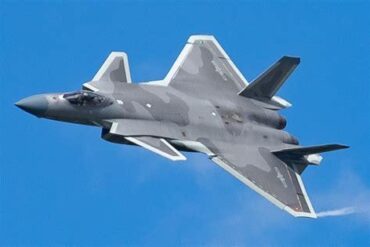
For the PLAAF, the J-35A complements the Chengdu J-20 “Mighty Dragon”, extending the stealth network across multiple mission profiles. While the J-20 serves as a high-altitude interceptor and long-range hunter, the J-35A’s agility and multirole capability make it suitable for frontline deployment near contested zones such as the South China Sea and Taiwan Strait.
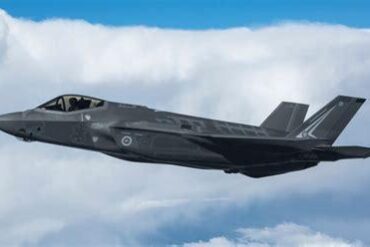
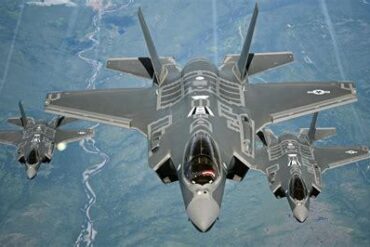
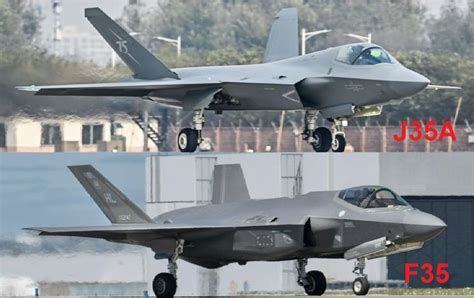
The dual-variant strategy mirrors U.S. practices with the F-35A (Air Force) and F-35C (Navy) models, suggesting that China aims to achieve interoperability between services while maintaining manufacturing efficiency through shared platforms.
A Rare Glimpse Behind the Curtain
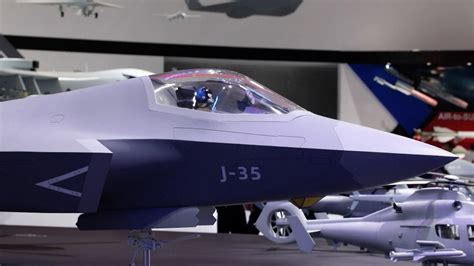
The decision to unveil footage from inside Shenyang’s production halls represents a deliberate messaging strategy. It signals industrial confidence and seeks to demonstrate that China’s stealth manufacturing base is not only operational but serially producing advanced airframes. The visible presence of multiple J-35A units, combined with the J-35’s carrier testing, paints a picture of synchronized development between the PLAN and PLAAF — a rare alignment even among major powers.
Observers note that this transparency may also serve diplomatic and psychological purposes, showcasing that China’s stealth fleet is transitioning from prototype to active deployment, reinforcing its narrative of technological parity with Western powers.
Toward Full Operational Readiness
As of late 2025, both J-35 and J-35A appear to be in the low-rate initial production (LRIP) phase. Analysts anticipate formal induction into PLAN service by 2026–2027, coinciding with the Fujian carrier’s full operational capability. Meanwhile, PLAAF units may begin integration trials within mixed squadrons alongside J-20s to refine data-sharing and stealth tactics.
In the long run, China’s stealth roadmap envisions a multi-layered combat ecosystem, with the J-35 serving as the bridge between fifth- and sixth-generation air combat. Its modular avionics and digital backbone allow for iterative upgrades, ensuring longevity akin to the U.S. F-35 program.
Conclusion
The first public unveiling of the J-35 and J-35A hangars offers more than just imagery — it provides a snapshot of China’s industrial and strategic confidence. The twin stealth fighters symbolize not only technological achievement but also a doctrinal evolution toward networked, precision-based warfare. With their entry into service drawing near, the J-35 family is poised to redefine China’s airpower projection across both land and sea, reshaping the balance of stealth capability in the Asia-Pacific region.