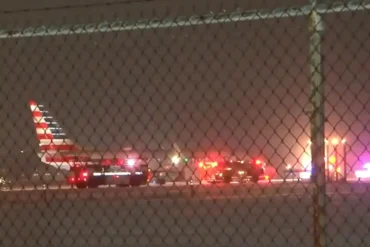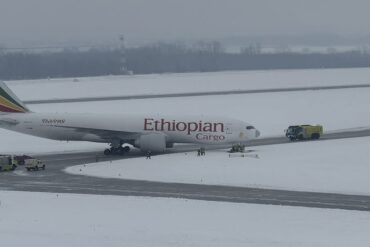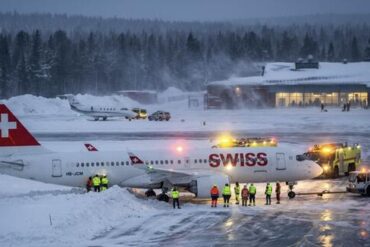
A Jet2 Boeing 737-800 operating flight LS1310 from Venice Marco Polo International Airport (VCE) left the runway after touching down at Birmingham International Airport (BHX) on Sunday afternoon, with the aircraft coming to rest on the grass alongside Runway 33 at approximately 14:19 local time. The airline attributed the excursion to “exceptional weather conditions” caused by Storm Boelo, the first named storm of the season to bring widespread disruption to the United Kingdom. Footage of the landing, shared online by Turbine Traveller, shows the narrowbody jet arriving in buffeting winds before the airframe departs the paved surface, a sequence that has spread rapidly across social media and drawn fresh attention to how Britain’s regional gateways manage autumn gales.
Birmingham Runway 33 Crosswind Exposure During Storm Boelo
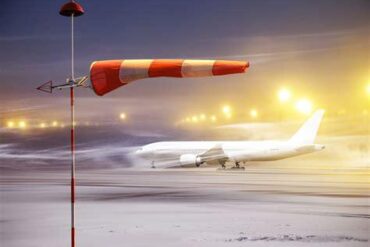
Runway 33 is oriented roughly northwest to southeast, a geometry that leaves landing aircraft exposed to a substantial crosswind component whenever westerly air dominates the region. Conditions at BHX on the day were anything but settled. The 10:50 UTC METAR recorded winds from 270 degrees at 18 knots, gusting to 29 knots, with the direction swinging between 240 and 320 degrees. The accompanying TAF issued at 11:19 UTC forecast the same 270-degree flow at 18 knots, gusting to 35 knots, and warned that temporary gusts could reach 45 knots between 12:00 and 15:00 UTC — a window that comfortably enveloped the LS1310 arrival.
Gusts beyond 32 knots are widely recognised within commercial aviation as the threshold at which maintaining precise runway alignment becomes materially harder. The airport’s own forecast pointed to gusts of around 42 mph, or 68 km/h, through the afternoon, while the Met Office advised that windy conditions would persist across the West Midlands well into the evening.
How the Jet2 737-800 Excursion Unfolded on Landing
Jet2 operates one of the largest Boeing 737 fleets in Europe, and the -800 remains the backbone of its leisure network. The type is engineered for demanding weather operations, but variable, gusting winds can still complicate the final approach: pilots use crab or sideslip techniques to counter drift, then must de-crab and establish alignment in the seconds before touchdown while remaining inside aircraft-specific crosswind limits. On Sunday, that margin was tested in a live setting. The aircraft moved off the runway, and the Jet2 spokesperson confirmed the sequence to BBC News: the flight “temporarily moved off the runway after landing at Birmingham Airport earlier this afternoon, due to exceptional weather conditions caused by Storm Boelo.”
Storm Boelo Wind Gusts and Airport Operations Across the UK
Storm Boelo delivered its most severe winds to Scotland, Northern Ireland and northern England, where the Met Office warned of gusts reaching 60 to 70 mph, or 97 to 113 km/h, and up to 80 mph in exposed locations. Even though the West Midlands sat outside the storm’s core, the region’s airspace absorbed the spillover. Aviation operations respond to such conditions in a variety of ways.
- Airports may switch runway configurations, thinning arrival rates and extending holding patterns.
- ATC can reduce departure capacity and issue greater spacing on final approach.
- Ground crews restrict movement of loose equipment, baggage carts and unsecured stands during gusts.
- Airlines adjust landing minima, divert flights to alternate airports, or refuel for contingency planning.
Heavy rain accompanying the system further reduced visibility, while turbulence below 5,000 feet made handling at the critical touchdown moment harder to control.
What the Birmingham Runway Excursion Means for Autumn Flight Safety
Birmingham International Airport handles domestic and European services at a scale that makes it one of the UK’s major international gateways, and the airport’s wind exposure on Runway 33 has long been factored into airline operational planning. The video circulating online provides a valuable visual record, but as is always the case, it does not establish causation on its own; the cause must be confirmed through operational records, weather observations and the investigation work that follows. Commercial aircraft routinely land in winds far stronger than those reported on Sunday, and the -800’s dispatch crosswind limits were likely not exceeded, though gusty conditions can still produce a momentary loss of directional control.
The incident underscores the practical reality airlines face every October and November. Britain’s autumn weather systems generate fast-moving low-pressure fronts that arrive with limited notice, and safe operations at airports like Birmingham depend on real-time weather data, crew decision-making and airport flexibility working in tandem. With Storm Boelo now moving on, the immediate question is whether the Jet2 737-800 will return to service quickly, but the broader lesson remains practical: storms do not discriminate when it comes to runway excursions.