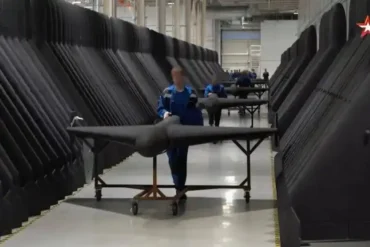
Kalashnikov Concern is accelerating Russia’s push into mass-produced unmanned systems by launching a new UAV family derived directly from the volunteer-built Archangel drone project, a grassroots initiative that has quietly evolved into one of the most influential design pipelines in the country’s wartime ecosystem. The announcement, delivered by CEO Alan Lushnikov in Russian-controlled Berdyansk on December 1, 2025, signals a decisive shift: volunteer battlefield innovation is no longer an auxiliary force but a core component of Russia’s formal defense-industrial strategy.
Archangel’s transformation from a community-driven effort in 2022 into a nationwide network of designers, engineers and frontline testers created an environment where practical battlefield experience fed directly into rapid UAV iteration. This combat-ready feedback loop made the project attractive to major defense producers, culminating in Kalashnikov’s decision to take the platform beyond small-batch assembly and into full serial production. The company now intends to create a modular UAV series—strike, interceptor and potentially reconnaissance variants—built around shared avionics, communications suites and ground control interfaces.
This industrial adoption validates a reality long visible on the battlefield: Russia’s low-altitude drone war is being shaped not just by traditional defense enterprises but by volunteer workshops, improvised labs and semi-formal design groups capable of long-range innovation under sanctions. By absorbing Archangel, Kalashnikov is institutionalizing this ad-hoc ingenuity.
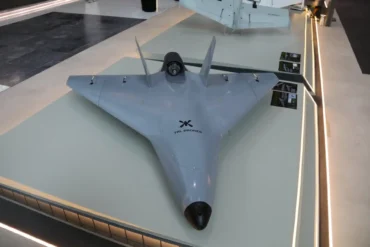
The Archangel drone rose to prominence as a fast, expendable strike platform capable of reaching speeds near 280 km/h and engaging targets roughly 50 km away. Its niche sat between nimble FPV kamikaze drones and bulkier loitering munitions, providing a combination of speed, reach and affordability that made it appealing to frontline operators. By 2024, volunteer engineers began experimenting with an interceptor variant designed to target enemy UAVs, and tests in Crimea throughout 2025 allowed the platform to mature into a more reliable, networked asset.
As its capabilities grew, Archangel evolved into a distributed drone ecosystem: training centers opened across multiple Russian cities, new engineering teams contributed incremental improvements, and battlefield units provided continuous telemetry and performance data. This organic infrastructure became the foundation for a more formalized cooperation. On August 27, 2025, Kalashnikov and Archangel signed a memorandum that effectively merged grassroots creativity with industrial muscle—Archangel would continue developing and combat-testing new designs, while Kalashnikov would provide the mass-manufacturing and logistics backbone.
Kalashnikov’s New UAV Line: Tactical Ambition at Scale
Lushnikov’s announcement in Berdyansk confirms that Kalashnikov is moving beyond experimental integration and into full product-line development. The new UAV family is expected to standardize critical components—navigation modules, communication architecture, ground control stations—while diversifying mission roles. The approach allows Russia to deploy mass numbers of attritable, low-cost drones that can be rapidly adapted to changes in Ukrainian electronic warfare tactics or Western counter-UAV technologies.
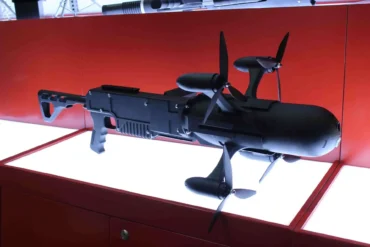
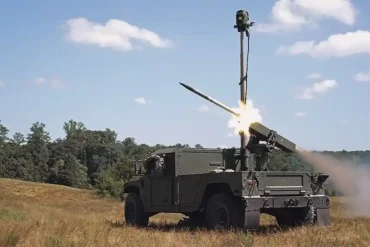
The strike variant derived from Archangel’s original configuration promises a faster refresh cycle than legacy Russian loitering munitions. Updated software, interchangeable payloads and improved anti-jamming modules can be deployed serially, informed by week-to-week frontline feedback. Meanwhile, the interceptor variant supplements existing Russian counter-drone methods, which range from vertical-takeoff interceptors to small-arms drone-defense units. Together, these systems feed into a broader, layered drone architecture where reconnaissance, attack and defensive roles operate through shared control systems.
Why This Matters for the War in Ukraine
The integration of volunteer-designed drones into one of Russia’s major weapons manufacturers represents more than industrial convenience. It reflects a wartime adaptation strategy built around scale, resiliency and improvisation. Russia’s sanctions-restricted defense economy has found efficiencies in building simple but highly iterable unmanned platforms, relying less on expensive, complex systems and more on rapid manufacturing enabled by commercial-grade electronics.
For Ukraine and its partners, this shift complicates counter-drone strategies. Western militaries have invested heavily in high-end air defense systems, but Russia’s new Archangel-based ecosystem favors quantity over individual platform value. Drone variants can now move from volunteer testing to factory production within months, challenging the pace at which countermeasures can be developed or deployed. The result is a more diverse, redundant and adaptive UAV force with a higher tolerance for losses.
The Strategic Implication: A New Industrial Doctrine
Kalashnikov’s decision to anchor its new UAV line in the Archangel project underscores a deep structural change within Russia’s defense-industrial posture. Instead of relying solely on formal state-run enterprises, Moscow is blending them with a nationwide network of civilian innovators, hobbyists and semi-professional collectives. This hybrid approach accelerates iteration while reducing vulnerability to supply chain disruption.
If the Archangel-Kalashnikov partnership achieves consistent serial output, Russian forces will gain more than a new drone model. They will gain a scalable pipeline where battlefield experience feeds directly into factory-level production, creating a self-sustaining cycle of adaptation. This marks a doctrinal shift in modern aerial warfare: control of low-altitude battlespace will depend not on a single superior platform but on the speed at which a military can integrate civilian innovation, industrial capacity and frontline data.
The evolution of Archangel into an industrial UAV family reflects a broader trend shaping the future of conflict—wars will increasingly be fought with systems that blur the line between improvised ingenuity and formal military engineering, where dominance emerges from rapid iteration rather than singular technological breakthroughs.