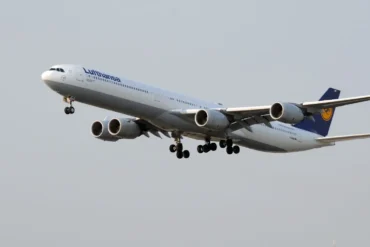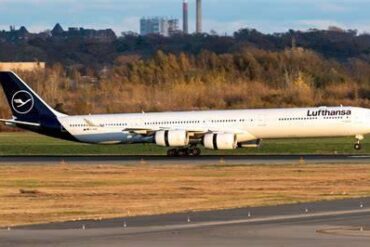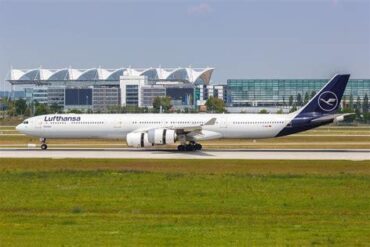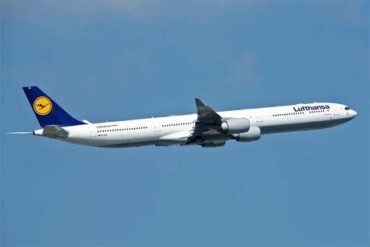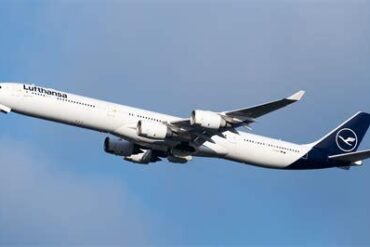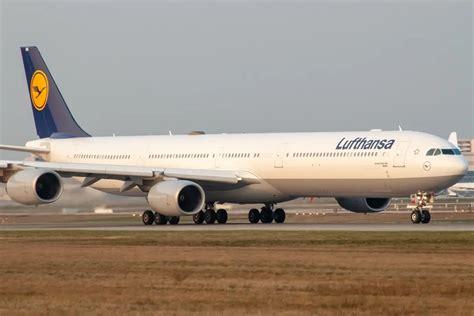
Lufthansa has finally confirmed the end date for one of the most recognizable aircraft in modern long-haul aviation. After years of uncertainty, delayed retirements, and repeated schedule extensions, the airline’s remaining Airbus A340-600 fleet will officially leave passenger service in October 2026, closing the chapter on more than two decades of operations for the stretched four-engine aircraft.
For aviation enthusiasts, premium travelers, and longtime Lufthansa loyalists, the announcement marks far more than a routine fleet update. The Airbus A340-600 was never just another widebody. It became a defining symbol of Lufthansa’s intercontinental network during the golden age of long-haul European aviation, connecting Frankfurt with destinations across North America, Asia, South America, and the Middle East while carrying one of the airline’s most prestigious onboard products.
The aircraft’s retirement also represents a broader industry transformation. As twin-engine jets continue to dominate global fleets with dramatically improved fuel efficiency and operational flexibility, the era of elegant long-range quadjets is rapidly disappearing.
Lufthansa’s remaining Airbus A340-600s are now scheduled to operate their final commercial flights on October 18, 2026, ending one of the last major passenger operations of the type anywhere in the world.
By the end, the aircraft will be serving just two transatlantic routes from Frankfurt: New York JFK and Washington Dulles.
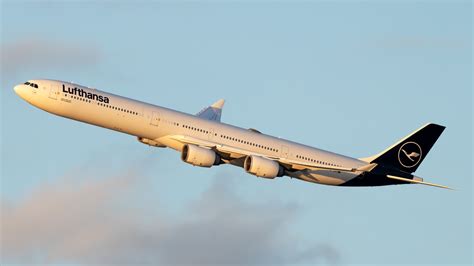
Lufthansa’s Airbus A340-600 Fleet Enters Its Final Months
At its peak, Lufthansa operated 24 Airbus A340-600 aircraft, making it the largest and most committed operator of the type globally. Introduced in 2003, the aircraft quickly became a cornerstone of the airline’s premium long-haul strategy thanks to its unique balance of range, cargo capability, and spacious cabin layout.
Today, only four aircraft remain active.
Those final aircraft are now concentrated almost exclusively on premium-heavy North American services where Lufthansa can still justify the economics of operating a large four-engine aircraft. Current schedules show the A340-600 continuing operations between Frankfurt and both Washington Dulles International Airport and New York JFK through mid-October 2026.
The deployment itself reveals how dramatically the aircraft’s role has changed over the years. Once seen across Lufthansa’s global network from Asia to Latin America, the A340-600 has gradually retreated into a narrow niche role while the airline waits for delayed next-generation aircraft deliveries.
Frankfurt to Washington Dulles remains one of the aircraft’s last strongholds. Lufthansa plans to operate the type on multiple frequencies throughout the busy summer season, although Boeing 747-8 aircraft will occasionally substitute on selected rotations. Meanwhile, the New York JFK route continues to see one daily A340-600 service alongside flights operated by the older Airbus A340-300.
That pairing creates an unusual sight in modern aviation: two aging four-engine Airbus widebodies still operating scheduled transatlantic flights in an industry increasingly dominated by highly efficient twinjets.
Why Lufthansa Delayed the A340-600 Retirement for So Long
The Airbus A340-600 was originally expected to disappear from Lufthansa’s fleet years ago. However, a combination of manufacturing delays and certification setbacks forced the airline to repeatedly postpone retirement plans.
The biggest issue came from delayed deliveries of new-generation aircraft.
Lufthansa has been aggressively modernizing its long-haul fleet with Boeing 787-9 Dreamliners and Airbus A350s, but supply chain disruptions and certification problems significantly slowed the transition process. Boeing’s long-delayed 777-9 program became particularly problematic, leaving Lufthansa without enough replacement capacity for its aging quadjets.
As a result, aircraft once considered economically obsolete suddenly became operationally essential again.
The A340-600 survived because it still offered several advantages despite its age. The aircraft features a large premium cabin footprint, excellent long-range performance, and available capacity during a period when global widebody shortages affected airlines worldwide.
Lufthansa effectively turned the aircraft into a temporary bridge solution.
The airline’s fleet now spans multiple generations of aviation technology simultaneously. Lufthansa still operates Boeing 747-400s first introduced in the late 1980s while also receiving factory-fresh Boeing 787s and preparing for the arrival of Airbus A350-1000s.
That unusual overlap created one of the most diverse long-haul fleets among major global airlines.
The direct successor to the Airbus A340-600 will be the Airbus A350-1000, which Lufthansa expects to begin receiving in 2026. The aircraft closely matches the A340-600 in physical size while delivering dramatically lower fuel consumption and operating costs.
Lufthansa has already confirmed the A350-1000 will feature First Class cabins and primarily serve high-yield premium routes — effectively inheriting the exact role long occupied by the A340-600.
The Aircraft That Became Synonymous With Lufthansa
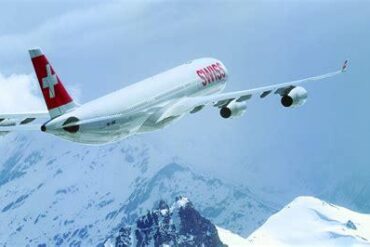
Although airlines including Virgin Atlantic and Iberia also operated significant Airbus A340-600 fleets, no carrier became more closely associated with the aircraft than Lufthansa.
For more than twenty years, the type served as one of the airline’s most visible international ambassadors.
The aircraft itself possessed an unmistakable presence. At nearly 247 feet long, the Airbus A340-600 held the title of the world’s longest passenger aircraft until the arrival of the Boeing 747-8. Its stretched fuselage, graceful proportions, and four-engine configuration gave it a silhouette many aviation enthusiasts still consider among the most elegant ever designed.
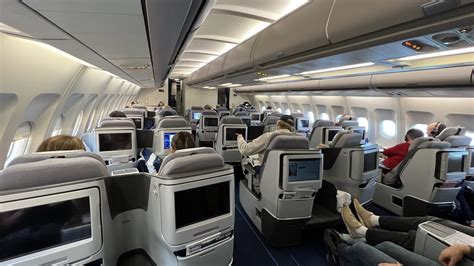
Passengers frequently praised the aircraft for its remarkably quiet cabin environment and spacious premium seating layouts. Lufthansa especially leaned into the aircraft’s strengths by deploying it on business-focused long-haul markets where premium demand justified its larger First and Business Class footprint.
Over its operational lifetime, Lufthansa’s Airbus A340-600 fleet served nearly 60 destinations.
Some routes became especially linked to the aircraft. Seoul Incheon emerged as the most frequently served destination, followed by Osaka, Bogota, Denver, Vancouver, and New York JFK. The aircraft also became a familiar sight in destinations including Riyadh, Caracas, Boston, and Tehran.
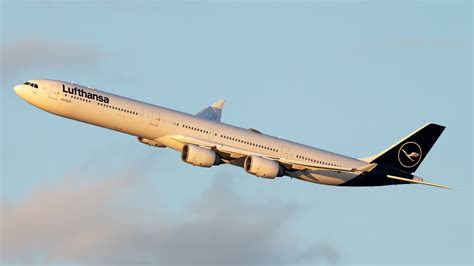
For years, the aircraft represented the pinnacle of Lufthansa’s long-haul experience. Travelers associated it with spacious cabins, intercontinental prestige, and the classic era of four-engine flagship aircraft dominating international airports.
But aviation economics eventually caught up with the program.
Why the Airbus A340-600 Could No Longer Survive
The downfall of the Airbus A340-600 ultimately came from the rapid advancement of twin-engine aircraft technology.
When the aircraft entered service in the early 2000s, four engines still offered important operational advantages on ultra-long-haul routes. ETOPS restrictions limited how far twin-engine aircraft could operate from diversion airports, giving quadjets greater flexibility across oceans and remote regions.
That advantage slowly disappeared.
As ETOPS regulations evolved and engine reliability improved, newer twin-engine aircraft gained the ability to operate virtually every route previously dominated by four-engine jets. Aircraft like the Airbus A350 and Boeing 787 could match or exceed the A340-600’s range while burning significantly less fuel and requiring lower maintenance costs.
The economics became impossible to ignore.
Four engines meant higher fuel consumption, greater maintenance complexity, and increased operational expenses at a time when airlines were under growing pressure to improve efficiency and reduce emissions. Even loyal operators like Lufthansa eventually had to acknowledge that the aircraft no longer fit the future economics of long-haul travel.
Still, the emotional attachment surrounding the aircraft remains unusually strong.
The Airbus A340-600 developed a devoted following among passengers, pilots, and aviation photographers alike. Its long fuselage, quiet cabin, and increasingly rare four-engine design gave it a personality many newer aircraft struggle to replicate.
By October 2026, that personality will largely vanish from commercial passenger aviation.
Lufthansa’s final retirement of the Airbus A340-600 will not simply remove another aircraft type from service. It will close the curtain on one of the last surviving symbols of the classic long-haul quadjet era — a period when massive four-engine aircraft still represented the height of international air travel glamour and engineering ambition.