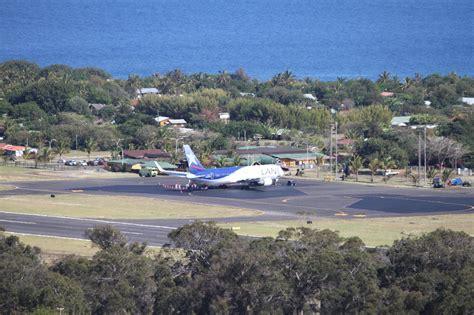
Mataveri International Airport, on remote Easter Island in the South Pacific, occupies a place in aviation that few airports can rival. Its distinction is not simply that it sits on an isolated island, but that the nearest other airport is roughly 1,617 miles (2,603 kilometers) away. There is no direct air link between the two facilities, leaving Mataveri separated from the world’s airport network by an immense expanse of ocean.
For most airports, remoteness is measured in road miles from a city or perhaps in the time required to reach a regional center. Mataveri presents a much more dramatic definition. The airport is part of Rapa Nui, a Chilean territory more than 2,000 miles from mainland South America, while its nearest inhabited neighbor, Pitcairn Island, is around 1,200 miles away. In practical aviation terms, the runway on Easter Island is a vital outpost rather than simply another regional airport.
That isolation has shaped nearly every aspect of Mataveri’s operation, from the aircraft that serve it to the procedures governing flights and the difficulty of repairing an airplane when something goes wrong. Yet the airport is not a forgotten strip in the Pacific. It is the principal gateway to one of the world’s most distinctive cultural destinations, and its runway is long enough to accommodate widebody aircraft.
Why Mataveri International Airport Is the World’s Most Remote Airport
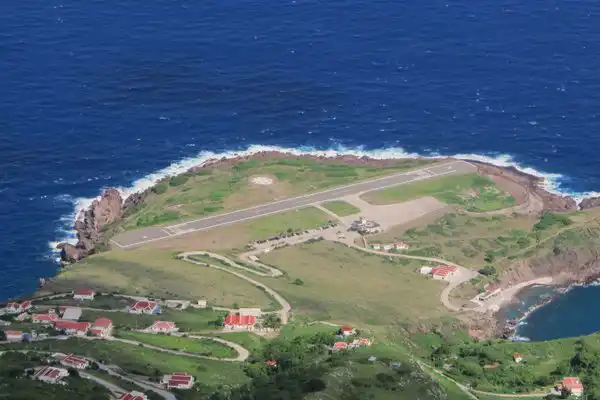
Mataveri International Airport (IPC), also known as Isla de Pascua Airport, earns its reputation primarily through its distance from another airport. Its nearest airport is Totegegie Airport in the Gambier Islands of French Polynesia, approximately 1,617 miles away. That figure makes Mataveri exceptionally isolated within the global airport network, even though the airport itself has regular commercial service.
The distinction matters because airport remoteness can be defined in several ways. An airport may be far from a major city, separated from a country’s mainland, or difficult to reach by road. Mataveri stands out under the particularly stark measure of distance to another airport. The surrounding Pacific Ocean leaves few alternatives for aircraft that might need another runway, creating unusual consequences for flight planning and operational safety.
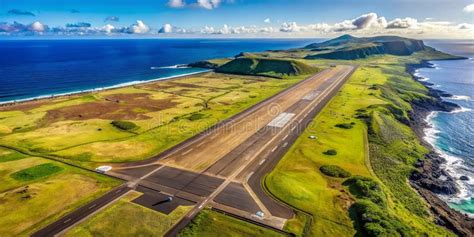
Mataveri sits near Hanga Roa on the western side of Easter Island and is the island’s only airport. At an elevation of 227 feet (69 meters) above sea level, it has a single asphalt runway designated 10/28. The runway measures 10,886 feet (3,318 meters), an extraordinary length for such an isolated island and one that allows the airport to accommodate widebody aircraft.
Easter Island Gives Mataveri Its Extraordinary Isolation
Easter Island, or Rapa Nui, is famous for its monumental moai statues, created by the Rapa Nui people. Its cultural importance makes the island a major destination despite its geographic isolation, but reaching it has always required aviation to bridge an enormous oceanic gap. There is no convenient chain of neighboring airports gradually leading toward the island, as there would be for a destination in Europe, North America, or much of Asia.
The geography explains why Mataveri cannot be treated like a conventional island airport. A traveler arriving in Hanga Roa has already crossed a vast stretch of the Pacific, while an aircraft departing for mainland Chile faces another long sector before reaching an airport with suitable alternatives. The airport therefore functions as both a tourism gateway and a critical connection between the island and the outside world.
Its location also gives Mataveri a distinctive place in South Pacific aviation. Airlines cannot simply add frequencies or reroute aircraft with the same flexibility available at airports surrounded by dense networks. Every scheduled flight represents a carefully planned connection across a region where suitable diversion options are extremely limited.
Mataveri International Airport Has Served Easter Island Since 1967
Mataveri began operations in 1967, when commercial aviation technology looked very different from today’s long-range widebody era. Early services were operated by LAN Chile using Douglas DC-6 aircraft, four-engine piston-powered airliners that required about nine hours to travel between Easter Island and mainland Chile. Those flights were an extraordinary undertaking for their time, linking one of the world’s most isolated inhabited islands with the Chilean mainland.
The arrival of jet aircraft changed the airport’s capabilities. LAN Chile later introduced Boeing 707s on routes linking Mataveri with Santiago and Faa’a International Airport in Papeete, Tahiti. The transition from piston aircraft to jets made long Pacific services more practical and eventually opened the door to larger aircraft.
The runway initially measured roughly 2,900 meters. In 1987, NASA extended it to its present 3,318-meter length at a cost of about $7.5 million. The project was driven by an extraordinary contingency plan involving the Space Shuttle.
NASA had intended to use Mataveri as a South Pacific abort site for planned Space Shuttle missions launched from Vandenberg Air Force Base. Those polar-orbit missions were eventually canceled, meaning the Space Shuttle never actually used Easter Island as an emergency landing site. Nevertheless, the longer runway remained, and commercial aviation benefited from infrastructure created for an entirely different purpose.
Widebody Aircraft Connect the Remote Island With Chile
The extended runway gave airlines additional flexibility in operating larger aircraft to and from Easter Island. Over time, LAN Chile moved beyond the Boeing 707 era and used widebody aircraft including the Boeing 767 and Airbus A340. The airport therefore developed infrastructure that looks surprisingly substantial when compared with the small population and isolated geography around it.
Today, LATAM Chile is the only airline providing scheduled passenger services at Mataveri. The airline inherited the long-standing role once held by LAN Chile and remains the airport’s principal connection to the outside world. LATAM Peru briefly connected Lima with Mataveri between 2011 and 2013, while the route to Papeete was suspended in June 2020 during the COVID-19 pandemic and has not returned as a regular service.
The Santiago connection is now the airport’s key scheduled route. LATAM generally operates one or two daily flights, with a typical journey taking around five hours. The Boeing 787-8 accounts for more than 60% of services to Easter Island, giving Mataveri a regular connection to a modern long-haul widebody aircraft despite its extraordinary isolation.
A typical LATAM 787-8 configuration provides 272 seats, including 20 business-class flatbeds in a 1-2-1 layout and 252 economy seats in a 3-3-3 arrangement. LATAM has also used a less dense configuration featuring 30 Zodiac Aura Lite business-class flatbeds and 217 economy seats. For an airport thousands of miles from another airport, seeing a Boeing 787 arrive regularly is a striking reminder of how modern aviation can connect isolated communities to major cities.
Extreme Isolation Creates Unusual Flight Restrictions
The absence of nearby diversion airports creates operational challenges that passengers at more connected airports rarely have to consider. Between Easter Island and South America or Tahiti, there are no suitable diversion airports. Consequently, Chilean aviation authorities impose restrictions designed to prevent multiple aircraft from reaching the island simultaneously without a safe alternative.
Under the operating rule described for Mataveri, no more than one aircraft can be in the airport’s vicinity at a time. Once an aircraft traveling from South America passes the halfway point toward Easter Island, another aircraft cannot pass its own halfway point until the first aircraft has landed. The principle is straightforward: an aircraft must retain a realistic option to turn around rather than becoming committed to an airport that could suddenly become unavailable.
The concern becomes serious if an aircraft lands and then suffers an incident that blocks the runway. At a conventional hub, another aircraft might divert to a nearby airport within minutes. At Mataveri, that safety net does not exist. A second aircraft that had already traveled too far toward the island could face a difficult situation, which is why separation between aircraft is so important.
This is a clear example of how geography directly shapes aviation procedure. The airport’s remoteness is not merely an interesting statistic; it changes how flights are sequenced and how much operational flexibility is available to crews and controllers.

Aircraft Maintenance Is Harder at the World’s Most Remote Airport
Remoteness can become even more problematic after an aircraft has landed. Routine maintenance is one thing, but an unexpected structural or mechanical problem can become a major logistical challenge when specialist equipment, replacement parts, and large maintenance facilities are thousands of miles away.
A recent example involved a LATAM Boeing 787 that was grounded at Easter Island after a mobile airstairs truck collided with the aircraft during ground handling. The impact tore away the L2 passenger door. No passengers were injured because they had already disembarked, but the incident left the airline with a difficult recovery problem.
Mataveri does not have a large hangar capable of accommodating a Boeing 787. LATAM therefore had to address the aircraft’s damage on the island while arranging the parts, equipment, and specialist assistance required to return the widebody jet to service. At a major international airport, an aircraft requiring significant work might be moved into a purpose-built hangar and supported by an established maintenance supply chain. At Easter Island, every additional requirement becomes a transportation problem.
The episode illustrates why airport infrastructure is about much more than runways and terminals. An airport can have a runway long enough for a 787 while still lacking the facilities needed for extensive maintenance on that aircraft. Mataveri’s isolation magnifies that difference.
Mataveri Airport Is Undergoing a Major Modernization
The Chilean government is now planning a substantial modernization of Mataveri. Chile’s Ministry of Public Works included the airport in its 2025–2035 investment plan and allocated more than $400 million for infrastructure improvements and capacity expansion. The project is intended to give the airport facilities better suited to Rapa Nui as an international destination.
The first phase includes a temporary passenger terminal of approximately 4,500 square meters and a new 29,000-square-meter commercial aviation platform. Construction is expected during 2026 and 2027, with the temporary terminal targeted for opening in late 2026. A helicopter emergency landing point is also planned.
The longer-term project calls for a permanent terminal in the Orito sector, approximately two kilometers northeast of the existing airport. The new terminal is expected to cover about 9,000 square meters, nearly three times the size of the current passenger terminal, with completion targeted around 2035. The relocation is also connected to a long-standing land restitution agreement involving the Roe family, heirs of Rafael Roe, whose agreement covers the land occupied by the existing passenger terminal and commercial aviation platform.
When the new facilities are ready, the existing terminal area will be returned to the family. For Rapa Nui, modernization is therefore not simply a matter of adding passenger capacity. It is also part of an effort to create infrastructure that respects local land arrangements while supporting the island’s role as a global tourism destination.
According to figures cited by Aviacionline, Mataveri currently handles around 300,000 passengers and 7,000 tons of cargo annually. Although the island is extraordinarily isolated, demand for air travel is substantial enough to require a modern terminal, a larger aircraft platform, and improved emergency infrastructure.

Other Remote Airports Face Different Challenges
Mataveri may be the world’s most remote airport by distance to another airport, but it is not the only facility where geography profoundly influences aviation. Svalbard Airport in Norway’s Arctic archipelago is another striking example. It is the northernmost airport in the world with scheduled commercial flights, and its network is currently limited to domestic services to Oslo and Tromsø.
Svalbard’s challenge comes primarily from its extreme northern environment rather than the oceanic separation seen at Easter Island. Scheduled services are operated by Scandinavian Airlines and Norwegian Air Shuttle, giving residents and visitors access to mainland Norway despite the difficult Arctic setting.
Paro International Airport in Bhutan presents a completely different problem. It is Bhutan’s only international airport and is surrounded by dramatic Himalayan terrain, with peaks rising above 18,000 feet. Flights are restricted to daylight operations, and the surrounding mountains make the airport widely regarded as one of the most demanding commercial destinations for pilots.
These airports show that remoteness has many forms. Mataveri is defined by oceanic isolation and the absence of nearby diversion airports. Svalbard is defined by Arctic geography, while Paro is defined by mountainous terrain and demanding approach conditions. Each demonstrates how geography can become an active part of aviation planning rather than simply a backdrop.
Why Mataveri Matters Beyond Its Record
Mataveri International Airport is remarkable because its record tells only part of the story. Being about 1,617 miles from the nearest other airport sounds like a statistic, but the number represents a genuine operational reality. Every aircraft arriving at Easter Island crosses an immense stretch of ocean, every diversion decision carries unusual weight, and even an apparently routine ground incident can become a major logistical operation.
At the same time, Mataveri proves that isolation does not necessarily mean insignificance. The airport handles hundreds of thousands of passengers and thousands of tons of cargo, connects Rapa Nui with mainland Chile, and has infrastructure capable of receiving Boeing 787 widebody aircraft. Its long runway, originally extended for a canceled Space Shuttle contingency plan, has become one of the most valuable pieces of infrastructure on an island famous for being far from almost everywhere.
The planned modernization could strengthen that role for decades to come. With a new terminal, expanded aircraft apron, emergency facilities, and a long-term relocation project, Mataveri is being prepared for the demands of a destination whose global profile far exceeds its geographic footprint. The world’s most remote airport is not simply a curiosity at the edge of the map; it is a critical lifeline for Rapa Nui and a remarkable example of how modern aviation can overcome extreme isolation.