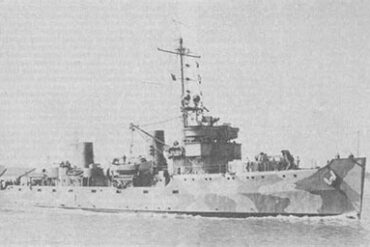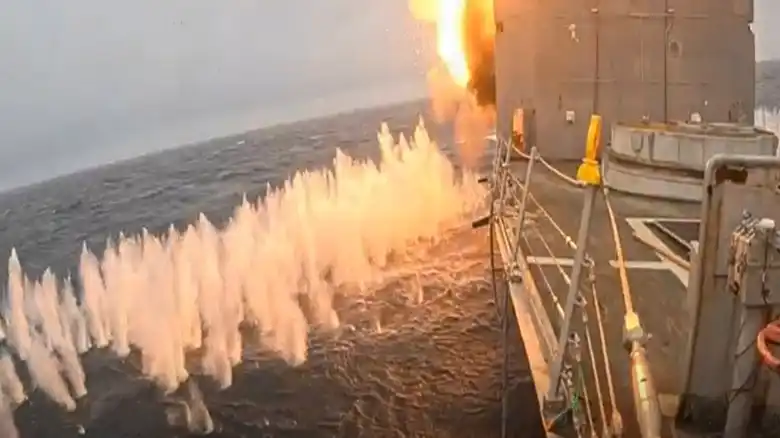
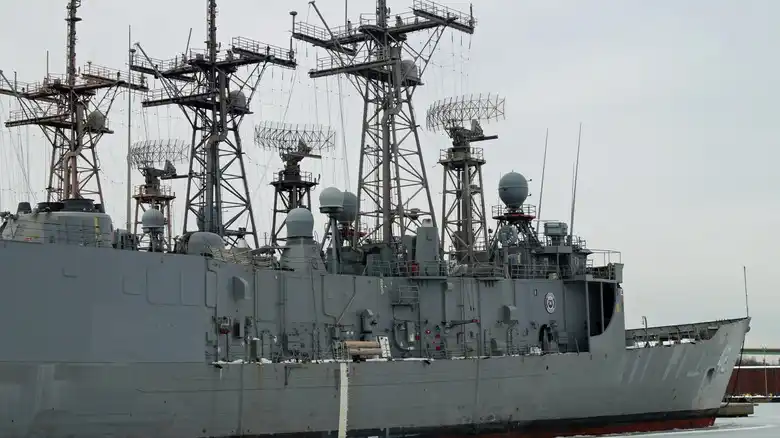
The USS Klakring, a decommissioned Oliver Hazard Perry-class frigate, now rests on the floor of the North Atlantic after becoming the target of a major multinational missile and torpedo test off the Scottish coast. The warship was sunk on September 25, 2026, during Exercise Atlantic Thunder, a joint U.S.-U.K. training operation led by the U.S. 6th Fleet.
The sinking was not simply a demonstration of destructive firepower. It was designed as a complex weapons evaluation involving multiple aircraft, ships, missiles, and a submarine. Before the exercise began, Navy personnel fitted the Klakring with sensors designed to record the effects of incoming weapons, creating a detailed picture of how a former warship responded to different types of attacks.
USS Klakring Targeted by SM-6 Missile
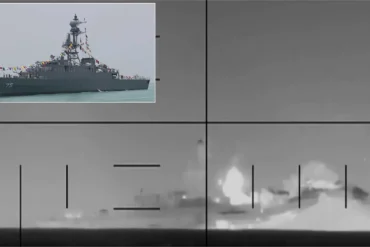
The first major American strike came from the USS Paul Ignatius, which fired an anti-surface variant of the SM-6 missile against the retired frigate. The weapon provided an opportunity to examine how a modern long-range missile could affect a surface target under realistic exercise conditions.
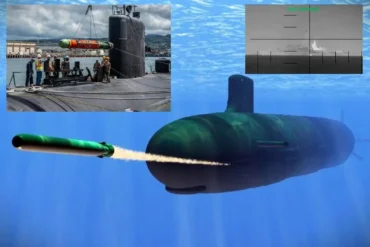
The attack was followed by a strike from the USS Massachusetts, a U.S. Navy submarine. Its Mk 48 Advanced Capability torpedo delivered the final blow that sank the Klakring. Using different weapons against the same target allowed participating forces to collect data across several stages of the attack rather than relying on a single weapon-effectiveness test.
Royal Navy Joins the Live-Fire Attack
Atlantic Thunder also provided the Royal Navy with an opportunity to conduct live-fire testing of newer anti-ship weapons. HMS Portland launched a Naval Strike Missile against the former American frigate, while a Royal Navy Wildcat helicopter attacked with Sea Venom missiles.
The exercise therefore brought together several layers of maritime strike capability. U.S. and British P-8 maritime patrol aircraft participated alongside U.S. Air Force F-15E Strike Eagles, creating a training environment that extended well beyond ship-versus-ship combat. The combination reflected the increasingly integrated nature of modern naval warfare, where submarines, surface ships, aircraft, and helicopters can contribute to the same engagement.
Why the Navy Sinks Decommissioned Warships
The Klakring had almost three decades of service before becoming a SINKEX target. Commissioned in 1983, the frigate was named after Rear Admiral Thomas B. Klakring, a World War II submarine commander who received three Navy Crosses. During its career, the ship participated in counter-drug missions, multinational exercises, and deployments across the Caribbean, Pacific, and Mediterranean.
Its final deployment occurred in 2012, followed by decommissioning in 2013. More than a decade later, the ship was given another operational role—not as a warship, but as a controlled target for evaluating weapons and tactics.
The U.S. Navy’s 2026 shipbuilding plan identifies 10 retired ships for future sinking exercises. These SINKEX events allow military forces to examine weapon performance, ship survivability, damage effects, and multinational coordination using realistic full-scale targets.
Atlantic Thunder Builds Realistic Naval Combat Data
The sinking of the Klakring demonstrates why retired warships can remain valuable long after leaving active service. Instead of being dismantled immediately, a decommissioned vessel can become a large-scale test platform capable of revealing information that simulations cannot fully reproduce.
A similar approach was used during RIMPAC 2026 near Hawaii, when American and allied forces employed decommissioned ships as targets during live-fire SINKEX events. Such exercises provide participating nations with practical experience in coordinating complex attacks while generating data that can influence future weapons evaluations and naval tactics.