The transatlantic journey has long been defined by its final hurdle. After seven or eight hours crossing the Atlantic, passengers arriving in the United States have typically braced themselves for an exhausting ritual: immigration queues, baggage claim, re-checking luggage, and another full security screening before sprinting toward a connecting gate. That choreography is now being rewritten. TSA’s One Stop Security (OSS) program is not a minor operational tweak; it is a structural shift that is cutting connection times by more than half and reshaping the arrival experience for European travelers.
Launched in July 2025, the OSS initiative represents a coordinated effort between the Transportation Security Administration (TSA), Customs and Border Protection (CBP), and the UK Government. The goal is deceptively simple: eliminate redundant security screening for eligible transatlantic passengers and streamline their transfer to domestic flights. In practice, that change unlocks a dramatic efficiency gain inside some of America’s busiest hub airports.
For now, the program operates on flights from London Heathrow Airport (LHR) to two major US gateways: Dallas/Fort Worth International Airport (DFW) and Hartsfield-Jackson Atlanta International Airport (ATL). The participating carriers are American Airlines and Delta Air Lines at their respective hubs. Though geographically limited, the results have been immediate and measurable.

How One Stop Security Cuts Connection Times by 50%
Under traditional procedures, passengers arriving from international destinations must collect their checked luggage after clearing immigration, move it through customs, re-check it for their onward flight, and then pass through TSA security screening again. Even seasoned travelers know how easily that sequence can devour an hour—or more.
One Stop Security eliminates the second TSA screening entirely. After clearing CBP federal inspections, eligible passengers move directly into the sterile, post-security area of the airport. Their baggage is automatically transferred to the connecting flight without requiring them to retrieve and re-check it. This may sound procedural, but operationally it removes one of the most time-consuming choke points in international arrivals.
According to reporting from Aviation Week, American Airlines has seen connection times reduced by over 50%. Chris McLaughlin, CEO of Dallas/Fort Worth International Airport, described the impact in practical terms: the first passenger off the aircraft can enter the sterile area in as little as seven minutes, while the last passenger typically arrives within about 35 minutes. For a large widebody arrival, that compression of time is extraordinary.
The implications stretch beyond convenience. Shorter minimum connection times increase network flexibility. Airlines can offer tighter itineraries, reduce misconnect risk, and optimize aircraft utilization. Airports benefit from smoother passenger flows, and security agencies maintain oversight without duplicating effort. It is a rare alignment where efficiency and security reinforce rather than undermine each other.
From Heathrow to America’s Mega-Hubs
The current scope of OSS is intentionally focused. Only flights from London Heathrow qualify, and only at DFW and ATL. Yet those routes are anything but marginal. Heathrow–Dallas and Heathrow–Atlanta represent high-frequency, high-capacity corridors linking Europe to two of the most significant domestic connection complexes in the United States.
Flight data shows that American Airlines operates more than 21 weekly flights on the LHR–DFW route, while Delta operates 21 weekly flights between LHR and ATL. British Airways and Virgin Atlantic also serve these routes daily, though the OSS program currently applies to eligible passengers on the US carriers. In total, approximately 42 weekly flights are currently eligible under the scheme.

The exclusivity of Heathrow is strategic. The airport’s security infrastructure and regulatory alignment make it a strong candidate for meeting the TSA’s stringent standards. For a foreign airport to join OSS, it must demonstrate end-to-end compliance with US security requirements. That means consistent screening protocols, controlled transfer processes, and data-sharing frameworks robust enough to satisfy American authorities.
The program is reciprocal in operational spirit. American and Delta passengers arriving in London can also benefit from an expedited connection process within Heathrow’s Terminals 3 and 5. This bilateral design reinforces the long-term viability of the model.
Security Integrity Without Redundancy
The most striking aspect of OSS is that it preserves CBP inspection requirements while removing duplicate TSA screening. This distinction is critical. Arriving passengers still undergo full immigration and customs checks conducted by US federal officers. What disappears is the second physical security check that previously treated them as if they had just entered from a public area.
The architecture of modern airport security relies on sterile zones—controlled areas where every passenger has been screened to a known standard. OSS effectively extends that trust across the Atlantic. If Heathrow’s departure screening meets TSA-approved standards, then re-screening in Dallas or Atlanta becomes unnecessary.
This is not deregulation; it is harmonization. Instead of layering procedures, authorities are aligning them. For passengers, the effect is seamless. For regulators, it demands rigorous oversight and international cooperation. That balance between trust and verification is what makes the program technically sophisticated rather than simply convenient.
One Stop Security vs. US Preclearance
To understand OSS in context, it helps to compare it with US Preclearance. Preclearance facilities allow CBP officers to conduct immigration and customs inspections at select foreign airports before departure. Passengers arriving in the United States from those airports land as if they were domestic travelers. They skip immigration entirely and proceed directly to baggage claim or onward connections.
Preclearance exists at 15 airports across six countries. It offers the most seamless possible arrival experience because it removes both immigration and secondary screening upon arrival. In that sense, Preclearance remains the gold standard.
OSS, however, occupies a pragmatic middle ground. It does not eliminate CBP processing, but it dramatically reduces friction by removing TSA re-screening and baggage re-check procedures. The advantage lies in scalability. Achieving full Preclearance status requires significant infrastructure, dedicated CBP staffing abroad, and long-term bilateral agreements. Meeting OSS criteria, while still demanding, may be more attainable for major international gateways.
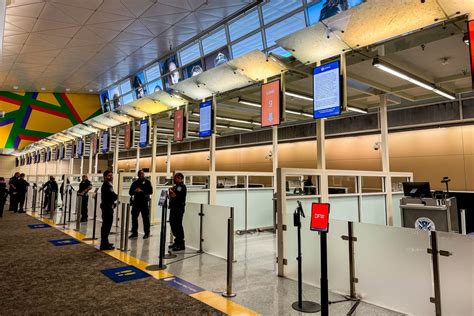
In practical terms, this means more airports could potentially qualify for OSS than for Preclearance. If expanded across additional European hubs, the cumulative time savings would be immense. For airlines operating complex global networks, that flexibility could reshape scheduling strategies and competitive positioning.
A Structural Shift in the Transatlantic Experience
The broader significance of One Stop Security lies in what it signals about aviation’s future. Air travel infrastructure has historically evolved through additive layers—more checks, more buffers, more redundancies. OSS demonstrates a different philosophy: targeted integration that preserves security while eliminating duplication.
For passengers, the change feels almost radical. The psychological weight of a US arrival often begins before touchdown, with travelers calculating whether their connection window is sufficient. By cutting that uncertainty in half, OSS does more than save minutes; it reduces stress and restores predictability.
For hub airports like DFW and ATL, the benefits compound. Faster transfers mean improved on-time performance, reduced gate congestion, and better passenger distribution throughout terminals. For airlines, tighter connections expand itinerary options without increasing fleet size. In a competitive transatlantic market, that edge matters.
The pilot phase will determine how rapidly the program expands. The TSA has already indicated interest in broadening eligibility. If additional airports meet the required standards, OSS could evolve from a targeted experiment into a foundational element of transatlantic travel.
Air travel has always balanced two imperatives: security and speed. For decades, those forces often seemed opposed. One Stop Security suggests they can coexist more intelligently. By trusting aligned systems and eliminating unnecessary repetition, the United States is quietly rewriting the arrival experience for millions of passengers. The Atlantic may remain vast, but the ground experience on the other side is becoming dramatically shorter—and far more efficient.