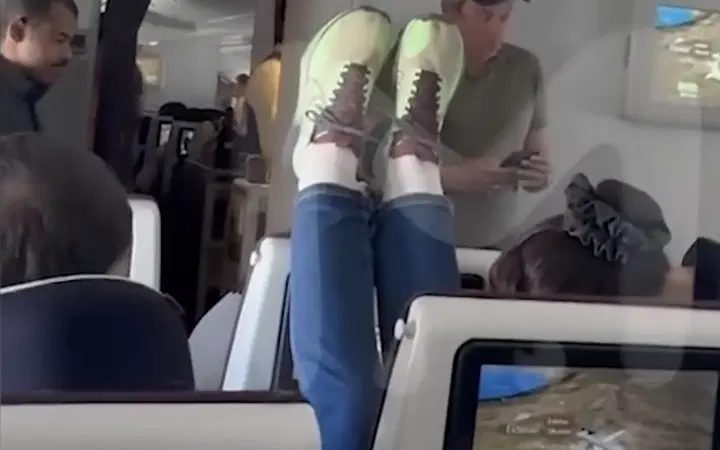
Air travel has a peculiar way of compressing human patience along with legroom, and few recent incidents illustrate this better than a now-viral confrontation aboard a Qatar Airways flight. What began as a routine seat recline escalated into a spectacle that left fellow passengers stunned, amused, and deeply uncomfortable. The episode, captured on video and shared widely online, offers a revealing snapshot of how quickly minor in-flight irritations can mutate into public theater at 35,000 feet.
The incident unfolded on a Qatar Airways Boeing 777-300ER operating the long-haul route from Doha (DOH) to Moscow (SVO). The aircraft’s economy cabin, typically a place of quiet endurance, became the stage for a bizarre act of revenge. A passenger seated behind another traveler objected to the seat in front being reclined. Rather than requesting assistance or attempting a conversation, she opted for a more theatrical protest, lifting both legs and resting her feet squarely on top of the forward seat’s headrest.
For those seated nearby, the scene was impossible to ignore. The woman in front, now effectively sharing her personal space with someone else’s feet, voiced her disbelief. Around her, other passengers reacted with a mix of sarcasm, commentary, and incredulity. One bystander joked that the contortionist display resembled “business class”, while another remarked on the uniquely surreal nature of the encounter. The cabin, meant for rest, instead echoed with awkward laughter and pointed remarks.
The physicality of the act itself was striking. Maintaining that posture for more than a few seconds would challenge most people’s flexibility, yet the passenger persisted, seemingly unfazed by discomfort or social norms. When she noticed cameras pointed in her direction, she doubled down, theatrically clapping her feet together as if performing for an audience. Silence became part of her strategy, amplifying the provocation rather than diffusing it.
Flight attendants eventually intervened, kneeling beside the offending passenger and asking her to stop. The request, however, was met with refusal. This moment became another focal point of online debate, with viewers questioning whether the crew’s response was too restrained. Qatar Airways is widely regarded for its polished service standards, but this incident exposed the delicate balance cabin crews must strike between calm professionalism and assertive enforcement.
From a passenger etiquette perspective, the episode sits at the intersection of rights versus consideration. Seat recline in economy class is, undeniably, a built-in feature and a passenger’s right. Yet exercising that right without situational awareness can strain already limited personal space, especially during meal services or when the person behind is working. In this case, the reclined passenger reportedly had ample legroom and was using a laptop, which may have added fuel to the resentment brewing behind her.
That context, however, does little to justify the response. Placing feet on a stranger’s headrest crosses a clear boundary of hygiene, respect, and basic decency. It transforms a minor inconvenience into a confrontational act that disrupts not only the two people involved but an entire cabin. The spectacle underscores how quickly entitlement can escalate when empathy exits the conversation.
The viral spread of the video also reveals something deeper about modern air travel culture. Smartphones have turned cabins into potential stages, where bad behavior is instantly documented and judged by millions. While this visibility can discourage misconduct, it can also encourage escalation, as participants become aware they are being watched. The footrest incident felt less like a private dispute and more like a performance shaped by the knowledge of an online audience.
There is also a cultural undertone that viewers latched onto, interpreting remarks made during the incident as reflections on national stereotypes and social behavior. Such readings are slippery and often unfair, yet they highlight how confined environments amplify perceptions and misperceptions alike. In the sealed tube of an aircraft, every action feels larger, heavier, and more symbolic than it would on the ground.
Ultimately, the Qatar Airways footrest incident is memorable not because it involved violence or threats, but because of its sheer absurdity. It showcased remarkable flexibility paired with astonishing pettiness, all in response to a reclined seat. The situation could have been resolved quietly through conversation or crew mediation, yet it instead became an enduring example of how not to handle shared discomfort.
Airplanes are exercises in forced cooperation. No one has enough space, everyone is tired, and patience is a finite resource. This viral moment serves as a cautionary tale: when minor grievances are met with exaggerated retaliation, everyone loses. Courtesy may not buy extra legroom, but it remains the only upgrade that costs nothing and makes the journey tolerable for all.