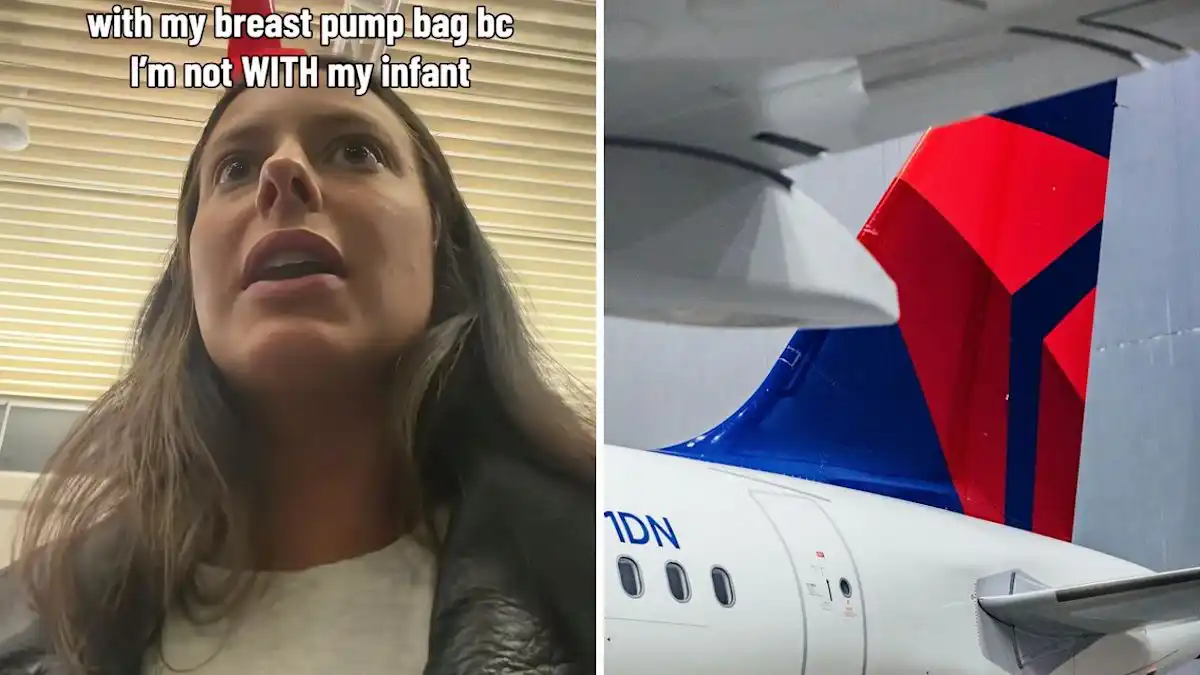
A Delta Air Lines passenger has publicly condemned the carrier after a gate agent refused to allow her to bring a breast pump onboard because her baby was not traveling with her, despite the airline’s own written policy explicitly permitting the device as an additional carry-on item. Jordon Lally documented the confrontation in a 73-second TikTok video that amassed nearly three million views within twenty-four hours, capturing the moment a Delta gate agent told her that passengers may only bring a breast pump onboard if they are traveling with an infant. The incident has reignited scrutiny over how the Atlanta-based carrier trains its frontline staff on policies designed to accommodate traveling parents, particularly those who need to pump milk while separated from their children.
The viral clip shows Lally standing at the gate, calmly presenting screenshots of Delta’s official policy from the airline’s website, only to be dismissed by the agent who allegedly characterized the documentation as an “AI overview” rather than the carrier’s actual rules. The agent can be overheard stating, “You are not traveling with an infant, that’s the thing,” before insisting that the pumps would be permitted onboard only if her infant were also present. Lally explained that the agent further claimed she had “too many bags” and could not bring an additional item regardless of whether it qualified as a medical device. “These women at the gate need to be held accountable,” Lally said in her post. “When I showed her these things on the Delta website, she proceeded to tell me, ‘those are just AI overviews, and they aren’t actually the policies.'” Ultimately, Lally agreed to check the bag so she could catch her flight, a concession that underscores the power imbalance passengers face when frontline staff misinterpret corporate guidelines.
What Delta’s Official Policy Actually Says About Breast Pumps
Delta Air Lines maintains a dedicated section on its website outlining accommodations for passengers traveling with children and infants, stating that it aims to “make traveling with kids as easy and convenient as possible.” According to the carrier’s published rules, in addition to the standard one-bag carry-on allowance, passengers may bring a “booster seat or other infant seat,” as well as a “breast pump and associated cooler bag” as an additional free item. The policy explicitly notes that these items “must also meet the carry-on size restrictions,” which was not the point of contention in Lally’s case, as she asserted that her pump bag fell within the airline’s listed dimensions. Crucially, Lally also shared a screenshot of Delta’s website stating that “you don’t have to have your baby with you” to bring a breast pump and cooler bag onboard. This direct language contradicts the gate agent’s assertion and raises serious questions about whether Delta’s frontline employees are adequately trained on the very policies the airline publishes for its customers.
The confusion is compounded by the fact that there is no federal rule requiring airlines to allow breast pumps outside their standard carry-on limits, meaning each carrier sets its own policy. Most major U.S. airlines take an approach similar to Delta’s. Southwest Airlines, for instance, states that breast pumps do not count toward its carry-on limit, while American Airlines also excludes them from the standard allowance. Breast pumps are classified as medical devices by the U.S. Food and Drug Administration, and the Transportation Security Administration permits breast milk in carry-on bags in quantities exceeding the usual 100-milliliter limit, along with ice packs and other cooling accessories. Despite these federal recognitions, the enforcement of airline-specific policies remains inconsistent, leaving passengers vulnerable to the discretion of individual gate agents who may not fully understand the rules they are tasked with upholding.
A Pattern of Complaints Against Delta Over Breast Pump Handling
This is not the first time Delta has faced public criticism for its treatment of breastfeeding mothers at the boarding gate. In March, a TikTok user named Amanda, posting under the handle @amarx76, complained that she was told to consolidate her belongings before boarding a Delta flight in Chicago. When she explained that her breast pump was a medical device, the employee allegedly questioned whether she needed one and told her that it did not count as a medical device. That incident, like Lally’s, highlights a troubling pattern in which Delta employees appear to be either unaware of or unwilling to honor the carrier’s own accommodations for nursing mothers. The repeated nature of these complaints suggests that the issue is not an isolated misunderstanding but a systemic failure in training and communication.
The broader implications of these incidents extend beyond the individual inconvenience of checking a bag. For many mothers, a breast pump is not a luxury but a medical necessity, essential for maintaining milk supply and preventing painful conditions such as mastitis. When airlines refuse to allow pumps onboard, they are effectively forcing mothers to choose between their health and their travel plans. Delta’s policy, as written, is designed to prevent exactly this scenario by explicitly allowing pumps and cooler bags as additional carry-on items, even when the baby is not present. The disconnect between the policy on paper and its enforcement at the gate is a reputational liability for Delta, which has otherwise positioned itself as a family-friendly carrier. As Lally’s video continues to circulate, the airline faces mounting pressure to ensure that its gate agents are properly trained and held accountable for honoring the accommodations it publicly promises.