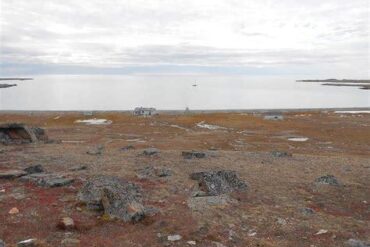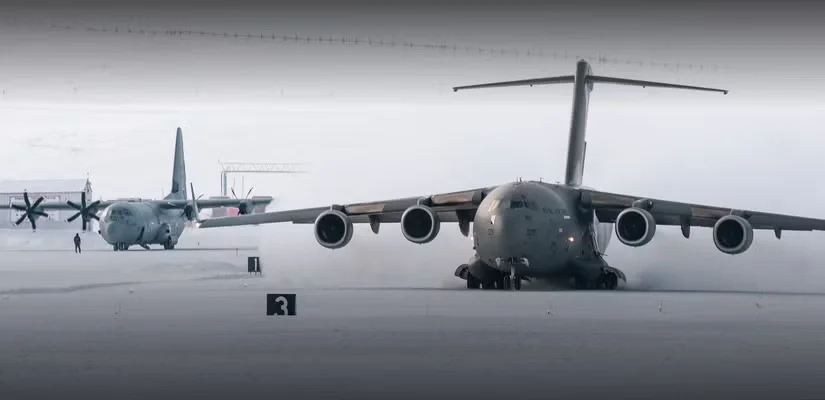
The sheer scale of Arctic logistics is rarely visible to the public eye—until a mission like this unfolds. A Boeing C-17 Globemaster III operated by the Royal Air Force has successfully completed a series of demanding supply flights deep into the High Arctic, reaching the isolated Canadian Forces Station Alert. Positioned more than 82 degrees north latitude, this remote installation sits roughly 1,100 miles inside the Arctic Circle, making it the northernmost permanently inhabited settlement on Earth.
This mission was not simply about transport—it was a precise demonstration of endurance, engineering, and operational mastery under some of the harshest conditions on the planet. Over the course of a week, the aircraft executed multiple supply runs from Greenland, delivering critical fuel and proving once again why the C-17 remains one of the most capable airlifters ever built.
Extreme Logistics: Supplying the Edge of the World
At CFS Alert, survival depends entirely on airborne logistics. There are no shipping lanes, no roads, and no margin for error. The surrounding Arctic Ocean remains locked in ice for most of the year, rendering maritime resupply impossible. Everything—from heating fuel to communications equipment—must arrive by air.
The RAF’s contribution came under Operation Boxtop, working alongside Canada’s Exercise Polar Puma. Together, these missions ensure that the station continues to function as both a signals intelligence hub and a critical climate research facility.
What makes this operation especially remarkable is not just the distance, but the conditions. The runway at Alert is not paved. Instead, it is a semi-prepared strip of compacted snow and gravel, significantly shorter than standard airfields. Precision flying is not optional—it is survival.
Short Runway, Zero Margin: The C-17’s Defining Moment
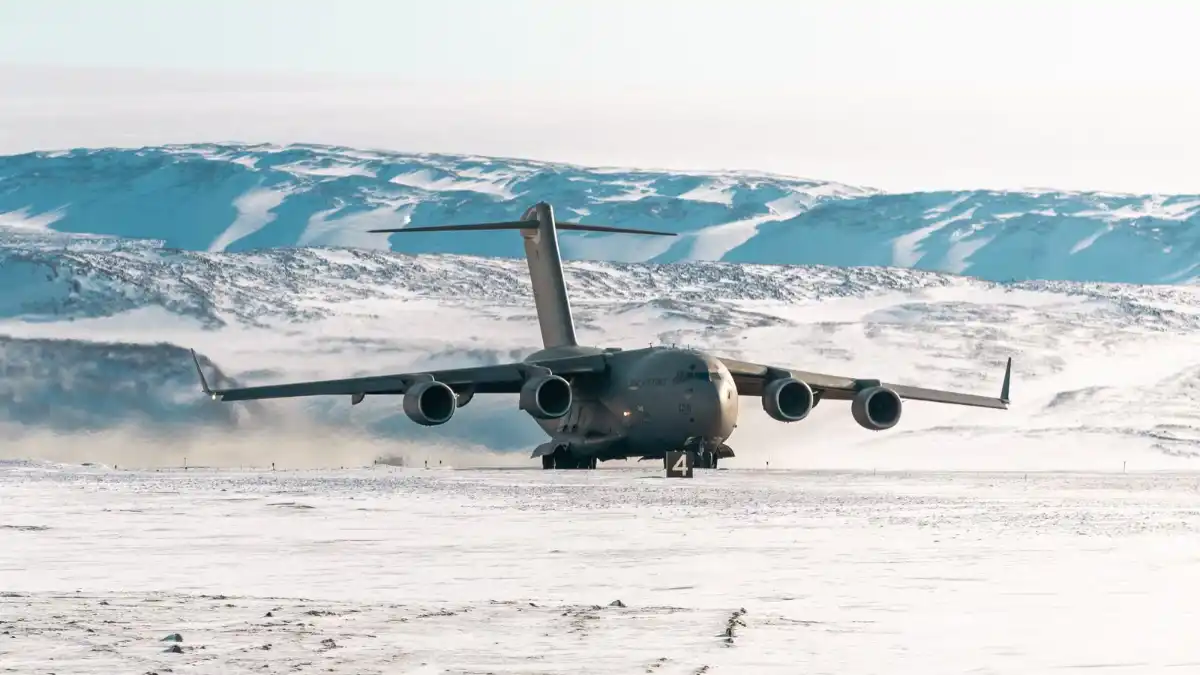
The mission highlighted one of the aircraft’s most celebrated capabilities: Short Takeoff and Landing (STOL) performance. On a runway described as “less than half the length of a normal airport strip,” the C-17 demonstrated why it remains indispensable for military logistics.
Unlike conventional cargo aircraft that require long, paved surfaces, the Globemaster thrives in austere environments. Its advanced wing design, powerful engines, and rugged landing gear allow it to operate where others simply cannot.
Each landing demanded flawless execution. Arctic weather is notoriously volatile, capable of shifting from clear skies to blinding snowstorms within minutes. Pilots had to contend with:
- Rapidly changing visibility
- Extreme cold affecting aircraft systems
- Limited navigation infrastructure
- Narrow operational windows for safe landing
These conditions transform every approach into a high-stakes maneuver, where experience and aircraft capability intersect.
Eight Missions, 300,000 Liters: A Week of Relentless Flying
The operation was not a single dramatic flight—it was a sustained logistical effort. One RAF C-17, tail number ZZ176, completed eight round trips between Pituffik in Greenland and CFS Alert.
In total, the aircraft delivered nearly 300,000 liters of jet fuel, a lifeline resource for the station. This fuel powers everything from heating systems that combat subzero temperatures to radio and surveillance equipment critical for intelligence operations.
The mission timeline reveals a tightly coordinated operation. After departing RAF Brize Norton, the aircraft staged through Keflavík International Airport before reaching Greenland. From there, the Arctic shuttle began—eight cycles of loading, flying, landing, unloading, and returning.
Notably, the return leg to the UK was completed nonstop, covering thousands of miles in a single stretch—another testament to the aircraft’s range and efficiency.
Why Alert Matters: Intelligence and Climate at the Top of the World
CFS Alert is far more than an isolated outpost. Its strategic importance lies in two critical domains: signals intelligence and climate monitoring.
From a defense perspective, its location provides a unique vantage point for monitoring communications and activities across the polar region. In an era where Arctic geopolitics is intensifying, such capabilities are increasingly valuable.
Equally significant is its role in climate research. Positioned at the edge of the polar ice cap, Alert offers scientists direct access to one of the most sensitive indicators of global climate change. Data collected here contributes to a broader understanding of ice melt patterns, atmospheric shifts, and long-term environmental trends.
Without consistent resupply missions, none of this work would be possible.
From Arctic to Antarctic: A Truly Global Airlifter
The C-17’s Arctic success is not an isolated case—it is part of a broader legacy. The aircraft has proven its versatility across both extremes of the planet. In Antarctica, the United States Air Force has deployed the same platform to support operations at McMurdo Station, landing on deep compacted snow runways.
This dual-polar capability underscores a simple truth: few aircraft can match the C-17’s combination of range, payload, and adaptability. Whether navigating the frozen north or the icy expanse of the south, it remains a cornerstone of global military logistics.

The Strategic Future of High North Operations
This mission signals more than operational success—it marks a shift in capability. The RAF’s 99 Squadron is now actively expanding the United Kingdom’s reach into the High North, a region of growing geopolitical and environmental importance.
As Arctic routes open and global interest intensifies, the ability to project power and sustain operations in such environments will become increasingly critical. The success of these flights demonstrates that the RAF is not only participating—but leading in the development of Arctic air mobility.
In a world where logistics often define strategy, the image of a massive C-17 touching down on a frozen strip at the top of the planet says everything. It is not just about reaching the edge of the map—it is about owning the capability to operate there, reliably and repeatedly.