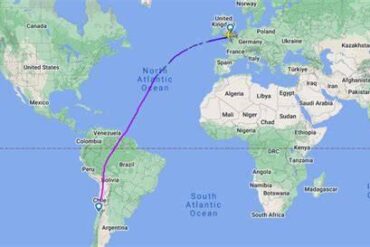
In the landscape of aviation myths, few tales have endured like the bizarre story of Santiago Flight 513—an aircraft allegedly lost in 1954 only to reappear, decades later, with a ghostly cargo of skeletons aboard. First published in 1989 by the sensationalist Weekly World News, the article stunned readers with a claim so outrageous it bypassed logic and tapped into primal fascination: time travel, vanished airliners, and the impossible return of the dead.
Even though modern scrutiny has revealed the tale as pure fabrication, the myth persists. Today, we dissect the Santiago Flight 513 hoax with surgical precision—examining its origins, technical impossibilities, and cultural impact, to set the record straight.

The Birth of a Legend: Weekly World News and the Irwin Fisher Article
The story emerged in the October 1989 edition of Weekly World News, a tabloid renowned for its fantastical headlines. Written by Irwin Fisher, the article claimed that a Lockheed L-1049 Super Constellation operated by the fictitious Santiago Airlines had taken off from Aachen, Germany, on September 4, 1954, bound for Porto Alegre, Brazil. Midway across the Atlantic, the aircraft supposedly vanished without a trace. No wreckage was found, and it was presumed lost to the sea.
Then came the alleged miracle. On October 12, 1989, the same aircraft was said to have reappeared, circling Porto Alegre Airport before making a perfect landing. Startled airport staff discovered 92 skeletons—88 passengers and 4 crew members—still seated in the pressurized cabin. According to the report, the engines were still idling, and the pilot’s remains were found clutching the controls.
The article even quoted a so-called paranormal researcher, Dr. Celso Atello, who theorized the aircraft had flown through a time warp. “God only knows how a skeleton managed to land it,” the article concluded.
Fiction Disguised as Fact: Deconstructing the Hoax
The first layer of deception lies in the publication itself. Weekly World News was never a journalistic outlet in the traditional sense. It was a purveyor of satirical and sensational content that blurred the line between entertainment and misinformation. Its track record includes stories like “Bat Boy Found in Cave” and “12 U.S. Senators Are Space Aliens.”

A deeper inspection of the Santiago Flight 513 story reveals a collection of factual inconsistencies and impossibilities:
- No record exists of Santiago Airlines. The airline was entirely fabricated.
- No official aviation records document the loss of a flight matching this profile in 1954.
- The Lockheed Super Constellation, although a real aircraft, had a maximum range of 5,150 miles—far short of the 6,600-mile distance between Aachen and Porto Alegre.
- Aachen’s airfield in 1954 was a modest grass strip, unsuitable for a fully loaded Super Constellation.
- There were no contemporary media reports or government investigations in 1989 to support the story’s claims.
These factual errors render the story implausible from an aeronautical and historical standpoint.
The Aircraft in Question: Lockheed L-1049 Super Constellation
The Lockheed L-1049, part of the celebrated Constellation series, was a mainstay of post-war commercial aviation. Known for its triple-tail design and sleek fuselage, the aircraft could carry up to 106 passengers and cruised at around 300 mph (483 km/h).

While technically advanced for its era, the L-1049 faced severe limitations on long-haul routes. Without in-air refueling or modern range-extending modifications, a direct flight from western Germany to southern Brazil would have been impossible without multiple refueling stops. This makes the article’s central claim—that the aircraft flew uninterrupted across the Atlantic—even more far-fetched.
Aachen to Porto Alegre: The Geographic Implausibility
The reported departure point, Aachen, is not home to a commercial airport. The closest facility is Maastricht Aachen Airport in the Netherlands, which did not serve long-haul international flights in 1954. Aachen’s local airfield, at the time, was primarily a grass-strip aerodrome with limited capacity.
Given the aircraft’s size and weight, the chance of it taking off with 92 people aboard from such a strip is negligible. Additionally, Porto Alegre’s Salgado Filho Airport in 1989 had long transitioned to servicing modern jetliners, not vintage four-prop aircraft.
Cultural Echoes and Persistent Myths
Despite being a demonstrably false account, the Santiago Flight 513 myth continues to resurface on social media, conspiracy forums, and even clickbait YouTube videos. Why? Because it combines several narrative elements that captivate the human psyche:
- The romanticism of lost aviation history
- The fear of vanishing into the unknown
- The allure of time travel and wormholes
- The mystery of skeletons trapped in time
These themes resonate in a way that makes the story unforgettable, even when its flaws are obvious.

Parallel Myths: Pan Am Flight 914 and Other Fabrications
The Santiago story wasn’t even original. In 1985, Weekly World News published a nearly identical tale about Pan Am Flight 914, a Douglas DC-4 that allegedly disappeared in 1955 and reappeared in Caracas in 1985. That tale followed the same structure: a sudden disappearance, an impossible return decades later, and an absence of tangible follow-up.
This technique—recycling ghost-plane narratives—became a formula for the tabloid. Its stories were crafted not to inform but to stimulate belief, often cloaked in pseudoscientific jargon and speculative quotes.

Aviation Mysteries vs. Manufactured Myths
While real aviation disappearances—such as Amelia Earhart in 1937 or Malaysia Airlines Flight MH370 in 2014—continue to perplex experts and fuel public speculation, these events are grounded in traceable data, search operations, and legitimate reporting. In contrast, Santiago Flight 513 leaves no paper trail—no aircraft registry, no passenger manifest, no international alert.
The failure of the myth to appear in any aviation safety databases, ICAO records, or governmental archives confirms its fictional status.
The Danger of Belief Without Evidence
At its core, the Santiago Flight 513 tale is a reminder of the power—and danger—of storytelling. In a pre-digital world, such hoaxes found a home in tabloids. Today, they spread faster and wider, amplified by the very platforms that also host legitimate information.
While some myths are harmless curiosities, others erode public trust in journalism and history. When we indulge in fantasy without scrutiny, we risk confusing entertainment for truth.
Conclusion: Closing the Hangar on Santiago Flight 513
There was no Santiago Flight 513. No skeletal crew miraculously landed a ghost airliner in Brazil. The story, born from the fertile imagination of a tabloid journalist, was never meant to be believed—only to be read.
Yet, its legacy endures as a case study in media literacy, aeronautical logic, and the timeless lure of the mysterious. As aviation historians, it is our duty to honor the real mysteries of the sky and to shine a light on those that belong to fiction.
In the final tally, the only thing Santiago Flight 513 ever flew was straight into the realm of urban legend.