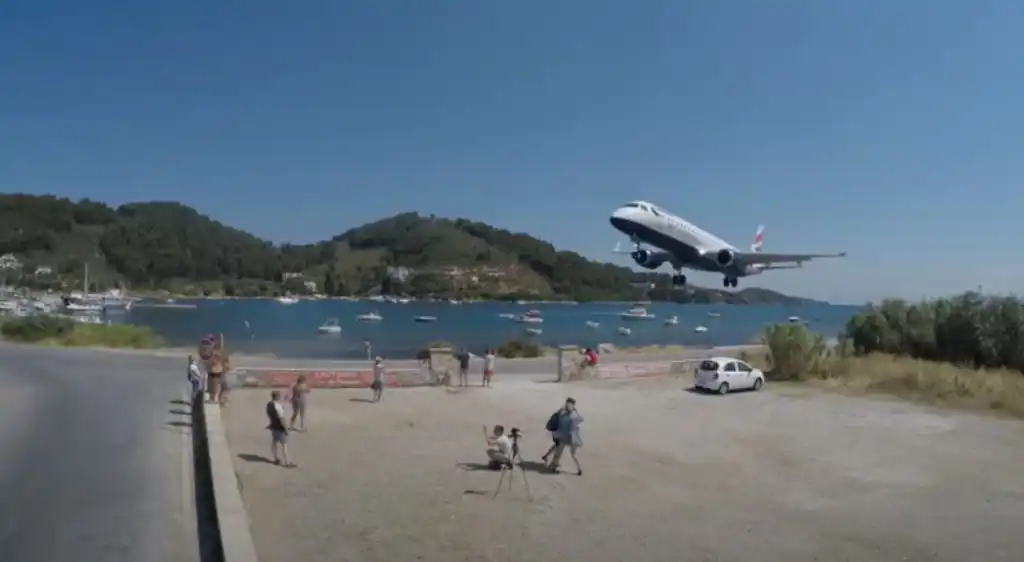
Skiathos International Airport has once again drawn attention for a reason that goes far beyond its spectacular aviation views. Two tourists were seriously injured by jet blast while plane-spotting at Skiathos Airport this month, with both incidents occurring only days apart. The accidents have renewed concerns about the risks faced by visitors who gather close to departing aircraft at one of Europe’s most famous plane-spotting locations.
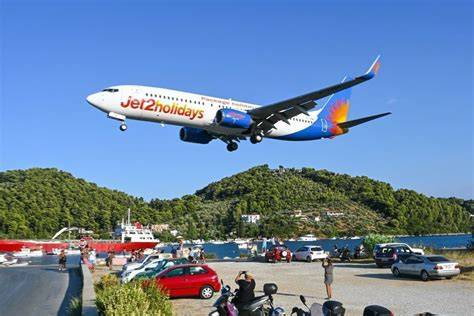
The Greek island’s Skiathos International Airport Alexandros Papadiamantis (JSI) has earned a reputation among aviation enthusiasts because aircraft operate unusually close to a public road and nearby viewing areas. The airport’s distinctive geography allows spectators to watch aircraft at remarkably close range, creating an experience that has helped Skiathos become known as the “European St. Maarten.” However, that proximity also creates a potentially dangerous environment when spectators underestimate the power generated by a commercial jet’s engines.
The first reported incident occurred on Monday, August 10, when an Italian tourist was knocked off her feet by the jet blast produced by a departing aircraft. She fell onto a concrete surface and struck her head, sustaining serious trauma. Emergency responders attended to her before she was taken to a local medical center, where doctors conducted a CT scan that revealed a brain bleed accompanied by significant head injuries.
Because of the seriousness of her injuries, the tourist required treatment beyond what was available locally. She was subsequently airlifted to Volos General Hospital on the Greek mainland for specialist medical care. The incident illustrates how quickly an apparently routine plane-spotting experience can become a medical emergency when spectators stand within an area affected by powerful engine exhaust.
A Second Tourist Suffers a Serious Arm Fracture
The situation became even more concerning only three days later. On Thursday, August 13, another Italian tourist was knocked over while watching aircraft at the same popular plane-spotting location. She lost her footing after being exposed to the force generated by a departing aircraft and fell heavily to the ground.
The second accident resulted in a serious arm fracture, according to reports. Although the injuries differed from those suffered in the first incident, the circumstances were remarkably similar: tourists were positioned close enough to an operating aircraft for jet blast to affect their stability.
Local authorities are reportedly investigating both incidents. The repeated accidents have intensified attention on what has become a persistent safety issue at Skiathos, particularly because the location continues to attract visitors specifically because aircraft can be observed at exceptionally close range.
Why Skiathos Is Famous Among Plane Spotters
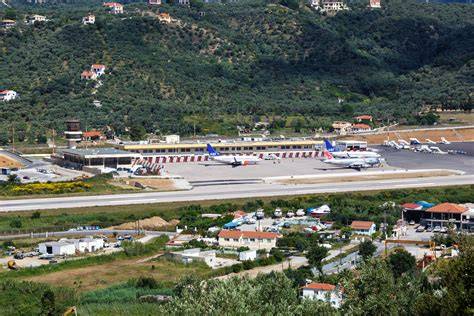
Skiathos offers an unusual combination of geography and airport infrastructure that makes it especially attractive to aviation enthusiasts. Skiathos International Airport “Alexandros Papadiamantis” serves the Greek island and operates from a relatively short runway measuring approximately 5,341 feet (1,628 meters).
The airport was constructed using reclaimed land because of Skiathos’ challenging geography. Its development also involved joining Skiathos with Lazareta, an island historically associated with a former leper colony. Today, that unusual physical setting contributes to an airport environment unlike many conventional European gateways.
The airport’s runway and perimeter are positioned close to the public road known as Paraliakos, allowing spectators to stand near the airport boundary and watch aircraft arriving and departing. For plane spotters, photographers and aviation enthusiasts, this can provide an extraordinary perspective that is difficult to reproduce at larger airports where extensive security perimeters separate the public from aircraft operations.
That accessibility, however, should not be confused with safety. Being able to legally stand near an airport perimeter does not mean that every position around the perimeter is safe from aircraft-related hazards.
The Hidden Power of Jet Blast
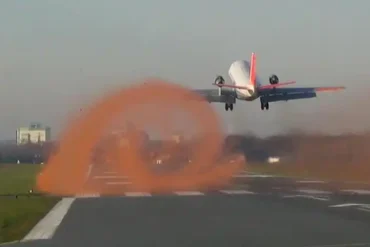
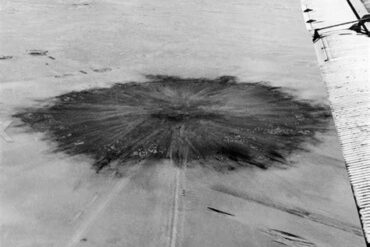
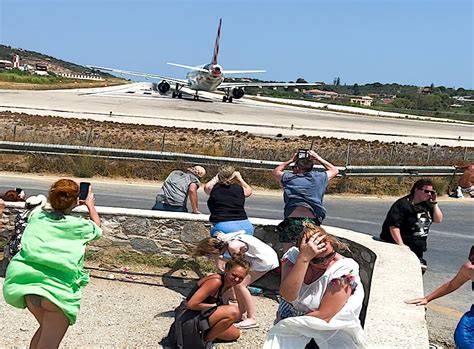
Jet blast is one of the most significant hazards facing people who stand too close behind a departing jet. Unlike the visible aircraft itself, engine exhaust can be difficult for spectators to judge. A modern commercial aircraft can produce an enormous amount of thrust, sending a high-velocity stream of hot air and exhaust behind the engines.
A person standing within the affected area can potentially lose balance almost instantly. The danger becomes particularly serious when someone is standing on uneven ground, near a hard surface, beside barriers or among other spectators. A fall that begins with a momentary loss of balance can result in severe secondary injuries, as demonstrated by the two Skiathos incidents.
The risk is not limited to the physical force itself. Loose objects can also become hazardous around aircraft operating at close range, while spectators focused through smartphone cameras or long camera lenses may pay less attention to their surroundings. The excitement of seeing a large passenger aircraft take off only meters away can make it easy to underestimate the forces involved.
Warning Signs Have Not Eliminated the Risk
Authorities and airport operators have reportedly installed warning signs and barriers near the airport perimeter to alert plane spotters to the dangers of jet blast. These measures are intended to keep visitors away from areas where departing aircraft could create hazardous conditions.
Yet the popularity of the location means that warnings have not eliminated risky behavior. Some visitors deliberately seek the closest possible viewpoint, hoping to capture dramatic photographs or videos of aircraft departing at extremely close range.
That behavior creates a difficult balance between aviation tourism and public safety. Skiathos’ reputation has been built partly on the extraordinary access it offers to aircraft movements, but the same characteristic that attracts visitors can become dangerous when people move too close to the operational area.
Skiathos Airport Has a Highly Seasonal Traffic Pattern
The safety issue is particularly relevant because Skiathos Airport becomes extremely busy during the Northern Hemisphere summer. Around 17 operators serve the airport seasonally, connecting the island with approximately 54 destinations across Europe.
Major seasonal operators include Jet2, Ryanair, easyJet and TUI Airways, giving plane spotters opportunities to see a wide variety of aircraft and airline liveries throughout the peak travel period. Jet2 serves around ten destinations, while Ryanair operates approximately nine. easyJet and TUI Airways each connect Skiathos with around six destinations during the seasonal period.
The airport’s year-round network is considerably smaller. Olympic Air and Sky Express provide domestic connectivity, including flights to Athens International Airport. This sharp contrast between summer and winter traffic helps explain why the airport’s plane-spotting culture becomes particularly visible during the holiday season.
A Famous Viewing Location With Real Aviation Risks
The two injuries serve as a powerful reminder that plane spotting is an activity that requires respect for aircraft operations, even when spectators are standing in a publicly accessible area. Skiathos remains one of Europe’s most recognizable destinations for aviation enthusiasts, and its unusual airport geography is a major part of its appeal.
But the events of August 10 and August 13 show that the spectacle has a serious side. One tourist suffered a brain bleed and required an airlift to the Greek mainland, while another sustained a significant arm fracture only days later.
The lesson is straightforward: jet blast should never be treated as a harmless part of the plane-spotting experience. The force produced by a departing aircraft can overwhelm an adult’s balance in seconds, turning a memorable holiday moment into a potentially life-changing accident.
As local authorities investigate the two incidents, attention will likely remain focused on whether additional safety measures are needed around Skiathos’ famous viewing areas. For visitors, the safest approach is equally clear: follow warning signs, respect barriers and maintain as much distance as possible from operating aircraft. The closer view may produce a more dramatic photograph, but no photograph is worth a serious injury.