For a brief moment in the 1950s, the future of commercial aviation still sounded like four enormous radial engines turning giant propellers at full power. The Douglas DC-7 represented the ultimate development of that technology in American airline service, arriving just before jetliners transformed the industry. It was faster, longer-legged, and more capable than the piston-powered transports that came before it, yet its career was already being overshadowed by an entirely different generation of aircraft.
The DC-7 is often described as the last major American piston-engine airliner, and that description captures its unusual place in aviation history. It was not an obsolete design when it entered service. Quite the opposite: Douglas had pushed piston technology remarkably far, extracting impressive performance from four Wright R-3350 Duplex-Cyclone engines. The aircraft could carry dozens of passengers across the United States at speeds that had seemed extraordinary only a few years earlier.
What makes the DC-7 particularly fascinating is the timing. It entered service in 1953, when airlines still depended heavily on piston-powered aircraft, but the first successful commercial jets were already approaching. The DC-7 therefore became the culmination of one technological era while simultaneously becoming one of its final casualties. Its story is less about a failed aircraft than about a machine that arrived at the summit just as the mountain was disappearing beneath it.
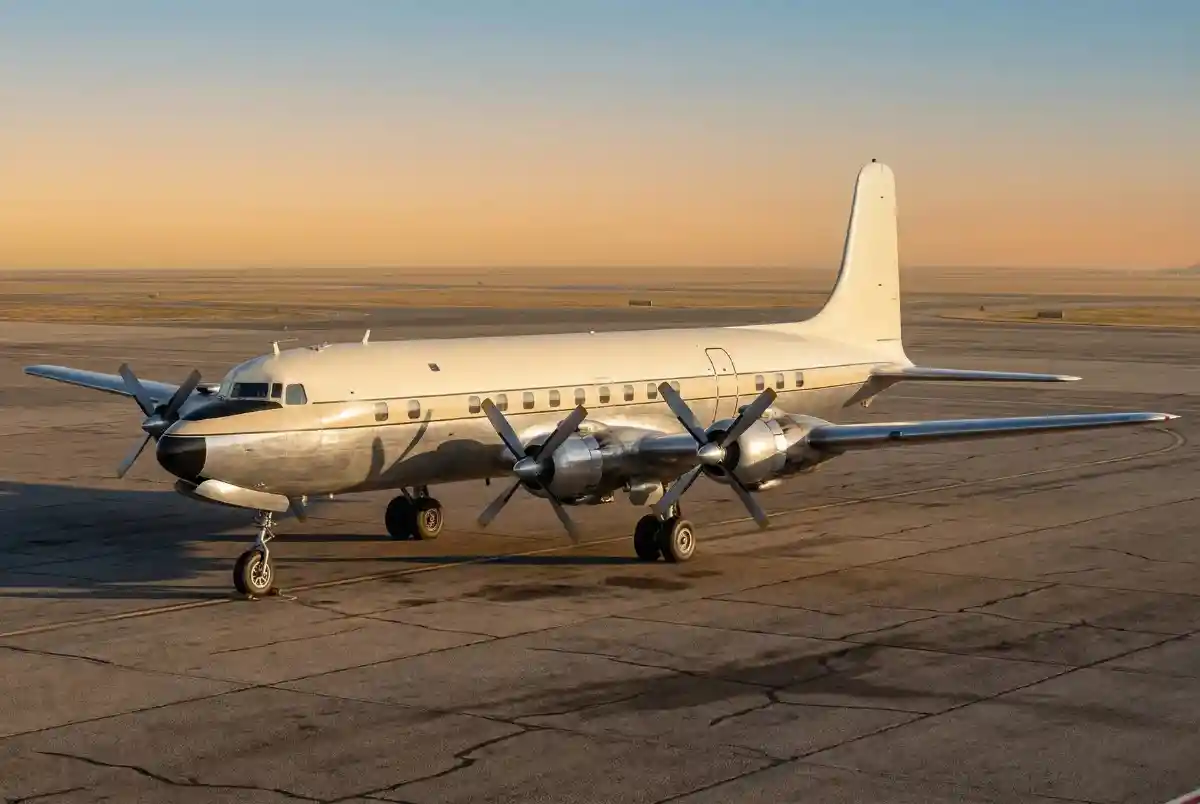
The Douglas DC-7 Was the Peak of American Piston-Airliner Development
The Douglas DC-7 evolved from the successful DC-6 family, but it was created with a more demanding objective: give airlines a powerful piston-powered aircraft capable of fast, nonstop long-distance service. Douglas needed an answer to Lockheed’s increasingly competitive Constellation family, while major US carriers wanted better performance on important transcontinental routes.
The prototype DC-7 first flew in 1953, and the production aircraft quickly demonstrated how far piston technology had progressed. With four Wright R-3350 Duplex-Cyclone engines, the DC-7 could reach a top speed of roughly 406 mph, depending on configuration and operating conditions. Its range was around 3,600 miles, making nonstop coast-to-coast operations practical under suitable conditions.
For passengers, the improvement was significant. A New York-to-Los Angeles flight could be completed in less than eight hours, a remarkable achievement for a propeller-driven airliner. The aircraft also offered a more refined cabin than many earlier piston transports, including configurations designed for overnight travel and sleeping accommodations.
The DC-7 subsequently developed into several important variants. The DC-7B incorporated improvements including greater fuel capacity, while the DC-7C was developed with longer-range international operations in mind. The DC-7C, sometimes associated with the name Seven Seas, represented Douglas’s attempt to squeeze even more capability from the piston-powered formula as airlines increasingly demanded longer nonstop routes.
Yet the aircraft’s impressive specifications concealed a fundamental problem. Piston engines of this size were becoming extraordinarily complicated to operate and maintain at the power levels demanded by modern airline schedules.
Four Wright R-3350 Engines Made the DC-7 Powerful—and Complicated
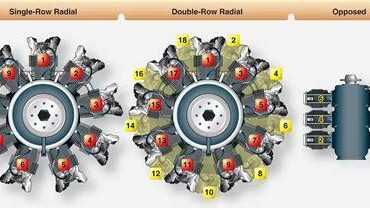
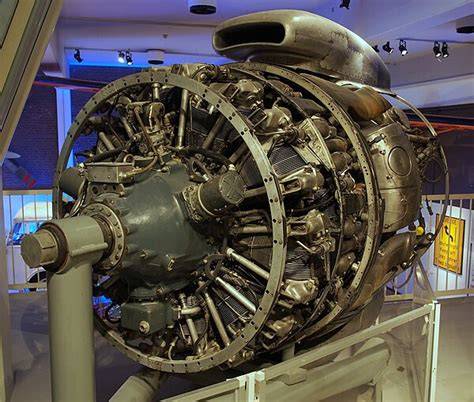
The heart of the DC-7 was its Wright R-3350 Duplex-Cyclone, a massive air-cooled radial engine. The R-3350 was not simply a scaled-up version of a small piston engine. It was a highly sophisticated 18-cylinder design developed to produce enormous power, and the DC-7 required four of them.
That combination gave the aircraft its distinctive personality. On the ground, the sound and vibration of four large radial engines were unmistakable. In the air, those engines provided the power necessary to move a large four-engine airliner at speeds that approached the limits of practical piston-powered commercial flight.
But extracting that performance came with costs. The engines generated tremendous heat, and overheating and mechanical reliability were persistent concerns. Maintaining an aircraft powered by four large piston engines required considerable labor, inspection, and technical expertise. Engine fires and other mechanical problems were among the risks that accompanied the technology.
The issue was not simply that the R-3350 was badly designed. Rather, piston engines were reaching a point where further increases in power produced increasingly difficult engineering challenges. More power meant more heat, more mechanical stress, more components, and more maintenance.
This became especially important as airlines began thinking about aircraft utilization differently. A commercial aircraft was expected to fly frequently, reliably, and economically. Every additional maintenance requirement could affect schedules and operating costs. The DC-7 was a spectacular machine, but its complexity was increasingly difficult to justify once a fundamentally different propulsion technology became available.
Why the Jet Age Made the DC-7 Obsolete So Quickly
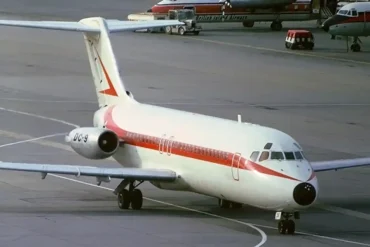
The arrival of the Boeing 707 and Douglas DC-8 changed the equation almost overnight. The DC-7 had been engineered to make piston propulsion as fast and capable as possible, but jet engines did not require engineers to keep pushing piston technology toward its physical and operational limits.
Jetliners could fly substantially faster, allowing airlines to reduce journey times while increasing the number of sectors an aircraft could potentially operate. They also offered a different reliability and maintenance proposition as turbine technology matured. Most importantly, passengers wanted speed, and airlines quickly recognized the commercial value of offering jet service.
The contrast between the DC-7 and the new jets was dramatic. A DC-7 could reach roughly 406 mph, while early Boeing 707 and Douglas DC-8 aircraft could cruise at speeds approaching or exceeding 600 mph. The difference was not merely a specification on a brochure. It fundamentally changed the experience and economics of long-distance travel.
The DC-7 therefore found itself caught in an uncomfortable position. It was technologically advanced within the piston era, but the industry had already moved beyond that era. Airlines that had invested heavily in DC-7 fleets soon faced the reality that their newest propeller aircraft were competing against jets with much higher performance.
The transition was remarkably rapid. By the end of the 1950s and into the 1960s, the Jet Age had become the defining direction of commercial aviation. Piston airliners were increasingly pushed toward secondary routes, cargo operations, charter work, and retirement.
American Airlines, Delta, United, and Other Carriers Flew the DC-7
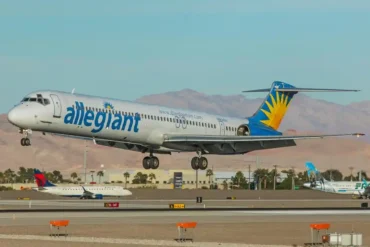
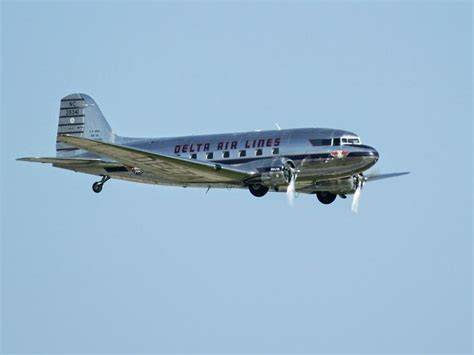
The DC-7 was not an experimental aircraft with limited airline acceptance. It was operated by some of the biggest names in American aviation, including American Airlines, United Airlines, Delta Air Lines, Eastern Air Lines, and Braniff.
For these carriers, the aircraft offered a major improvement in long-distance scheduling. Nonstop coast-to-coast flights became more practical, and the aircraft’s capacity and range allowed airlines to serve important markets with fewer intermediate stops.
Delta introduced the DC-7 in 1954 and operated the type until 1968. The aircraft helped Delta strengthen its long-distance network during a period when the airline industry was undergoing one of the largest technological transformations in its history.
The DC-7 also achieved an international presence. Operators in more than 30 countries used various versions of the aircraft, demonstrating that its appeal extended far beyond the United States. For a few years, it represented one of the most capable piston-powered choices available to a major airline.
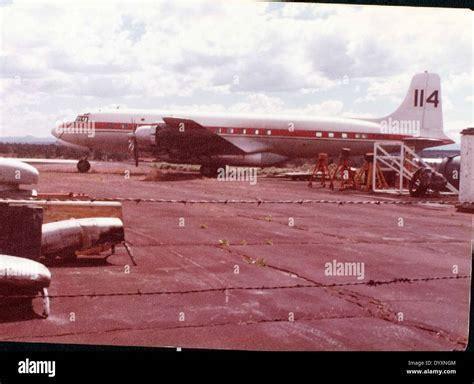
But its commercial career was short compared with aircraft that arrived only a few years later. As jet fleets expanded, airlines progressively withdrew DC-7s from passenger operations. Some continued working in specialized roles, while others were converted for cargo service.
In 1959, Douglas began conversions of DC-7 and DC-7C aircraft into DC-7F freighters, extending the useful life of airframes that were no longer competitive as premium passenger aircraft.
The DC-7 Versus the Aircraft That Replaced It
The technological gap becomes easier to understand when the DC-7 is placed alongside the aircraft that followed it. The DC-7 had four piston engines and a top speed around 406 mph, while the Boeing 707 and Douglas DC-8 introduced swept-wing jet technology and dramatically higher speeds.
The Lockheed Constellation also provides useful context. It was one of the most advanced piston airliners of its generation, but the same fundamental problem affected it: piston engines were approaching the limits of what airlines could economically demand from them.
The DC-7 therefore should not be viewed as an inferior aircraft simply because it was replaced quickly. It was actually a high point of piston-engine engineering. Its relatively short career reflects the extraordinary speed of technological change during the 1950s rather than a lack of capability.
There was even an interesting overlap between the two generations. Airlines were operating sophisticated piston airliners while jet prototypes and early production aircraft were already changing expectations. For passengers who flew on the DC-7 near the end of its commercial career, the aircraft could feel modern and luxurious. A few years later, it belonged to another era.
Where Can You Still See a Douglas DC-7?
Today, the DC-7 survives primarily as a preserved historic aircraft rather than an active airliner. Several examples remain in museums, where visitors can appreciate just how large the aircraft and its engines were.
The Delta Flight Museum in Atlanta, Georgia, preserves a DC-7 and provides an important connection to the airline’s piston-powered history. The Pima Air & Space Museum in Tucson, Arizona, also has a DC-7B that previously served United Airlines before later working with cargo operators.
Another notable example is preserved at Epic Flight Academy, which has the last production passenger DC-7, built in 1956. These surviving aircraft are particularly valuable because they allow visitors to see the physical engineering behind an aircraft that is otherwise increasingly difficult to understand through photographs alone.
A DC-7 is enormous by the standards of vintage piston aircraft, and the engines dominate its appearance. Standing beside one makes it easier to appreciate the amount of machinery required to move a fully loaded airliner across the country before turbine propulsion took over.
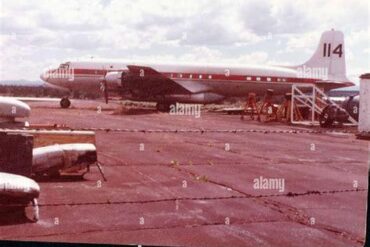
Some DC-7s were maintained in flying condition for decades. Tanker 60, one of the last airworthy examples, made its final flight in October 2020. Another aircraft, former Eastern Airlines DC-7B N836D, had been restored to flying condition before an engine failure grounded it in 2013.
Keeping one of these aircraft operational is exceptionally demanding. Original components are increasingly difficult to obtain, major engine overhauls are expensive, and relatively few mechanics retain deep experience with these large vintage radial engines. Certification and insurance requirements also make regular operation considerably more complicated than simply repairing an old airplane.
The Douglas A-1 Skyraider Was Another Final Piston Chapter
The DC-7 was the end of one civilian story, but Douglas also produced another important piston-powered aircraft during the transition to jets: the A-1 Skyraider.
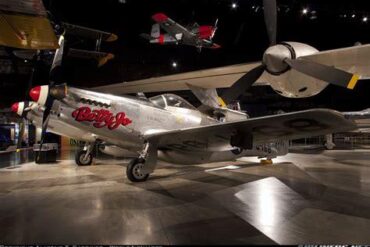
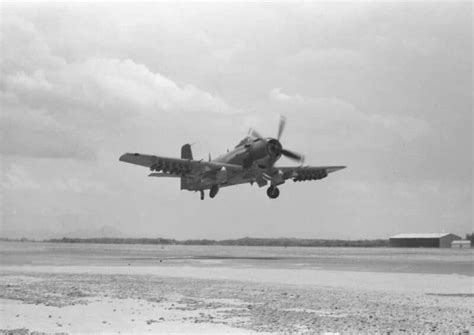
Developed after World War II, the Skyraider was a single-engine attack aircraft designed around endurance, payload, and ruggedness rather than outright speed. Its large Wright R-3350 engine gave it an extraordinary ability to remain over an area for long periods while carrying a substantial weapons load.
That made the aircraft valuable during the Vietnam War, where Skyraiders performed ground-attack and rescue-support missions even as increasingly sophisticated jet aircraft dominated the combat environment.
The Skyraider’s continued usefulness demonstrated something important about piston engines. They were not universally inferior to turbines. In certain roles, characteristics such as long endurance, low-speed handling, and payload flexibility remained extremely valuable. The technology was simply no longer the dominant solution for high-speed commercial transport.
Why the DC-7 Still Matters in Aviation History
The Douglas DC-7 occupies a fascinating position between two worlds. It was the final major expression of an American piston-airliner design philosophy that had produced aircraft such as the DC-4 and DC-6. At the same time, it arrived just as jet propulsion was preparing to rewrite the rules of commercial aviation.
Its importance is therefore larger than its relatively short service career might suggest. The DC-7 demonstrated what engineers could accomplish when they pushed large piston engines, propellers, aerodynamics, and airframe design toward their practical limits. It delivered speed and range that had once seemed extraordinary, while giving airlines a final generation of sophisticated propeller-driven transportation.
The aircraft also illustrates how technological progress actually happens. New aircraft do not always replace old ones because the old machines suddenly become useless. Sometimes the older technology reaches its peak at precisely the moment another technology becomes commercially viable.
That is exactly what happened with the DC-7. It was America’s last great piston-powered airliner, but it was also one of the most capable piston airliners ever built. Its enormous radial engines represented the culmination of decades of engineering progress, while the jets waiting behind it represented an entirely different future.
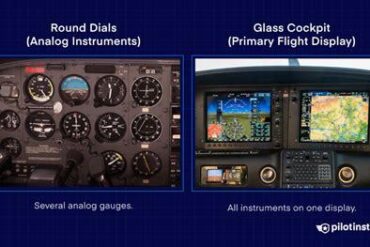
Today, the surviving DC-7s are more than museum exhibits. Their four-bladed propellers, huge radial engines, analog cockpits, and riveted airframes preserve the physical character of a period when crossing America by air meant listening to thousands of horsepower work together for hours at a time. The aircraft may no longer carry scheduled passengers, but its place in aviation history remains remarkably clear: the DC-7 was the last major American piston-engine propeller airliner before the jet age permanently changed the sky.