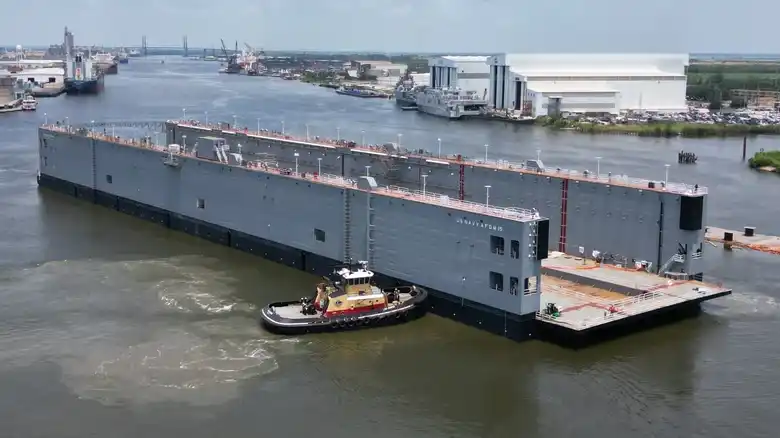
The U.S. Navy’s Auxiliary Floating Dry Dock Medium (AFDM) looks less like a conventional ship than a gigantic steel platform, yet its unusual design gives it one remarkable ability: it can sink beneath warships and then resurface while carrying them. Launched by Austal USA on July 28, 2026, the 694-foot vessel represents a specialized but vital part of naval infrastructure.
Unlike aircraft carriers, destroyers, or submarines, the AFDM is not designed to fight. Its mission is maintenance. By providing a floating repair facility capable of handling some of the Navy’s largest surface combatants, it allows damaged or maintenance-bound ships to return to service without relying exclusively on conventional shore-based dry docks.
A 694-Foot Vessel Designed To Sink
The AFDM is a Rennie-type floating dry dock, distinguished by continuous wing walls and pontoon sections that rise approximately 65 feet from the baseline to the wing deck. It weighs around 12,000 tons and provides an enormous working surface of approximately 90,800 square feet.
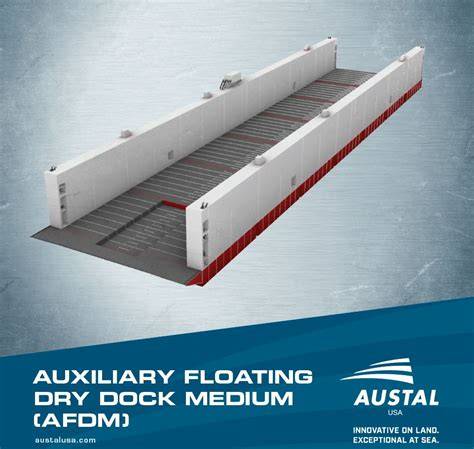
Its most important specification, however, is its 18,000-long-ton lifting capacity. That gives the floating dry dock enough capacity to raise major surface combatants from the water. A modernized Arleigh Burke-class destroyer displaces about 8,558 long tons, while a Ticonderoga-class cruiser weighs roughly 9,600 long tons.
The AFDM therefore has considerable margin beyond the weight of either ship. That capacity is critical because repairs frequently require access to areas normally hidden beneath the waterline, including hulls, propulsion components, shafts, rudders, and underwater fittings.
How The Navy’s Floating Dry Dock Works
The concept is surprisingly straightforward, even though the engineering involved is substantial. The AFDM first positions itself where the ship requiring maintenance can be brought above its submerged docking area. The structure then takes on water, reducing its buoyancy and allowing the dock to submerge beneath the target vessel.
Once the ship is properly positioned and secured, water is pumped out of the dock’s pontoons. As the AFDM becomes more buoyant, it rises toward the surface. The supported warship rises with it until its hull is exposed above the surrounding water.
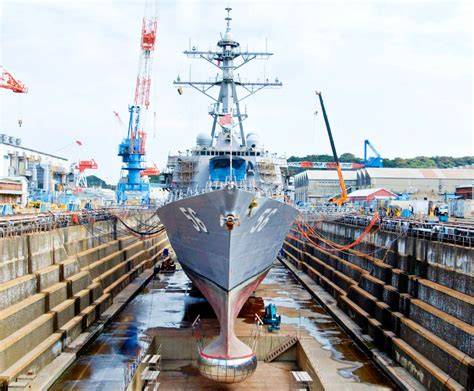
This process effectively transforms a floating structure into a temporary dry dock at sea. It eliminates the need for the entire repair operation to occur inside a permanent coastal facility and gives the Navy greater flexibility when maintaining vessels deployed far from major naval shipyards.
A Technology With More Than a Century Of History
Although the 2026 AFDM may look futuristic, floating dry docks have served the Navy for more than a century. The YFD-2, the first U.S. Navy vessel of this type, entered service in 1902. Another early example was the YFD-1, later associated with the USS Dewey.
The importance of these facilities became especially apparent during World War II. When the United States entered the conflict in 1941, the Navy already operated several floating dry docks. More than 150 additional floating dry docks were constructed during the war to support ships operating in overseas areas.
The YFD-2 itself was among the vessels damaged or sunk during the Japanese attack on Pearl Harbor on December 7, 1941. Remarkably, it was later raised, repaired, and returned to service, demonstrating exactly why mobile repair infrastructure could be so valuable during a major conflict.
Why The AFDM Matters To Modern Naval Operations
Modern warships are enormously complex machines, and keeping them operational requires more than weapons and sophisticated electronics. Maintenance capacity is itself a strategic capability. A destroyer sitting idle because its underwater systems cannot be repaired represents lost operational availability.
The AFDM provides another tool for keeping high-value vessels moving. Its ability to handle destroyers, cruisers, Freedom-variant Littoral Combat Ships, and certain dock landing ships makes it particularly useful for a Navy operating across widely separated theaters.
Unlike conventional ships, the AFDM typically does not propel itself. Tugs move floating dry docks into position, after which the dock performs its specialized lifting mission. That simplicity reflects its purpose: it does not need to cross oceans under its own power because its value comes from bringing a massive repair platform wherever naval maintenance is required.
The 694-foot AFDM may therefore be one of the Navy’s strangest-looking vessels, but its unusual appearance reflects an ingenious purpose. It is essentially a submersible maintenance platform, capable of disappearing beneath a destroyer and then rising with the warship safely supported above the water. In naval warfare, that kind of capability may be less glamorous than missiles or aircraft, but keeping combat ships operational can be just as important.