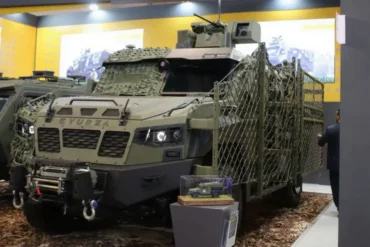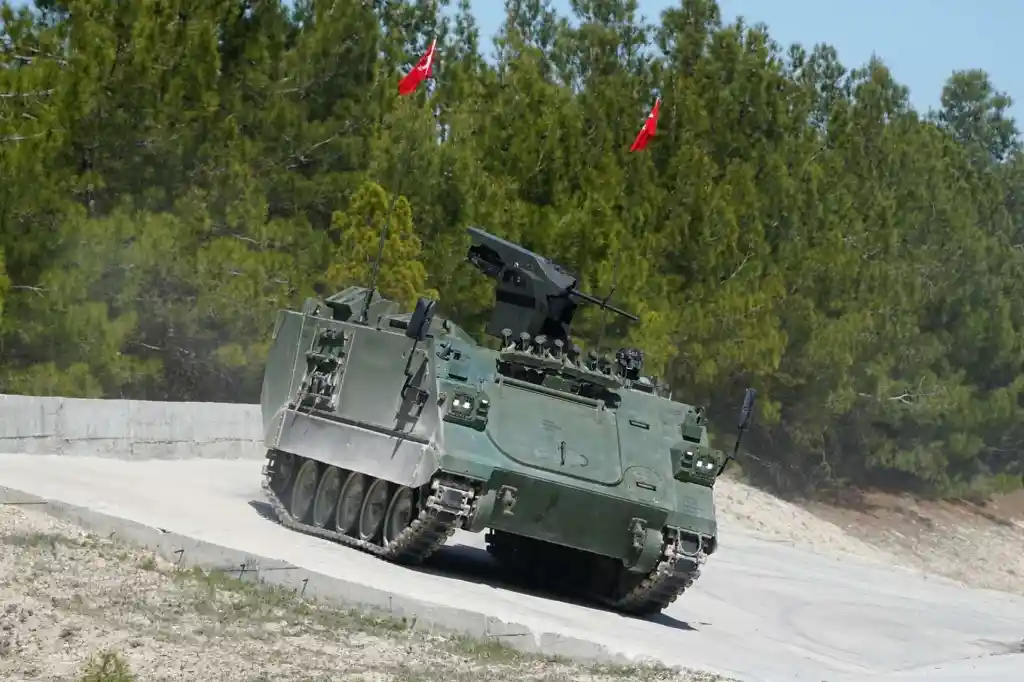
Türkiye’s defense sector is witnessing a groundbreaking shift with the introduction of the E-ZPT Electric Armoured Personnel Carrier (EAPC), a state-of-the-art vehicle designed for low-signature operations. Developed by Makine ve Kimya Endüstrisi A.Ş. (MKE), the E-ZPT promises to redefine how military forces approach battlefield mobility in an era dominated by high-tech surveillance and precision weaponry. The E-ZPT offers a crucial edge by reducing the vehicle’s acoustic and thermal signatures, allowing it to operate more stealthily in increasingly sensor-saturated environments. This move aligns with the Turkish Ministry of National Defense’s ongoing efforts to modernize its M113 series of armoured personnel carriers, ensuring both enhanced battlefield survivability and adaptability in future military engagements.
The Development of the E-ZPT: A New Paradigm for Armoured Mobility
The E-ZPT Electric Armoured Personnel Carrier marks a decisive move towards electrification in military vehicles, focusing on reduced detectability and environmental versatility. Unlike traditional vehicles powered by internal combustion engines, the E-ZPT uses an electric drivetrain, significantly lowering its acoustic and thermal footprints. This leap in technology is crucial in the context of modern warfare, where persistent Intelligence, Surveillance, and Reconnaissance (ISR), thermal imagers, and sensor-to-shooter chains can easily expose conventional vehicles. By using electric traction, the E-ZPT can operate more discreetly, making it less likely to be detected in urban environments, narrow valleys, and wooded terrain.
The strategic relevance of this vehicle is not about its novel branding but rather its ability to diminish the risk of early detection. With lower noise emissions, the E-ZPT can stay undetected by enemy forces for a longer period, even under the scrutiny of handheld thermal imaging devices and advanced airborne sensors. This extra time allows operators to react swiftly, either by repositioning or breaking contact before the vehicle becomes a target for indirect fire or loitering munitions.
Performance and Testing: Proven Reliability Under Harsh Conditions
MKE’s development of the E-ZPT took a pragmatic approach by modernizing the hull of the M113 series. This strategy allowed for faster field deployment while integrating next-generation subsystems. The result is a platform that retains the familiar characteristics of a legacy design while introducing advanced systems capable of enhanced maneuverability, reduced energy consumption, and greater operational flexibility.
The E-ZPT underwent an extensive qualification program from October 2024 to November 2025, totaling 376 consecutive days of testing. These trials encompassed 3,000 kilometers of durability driving, including asphalt, combat-simulating terrain, and stabilized roads. The vehicle was also put to the test in a range of extreme environmental conditions, with temperatures ranging from -32°C to +49°C. This not only demonstrates the reliability of the vehicle in diverse climates but also proves that the electric drivetrain can perform in combat conditions without the usual limitations of temperature or terrain.
One of the most crucial aspects of the E-ZPT’s performance is its electric propulsion system, which combines battery packs with an onboard generator. This hybrid system supports an impressive range of 150 kilometers on battery alone and can be extended up to 650 kilometers when the generator is in use. The integration of the generator while the vehicle is in motion ensures that the E-ZPT can operate effectively across extended patrol routes without the logistical burden of finding stationary charging stations in contested or remote areas.
Enhancing Survivability: Advanced Armor and Armament Systems
In terms of survivability, the E-ZPT is equipped with several advanced features designed to protect the crew and ensure the vehicle’s continued operability under fire. The vehicle incorporates a remote-controlled 12.7mm weapon system for self-defense, and a fire-extinguishing system to mitigate the risks of fire from enemy strikes. Additionally, it includes explosion suppression systems to protect against mines and improvised explosive devices (IEDs)—common threats on modern battlefields. These features enhance the E-ZPT’s survivability, ensuring that the vehicle can continue operating even when faced with enemy fire.
Inside the hull, the vehicle’s electronic systems include GPS/INS navigation, environmental imaging cameras, and a driver camera to improve situational awareness. Furthermore, the inclusion of a heating and cooling system guarantees the comfort and functionality of the crew, allowing them to operate efficiently even under harsh conditions.
The crew’s ability to function in complex environments is enhanced by a vehicle data display and internal intercom systems, facilitating coordination with dismounted infantry, unmanned systems, and command elements. These upgrades are significant because they reflect a shift towards smart vehicles that integrate seamlessly into modern networked military operations.
Tactical Advantage: Stealth and Mobility in Modern Combat
The E-ZPT provides significant tactical advantages, especially in operations that require stealth and quick, reactive movements. With a 0-50 km/h acceleration time of just 8 seconds, the vehicle is capable of rapid deployments and swift repositioning. This speed, combined with its ability to pivot turn around its axis, makes the E-ZPT a formidable force in urban warfare and asymmetric conflict scenarios where quick, unpredictable movements are essential for survival.
In combat, where the safest position is often the one least occupied, the E-ZPT’s short maneuver times can make all the difference. It allows infantry to quickly cross dangerous areas and exploit moments of concealment, minimizing the vehicle’s exposure. Moreover, fast charging capabilities enable the E-ZPT to quickly get back into action, making it a highly effective platform for extended operations in hostile environments.
The electric traction and strong braking system ensure that the E-ZPT can navigate challenging terrains such as steep gradients and trench crossings with ease. This combination of stealthy maneuverability and endurance makes it ideal for a wide range of operations, from covert reconnaissance to troop transport during active combat scenarios.
Future Impact on Military Doctrine and Operations
The introduction of the E-ZPT is not just about technological innovation; it’s about shaping a new military doctrine. The vehicle’s low acoustic and thermal signature allows for a stealthier approach to mechanized infantry operations. This is particularly advantageous in urban warfare, where conventional military vehicles are often at risk of detection and destruction. The E-ZPT’s ability to move silently and operate at night will redefine how infantry units are deployed in such environments, enabling them to infiltrate enemy positions with greater efficiency and less risk.
As electrified vehicles become more common across military forces worldwide, the E-ZPT signals a broader shift in how armed forces think about mobility, signature management, and energy sustainability. The vehicle’s ability to operate in sensor-rich environments will play a crucial role in shaping future battlefield tactics, particularly in situations where detection often precedes destruction. Even small reductions in acoustic and thermal signatures can have a profound effect over multiple engagements, ensuring that troops can conduct operations with a higher degree of safety and efficiency.
The E-ZPT also supports sustainability goals, reducing reliance on traditional fuel-powered vehicles and offering a longer operational lifespan through its innovative electric drivetrain. This reflects an increasing trend within global defense sectors to adopt green technologies that contribute to environmental sustainability while maintaining combat readiness.
Conclusion: Türkiye’s Bold Step Toward the Future of Armoured Warfare
With the deployment of the E-ZPT Electric Armoured Personnel Carrier, Türkiye is not merely adopting new technology—it is revolutionizing how modern military operations are conducted. By focusing on low-signature mobility and advanced electric propulsion, the E-ZPT offers a strategic edge in the evolving landscape of modern warfare. Its integration of state-of-the-art electronics, mobility systems, and survivability features makes it a vital asset for future military engagements, ensuring that Türkiye remains at the forefront of defense innovation. As militaries worldwide look to integrate more electric-powered platforms, the E-ZPT stands as a testament to the potential of electrification in achieving a more stealthy, resilient, and efficient combat force.