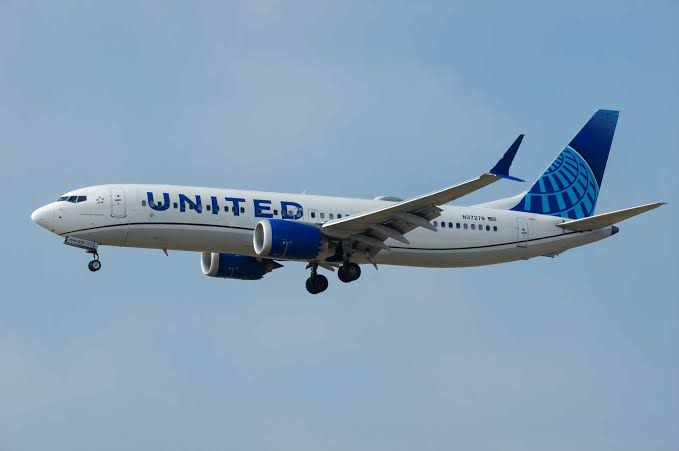
A routine late-night departure from Las Vegas turned into a security emergency when a United Airlines crew member saw a passenger’s text message that appeared to describe hijacking the aircraft. The flight attendant alerted the captain shortly after takeoff, and the cockpit was immediately locked down while the Boeing 737 MAX 8 circled back toward Harry Reid International Airport (LAS). United flight 1681 had been bound for Newark Liberty International Airport (EWR) on Saturday, October 24, carrying passengers who expected a simple overnight transcontinental journey rather than an unscheduled return to the City of Sin.
The aircraft pushed back from Las Vegas at 10:51 PM, eleven minutes behind its scheduled 10:40 PM departure. It climbed toward its cruising altitude without incident, reaching roughly 24,000 feet when the flight attendant noticed the message on the passenger’s phone screen. According to air traffic control audio shared by RobV on X, the crew moved quietly and deliberately: the cockpit door was secured, and the captain began coordinating a precautionary return rather than confronting the passenger directly in the cabin.
What followed was a carefully managed descent rather than a panicked scramble. The pilot informed controllers that the passenger remained completely unaware of what had happened, saying, “The passenger doesn’t know anything is going on. The flight attendant saw him texting that he was going to hijack the aircraft.” That single transmission framed the entire operation: the crew was treating a possible threat as real while avoiding any confrontation that could escalate inside a sealed metal tube at altitude.
Cockpit Lockdown and Squawk 7700 Emergency Declaration
Once the captain absorbed the report, the aircraft declared a general emergency and squawked 7700, the transponder code that signals an urgent situation to controllers and grants the flight priority handling. The jet made a wide U-turn over Oak Grove, Arizona, a ghost town in the desert, before a series of turns lined it up for an approach back into Las Vegas. Flight tracking data shows the plane touched down again at 11:42 PM, roughly fifty minutes after departure.
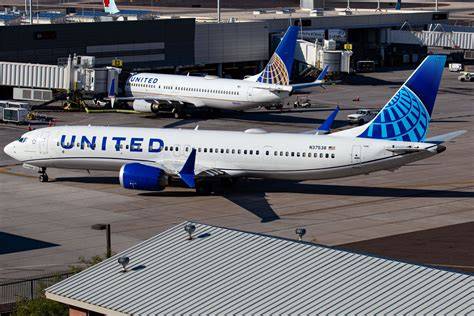
The return carried an unusual technical complication. The 737 MAX 8 had been fueled for a nearly six-hour transcontinental flight, leaving it well above its normal landing weight. The captain reported approximately 24,800 pounds (11,249 kg) of fuel still aboard, producing an overweight landing. Because the 737 cannot dump fuel, the crew flew slower than usual to burn as much as possible and warned controllers that they might need the full length of Runway 26L. The aircraft landed safely on that runway, and law enforcement officers met the jet on arrival.
Law Enforcement Response and the Passenger’s Apparent Unawareness
Officers boarded and spoke with the passenger, who reportedly still had no idea the crew had read the message or that his words had triggered an emergency declaration. He was questioned on the ground while the rest of the cabin disembarked into an airport terminal that had not been expecting them. Concerns about the flight and the potential security threat were referred to United and to the Las Vegas Metropolitan Police Department, while the Federal Aviation Administration opened its own investigation.
The episode raises uncomfortable questions about how quickly a private text message can transform into a federal incident. Crew members are trained to treat credible threats with maximum caution, and the decision to lock the cockpit and return rather than continue eastward reflects that training rather than overreaction. Whether the message was a reckless joke, a misunderstanding, or something more serious remains a matter for investigators, and no charges had been publicly confirmed at the time of reporting.
Aircraft Involved: N17310, a Young 737 MAX 8
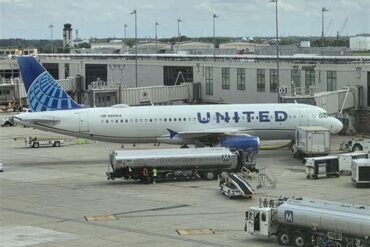
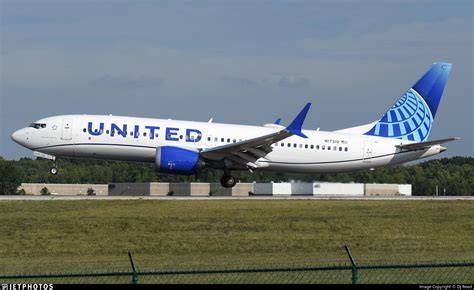
The jet at the center of the incident was N17310, a 737 MAX 8 delivered to United in 2023 and configured in a two-class layout seating up to 166 passengers across Domestic First and United Main Cabin. It first flew on June 20, 2023, joined the Chicago-based carrier on July 20, 2023, and has since operated primarily domestic and short-haul international routes. The airframe, serial number 67566 and line number 8638, is powered by two CFM LEAP-1B engines and carries the hex code A126E6.
Overnight Delay and a Replacement Flight to Newark
The disruption did not end when the wheels stopped. The crew ultimately timed out under duty-hour limits, forcing United to cancel the remainder of the original service and stage a replacement departure. That flight left Las Vegas at 7:03 AM on Sunday and reached Newark more than eight hours late, leaving travelers to reshuffle ground transportation, hotel plans, and connections on a weekend morning.
For United, the incident adds another entry to a year of high-profile cabin disruptions, and for passengers it is a reminder that aviation security depends heavily on the vigilance of frontline crew. A single glance at a lit phone screen at 24,000 feet was enough to redirect a widebody-capable narrowbody, burn thousands of pounds of fuel, trigger an emergency transponder code, and delay more than a hundred travelers by most of a day. The investigation now turns to what the passenger actually intended and whether his message crossed the line from idle words into a federal offense.