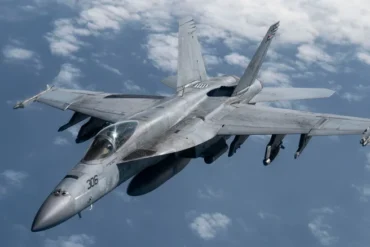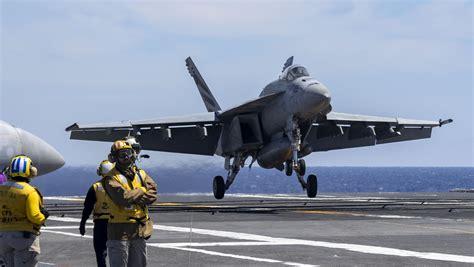
The United States Navy has quietly initiated one of the most consequential transformations in modern military aviation training. For decades, earning the coveted “Wings of Gold” demanded a defining moment: a successful arrested landing on an aircraft carrier in a training jet. That ritual—equal parts technical trial and symbolic rite—has now been fundamentally rewritten. Today, aspiring naval aviators destined for strike fighters will not experience their first carrier landing until they are already strapped into a frontline combat aircraft like the F/A-18 Super Hornet or the F-35C Lightning II.
This shift is not cosmetic. It reflects a deeper recalibration of how the Navy balances tradition, technology, and operational urgency. At its core lies a simple question: in an era of advanced automation and rising global tensions, what skills matter most—and when should they be learned?
The answer, increasingly, is shaped by software as much as by stick-and-rudder skill.
A Break from Decades of Carrier Landing Tradition
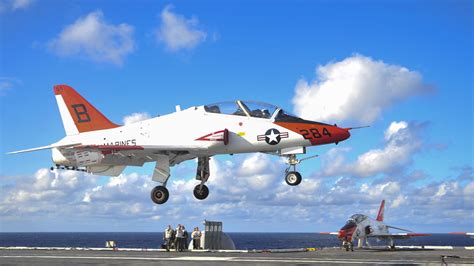
For generations, the path to becoming a carrier-qualified aviator followed a near-sacred sequence. Student pilots trained extensively in the T-45 Goshawk, a nimble jet specifically designed to prepare them for the unforgiving environment of carrier aviation. Before earning their wings, they were required to complete a series of arrested landings—“traps”—on a moving aircraft carrier, often in challenging sea conditions.
This wasn’t just a test of technical ability. It was a crucible that defined naval aviation culture. Landing on a carrier demanded precision, nerve, and instinct, with little margin for error. The deck is short, constantly moving, and surrounded by open ocean—a setting that leaves no room for hesitation.
Now, that defining moment has been removed from the early stages of training. Instead, student pilots complete Field Carrier Landing Practice (FCLP) on land-based runways that simulate carrier conditions. Only later, during advanced training with operational squadrons, do they face the real deck for the first time.
The implications are profound. What was once the final परीक्षा before earning wings is now a milestone delayed until much later in a pilot’s journey.
The Technology Driving the Shift: Precision Landing Mode
The catalyst behind this transformation is a powerful piece of software known as Precision Landing Mode (PLM)—often nicknamed “Magic Carpet.” Integrated into modern naval aircraft, PLM fundamentally changes how pilots approach carrier landings.
Traditionally, pilots relied on a method called “flying the ball,” manually adjusting their glide slope using visual cues from the carrier’s optical landing system. It was an art form honed through repetition and experience. PLM, however, automates much of this process. It stabilizes the aircraft’s approach, allowing pilots to focus on maintaining alignment rather than constantly correcting for pitch and power.
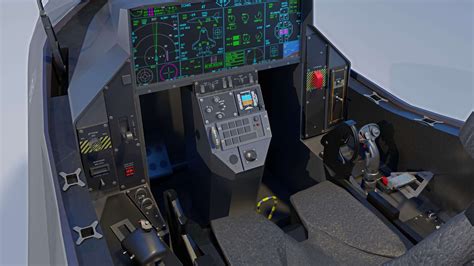
The result is a landing process that is more consistent, more predictable, and statistically safer. From the Navy’s perspective, this makes early carrier qualification in a simpler trainer aircraft increasingly redundant. If operational jets rely on automation to land, then training should reflect that reality from the outset.
This is not merely an upgrade—it is a philosophical shift. The Navy is betting that mastery of advanced systems is more critical than prolonged exposure to legacy manual techniques.
From Training Jet to Frontline Fighter: A High-Stakes First Landing
Under the new system, the first time a pilot “catches the wire” at sea occurs in a multi-million-dollar combat aircraft. This dramatically raises the stakes of that initial experience.
The Fleet Replacement Squadron (FRS)—once focused on transitioning pilots to specific aircraft—now carries the additional burden of carrier qualification. This effectively transforms the FRS into a gateway where technical mastery, psychological resilience, and operational readiness converge.
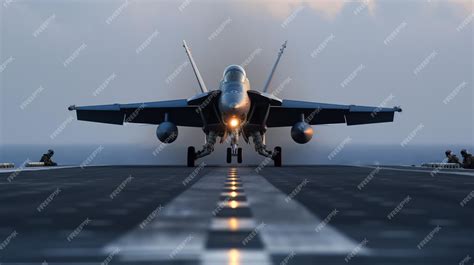
Landing a T-45 is one thing. Landing an F/A-18 or F-35C, with its complex avionics, higher performance envelope, and mission systems, is another entirely. Pilots must manage not just the approach, but also the intricacies of a modern combat cockpit.
Yet early results suggest the gamble is paying off. Reports indicate that carrier qualification failure rates have dropped significantly, from around 18% to approximately 4.5% in F/A-18 training units. That is not a marginal improvement—it is a dramatic increase in training efficiency.
Still, the question lingers: does improved success rate equate to deeper competence?
Efficiency vs. Airmanship: The Debate Intensifies
Critics of the new approach argue that something essential may be lost in the transition. Carrier aviation has always been about more than successful landings—it is about developing instinctive control under pressure, especially when systems fail.
Automation, while powerful, is not infallible. In combat scenarios, aircraft may suffer damage, electronic interference, or system degradation. In those moments, a pilot’s ability to revert to manual flying skills becomes critical.
The concern is not hypothetical. It is rooted in decades of operational experience. Removing early exposure to the raw challenge of carrier landings could, some argue, create pilots who are highly proficient with systems—but less prepared for edge-case scenarios where those systems are unavailable.
At the same time, proponents counter that modern warfare demands a different skill set. Today’s pilots must process vast amounts of data, manage sensor fusion, and operate within complex networked environments. Training time is finite, and priorities must evolve.
In this light, the shift is less about abandoning tradition and more about reallocating cognitive bandwidth.
Impact on Aircraft, Logistics, and Fleet Readiness
Beyond pilot development, the policy change carries significant operational consequences. Using frontline fighters for initial carrier qualifications increases wear and tear on high-value aircraft. The F/A-18 and F-35C are far more expensive to operate than the aging T-45, both in terms of maintenance and lifecycle costs.
At the same time, the Navy must allocate more carrier deck time to FRS units. Aircraft carriers are among the most strategically valuable assets in the military, and their schedules are tightly managed. Every hour spent on training is an hour not spent on deployment.
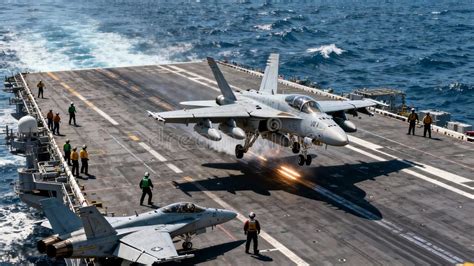
Yet the benefits are difficult to ignore. By eliminating the bottleneck of carrier availability during early training, the Navy can accelerate the pipeline, producing qualified pilots more quickly. In an era defined by near-peer competition and global commitments, speed matters.
This is not simply a training adjustment—it is a response to strategic pressure.
The Future of Training: Undergraduate Jet Training System
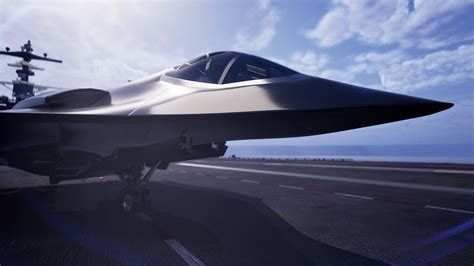
The retirement of the T-45 Goshawk is another key factor shaping this transition. The Navy is developing a new Undergraduate Jet Training System (UJTS) designed to better prepare pilots for fifth-generation aircraft. However, this new platform will not be carrier-capable.
That decision reinforces the long-term direction of training: carrier qualification will remain absent from early stages, regardless of the aircraft used. Instead, simulators and land-based training will carry more weight, while real carrier experience is deferred to later phases.
Simulators, in particular, are becoming increasingly sophisticated. They can replicate carrier environments, weather conditions, and emergency scenarios with remarkable fidelity. This allows pilots to rehearse complex situations repeatedly—something that is impractical and costly in real aircraft.
The result is a training ecosystem that is more scalable, more flexible, and more aligned with modern aviation technology.
Why Some Pilots Still Train the Old Way
Not all naval aviators are part of this new paradigm. Pilots assigned to aircraft like the E-2D Advanced Hawkeye—which lacks Precision Landing Mode—must still complete traditional carrier qualifications early in their training.
These aircraft rely more heavily on manual control during landing, making early exposure essential. Similarly, international pilots training with the U.S. Navy often follow different requirements based on their home countries’ operational doctrines.
This creates a dual-track system within naval aviation. Some pilots are shaped by the new, technology-driven approach, while others continue to experience the traditional path.
The coexistence of these systems highlights an important truth: there is no one-size-fits-all model for pilot training.
The Cultural Weight of the “Wings of Gold”
Beyond logistics and technology, the change touches something deeply symbolic. For over 80 years, earning the Wings of Gold after a successful carrier landing represented the ultimate validation of a naval aviator’s skill.
It was a moment of transformation—a transition from student to professional, marked by the ability to conquer one of aviation’s most demanding challenges.
By awarding wings before a pilot ever lands on a carrier, the Navy is redefining what that symbol represents. Critics argue this risks diluting its meaning, turning a hard-earned milestone into a procedural checkpoint.
Supporters, however, see it differently. They view the wings not as a marker of a single achievement, but as a recognition of readiness to begin operational training. In this interpretation, the true test has simply moved further down the timeline.
A Navy Shaped by Urgency and Innovation
Ultimately, this transformation reflects the broader evolution of the U.S. Navy itself. Faced with increasing global competition, rapid technological change, and operational demands, the service is prioritizing efficiency, adaptability, and readiness.
Carrier aviation remains one of its most powerful tools—but the way pilots are prepared to operate from those carriers is changing.
The move to delay first carrier landings until pilots are in F/A-18s and F-35Cs is not without risk. It challenges long-held assumptions about how skills are developed and tested. Yet it also aligns training with the realities of modern aircraft and modern warfare.
What emerges is a new kind of naval aviator: one who is deeply integrated with advanced systems, trained in a streamlined pipeline, and introduced to the carrier environment at a moment when the stakes—and the expectations—are significantly higher.
Whether this model proves superior in the long run will depend on how well it balances technology with fundamental airmanship. For now, it marks a decisive step into the future—one where the first trap is no longer a beginning, but a defining escalation in a pilot’s journey.