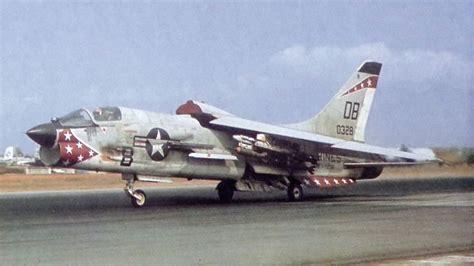
The Vought F-8 Crusader stands as one of the most iconic fighter aircraft ever to fly for the United States Navy. Originally designated as the F8U, it was a supersonic, carrier-based air superiority fighter that embodied the technological innovations of its time. Entering service in 1957, the Crusader was the last American fighter to rely primarily on guns for its offensive capabilities, marking it as a significant departure from the missile-dominated fighters that would come later. With its rugged design, advanced features, and critical role in major conflicts like the Vietnam War, the F-8 Crusader remains a symbol of the U.S. Navy’s commitment to air superiority during the Cold War era.
The Evolution of the F-8 Crusader
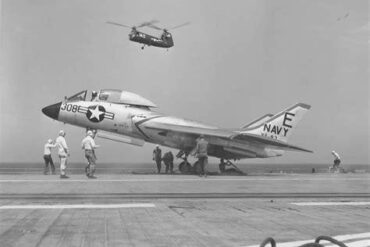
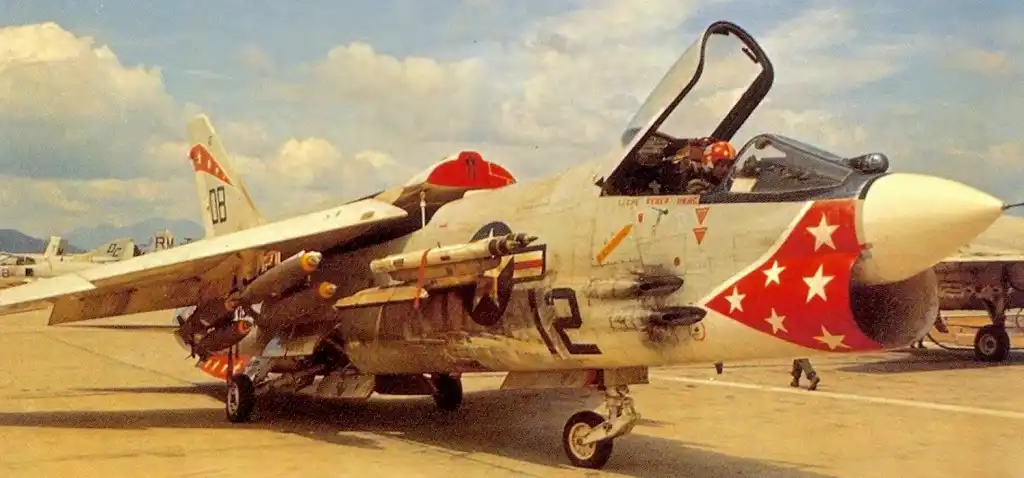
The Vought F-8 Crusader was born out of a need for a versatile, high-performance fighter capable of combat air patrols and interceptions from aircraft carriers. Its design was groundbreaking, incorporating features that would influence future military aircraft for decades. The variable-incidence wing allowed for greater maneuverability at different speeds, improving its performance during takeoffs and landings, particularly on the confined spaces of aircraft carriers. This was a crucial enhancement since it made the F-8 more effective at carrier operations than many of its contemporaries.
The Crusader’s area-ruled fuselage, a design borrowed from the research into transonic flow, reduced drag at supersonic speeds, improving fuel efficiency and maximizing performance. Another innovative feature was the extensive use of titanium, a lightweight yet strong material, which helped reduce the overall weight of the aircraft without compromising strength. This made the F-8 a highly agile platform, with the ability to carry out a variety of roles, from dogfighting to reconnaissance missions.
Design and Performance
The F-8 Crusader’s performance was one of its most impressive aspects. Powered by a Pratt & Whitney J57 turbojet engine, the aircraft was capable of reaching speeds up to 1,200 mph (Mach 1.8), allowing it to outrun most enemy fighters of its era. Its twin-engine configuration and lightweight airframe gave it superior maneuverability, which was especially crucial during dogfights. Armed with a mix of four 20mm M39 cannon and sidewinder missiles, the Crusader was well-suited for both close combat and long-range engagements, giving it a unique versatility on the battlefield.
The aircraft’s variable-incidence wing allowed it to adjust the angle of attack, improving takeoff and landing performance while maintaining high speed during flight. This design choice made the F-8 particularly suited for operations from aircraft carriers, where the ability to land in short distances was critical. The F-8’s control surfaces, including its leading-edge slats and flaps, were engineered to allow exceptional low-speed performance and high maneuverability during combat scenarios.
The F-8 Crusader in the Vietnam War
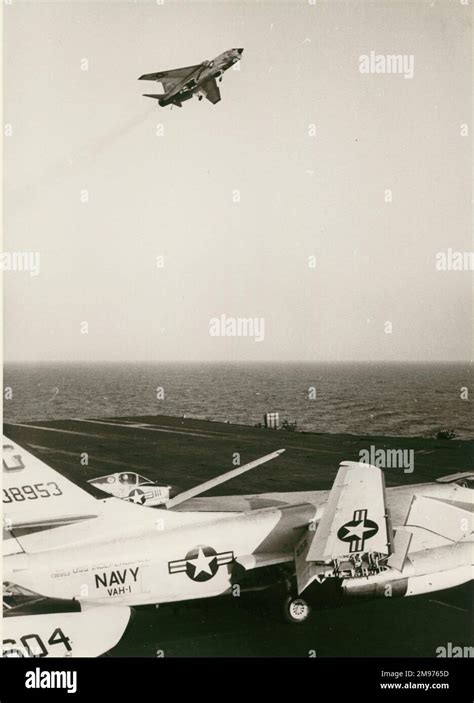
The Vietnam War was a defining period for the F-8 Crusader, where it earned a distinguished reputation. The aircraft played a crucial role in air superiority missions, performing dogfights with enemy aircraft, including the MiG-17. Though it was primarily designed as a fighter, the F-8 also performed reconnaissance duties during the war, flying photo-reconnaissance missions that provided critical intelligence for military operations.
One of the standout features of the Crusader during the Vietnam War was its high kill ratio. It was credited with shooting down more enemy aircraft than any other Navy fighter during the conflict, solidifying its place as a formidable fighter jet. The F-8’s sophisticated avionics and advanced radar systems gave pilots an edge in air combat situations, allowing them to lock onto targets at longer ranges than most other jets at the time.
Despite its impressive combat record, the F-8 also suffered from a relatively high mishap rate. This was largely due to its demanding flight characteristics, which required pilots to be highly skilled and well-trained. The Crusader’s short-range and complex flight controls sometimes led to difficulties in achieving safe landings on carrier decks, particularly in high-stress environments like combat zones. However, this did not diminish its effectiveness in the skies, as its air-to-air capabilities were unparalleled during its years of service.
Variants and Modifications
Over its service life, the F-8 Crusader was produced in several different variants, each tailored for specific missions or improvements in performance. The most widely used version was the F-8E, which incorporated better avionics and a more powerful engine, allowing it to operate in a wider range of combat situations.
The F-8H was a later version that incorporated upgrades to both the airframe and systems, including improved weaponry and navigation capabilities. Additionally, the RF-8 variant was developed as a photo-reconnaissance aircraft, equipped with specialized cameras and sensors to gather intelligence from behind enemy lines. This reconnaissance role proved invaluable, particularly during the Cuban Missile Crisis, where the F-8 Crusader played a pivotal role in intelligence gathering.
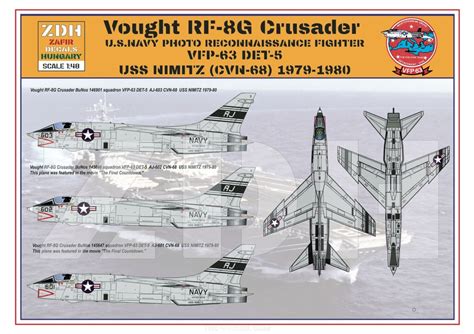
The French Navy was one of the primary international users of the F-8, operating it in a variety of roles until the year 2000. The aircraft was also used briefly by the Philippine Air Force, demonstrating the Crusader’s adaptability in a wide range of environments.
Legacy and Retirement
The F-8 Crusader was retired from U.S. Navy service in 1976, after nearly two decades of service. The F-4 Phantom II gradually replaced it, marking the end of an era for the carrier-based fighter jets. Despite being retired from active combat roles, the Crusader’s legacy continued in reconnaissance missions with the RF-8 variants, which were in service until 1987.
The Crusader’s impressive combat record and advanced design elements left a lasting impact on naval aviation. Its retirement marked the end of an era in which aircraft relied heavily on guns and manual dogfighting tactics, with newer jets favoring missiles and automated systems. However, the F-8’s role in air combat and reconnaissance missions during the Cold War remains a significant chapter in the history of military aviation.
Conclusion
The Vought F-8 Crusader was a true product of its time, a supersonic fighter that combined innovative design features with unmatched combat effectiveness. Its legacy lives on in the history of naval aviation, with its role in the Vietnam War, reconnaissance missions, and carrier operations solidifying its place as one of the most revered fighter jets ever built. Despite its relatively short operational history, the Crusader proved itself to be a formidable aircraft, one that would inspire future generations of fighter jets and continue to influence military aviation strategies for years to come.