Japan’s Shinkansen bullet trains are renowned not only for their incredible speed and legendary punctuality, but also for their engineering brilliance in overcoming the unique geographical and environmental challenges of the island nation. One of the lesser-known yet essential innovations of the Shinkansen is its trackside water jet system, a cutting-edge technology that plays a pivotal role in winter operations. These jets are not a spectacle or part of an elaborate cleaning ritual — they are a life-saving, train-preserving measure grounded in necessity and precision engineering.
The Harsh Reality of Japan’s Mountainous Railways
Japan’s topography is anything but forgiving. With heavily mountainous terrain, narrow corridors for infrastructure, and regions prone to heavy snowfall, maintaining uninterrupted high-speed rail service poses enormous technical challenges. Unlike the broad, flat plains of some countries, Japan’s terrain has demanded inventive adaptations from the very beginning of Shinkansen operations in the 1960s.
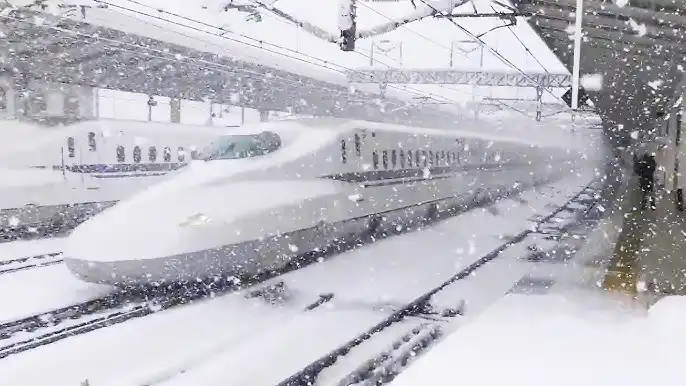
Snowy regions like Niigata, Yamagata, and parts of Hokkaido receive meters of snow each winter, and yet, Shinkansen trains must barrel through these areas at up to 200 mph (320 km/h) without delay. Weather-related disruptions, particularly due to snow and ice, could compromise safety, damage infrastructure, and halt operations. The introduction of water jets was a direct response to these climatic hurdles.
How the Water Jets Work: Not a Car Wash, But a Critical Safety System
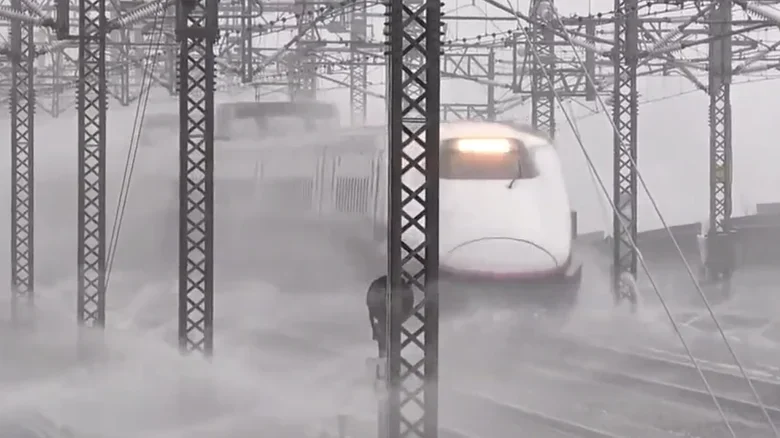
The water jets you see spraying Shinkansen trains are strategically placed along sections of the track, particularly where snow accumulation is most severe. As a train speeds past, the jets activate and spray water directly at the undercarriage and lower sides of the train.
The primary objective of this system is to prevent the formation and accumulation of ice caused by loose snow swirling up from the tracks. The aerodynamic profile of high-speed trains creates strong air turbulence underneath the cars, pulling snow into hard-to-reach mechanical components. When this snow refreezes, it forms hard ice blocks that can later dislodge at high speeds, potentially damaging the train body, trackside equipment, or even nearby infrastructure.
The water jets melt or remove the snow before it can freeze solid. This is critical not only for safety but for maintaining the integrity of the train’s undercarriage, braking systems, and wheels.
De-Icing on Rails: Similarities to Airplane Safety Procedures
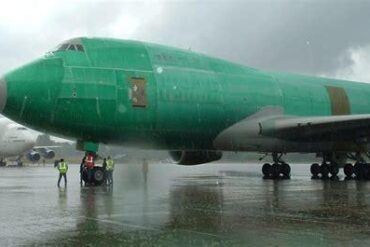
The concept behind the Shinkansen’s water jets closely parallels airplane de-icing techniques. Aircraft are sprayed with glycol-based fluids before takeoff to prevent ice buildup on wings and sensors. Though the execution differs, the Shinkansen’s goal is the same — ensure uninterrupted mechanical performance and passenger safety in freezing conditions.
Just like air travel, the rail system cannot afford to gamble with unpredictable snow accumulation. The consequences of ice dislodging from a train at full speed can be severe. Flying chunks of ice have the potential to crack windows, dent panels, and in worst-case scenarios, derail operations. Thus, proactive prevention via water jets is far more effective than dealing with damage after the fact.
Evolution of the System: Smarter Nozzles, Smarter Rail
Since their inception, the water spraying systems have seen considerable technological upgrades. Modern nozzles are now engineered for precision, able to target specific components under the train where ice is most likely to form. Some of the most advanced setups also employ temperature and motion sensors to regulate when and how the jets activate, ensuring water is used efficiently and only when necessary.
Additionally, spray intensity and angle are carefully calibrated based on local climate data and train speed. This level of precision ensures that snow and ice are neutralized without wasting resources or affecting track integrity.
Beyond water jets, Shinkansen stations in snow-prone regions deploy under-platform pressure washers, which blast residual snow and ice from stopped trains. This adds another layer of winterization, especially for long-haul services that accumulate ice between origin and destination.
Not Just Technology — An Operational Triumph
The success of the water jet system is not purely technological but also logistical. Coordinating thousands of trains, across thousands of kilometers, through unpredictable winter storms, is a feat of operational excellence. The real-time responsiveness of Japan’s rail operators ensures that water jets, snowplows, and ground crews are all deployed as needed.
Despite the reliance on snow management technology, it’s worth noting that even the Shinkansen is not immune to extreme weather. In the most severe snowfalls, services may be delayed or even suspended. However, such instances are remarkably rare compared to other rail systems globally. The mitigation strategies — with water jets at the forefront — ensure delays are minimal and passengers remain safe.
Shinkansen’s Water Jets: A Symbol of Engineering Precision
Far from being a mere curiosity, the water jets used on Shinkansen bullet trains exemplify the intersection of cutting-edge engineering and real-world necessity. They highlight how Japan’s railway system remains ahead of the curve, not just in speed or design, but in its ability to adapt and innovate under pressure.
This small but critical technology reflects the broader philosophy that governs Japan’s rail system — an unwavering commitment to punctuality, safety, and seamless travel, even when nature stands in the way. The water jets may seem subtle, but their role is enormous. As the world watches and emulates Japan’s approach to high-speed rail, the icy truth is clear: sometimes, the most powerful innovations are the ones you never notice at all.